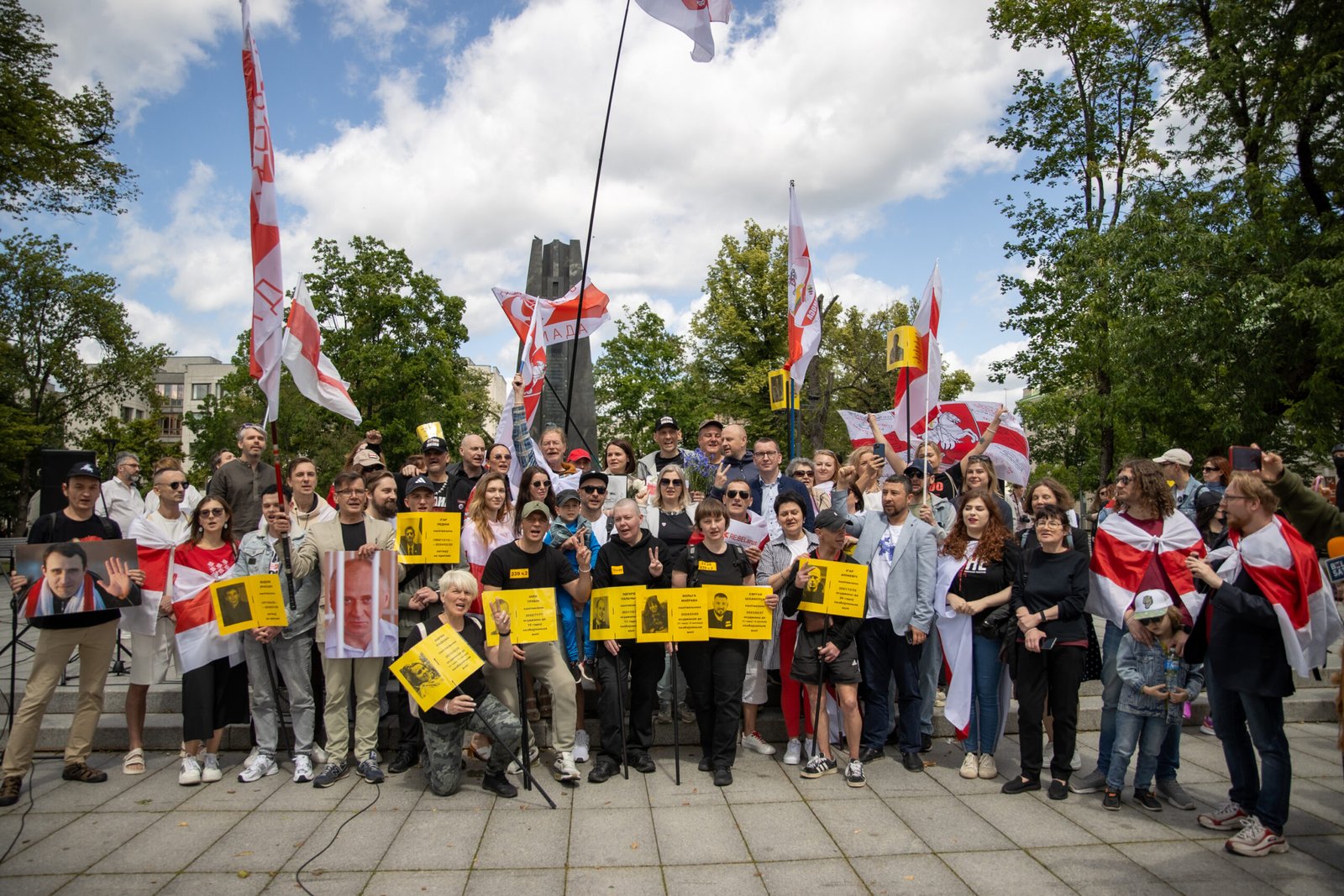




In 2025, Sviatlana Tsikhanouskaya’s Office and the Democratic Belarus Missions worked across several key areas: the release of political prisoners and support for those repressed; non-recognition of the 2025 sham election; legal and international legal accountability mechanisms; security and strategy; support for Belarusians inside the country and in exile; assistance to youth and women; cultural diplomacy; and international advocacy.
1. Release of political prisoners and support for the repressed
The main outcome of the year was the release of more than 200 political prisoners, achieved through the diplomacy of the US administration, with advocacy from the democratic forces and civil society of Belarus.
Additionally, in 2025:
- Luxembourg, Latvia, and Norway contributed around €530,000 to the International Humanitarian Fund to support and rehabilitate those repressed.
- The Second Congress on Political Prisoners in Belarus (#WithoutJustCause) was held; international coordination with Ukrainian and European partners continued, as did work on individual cases related to obtaining asylum (international protection).
2. Campaign for the international non-recognition of the sham election
The democratic forces carried out a coordinated campaign to highlight the fraudulent nature of the so-called presidential election held on January 26 and to ensure it was not recognized by the international community.
Key outcomes:
- The regime failed to legitimize itself through the electoral imitation.
- The number of states that did not recognize the results was twice as high as the number that congratulated Lukashenka.
- The democratic forces preserved their international political legitimacy.
3. Justice and human rights – systemic legal solutions
In 2025, the groundwork was prepared and adopted for a future just transformation:
- The Lustration Concept for Belarus was presented.
- The Concept for the Establishment of the Institute of National Remembrance of Belarus was prepared (presentation planned for 2026).
- Policy papers were developed on international accountability of the Lukashenka regime and on removing Belarusians from Interpol red notices.
- Side events on the human rights situation in Belarus were held at the UN.
The Legal Department of Sviatlana Tsikhanouskaya’s Office in 2025:
- launched an international campaign to prevent the persecution of Belarusians via Interpol;
- established migration working groups in the United States, Poland, Georgia, Armenia, and other countries;
- coordinated assistance to deported and repressed Belarusians.
As a result of sustained efforts, the following individuals, among others, were released and received protection: Artur Senko (USA), Anatoli Bakun, Kanstantsin Siarohin, and Andrei Hniot (jointly with the National Anti-Crisis Management and human rights groups).
4. Strategy, security, and analysis
The Red Paper became the flagship analytical publication of 2025, offering a comprehensive framework for the security of Belarus within the European context. Across three editions, the document analyzed six dimensions of Belarus’ security and formulated practical recommendations – ranging from military and political security to social and information security. The work was carried out in partnership with three international organizations and involved dozens of authors and editors.
In 2025, Sviatlana Tsikhanouskaya’s Office also organized official side events at key international venues:
- Side event at the NATO Summit in The Hague, “Zapad 2025 and Beyond: Understanding the Eastern Threat and NATO’s Response”.
- International conference in Brussels, “Belarus: A Part of or Apart from Europe’s Security?”, in partnership with the NATO Public Diplomacy Division.
5. Youth and the future
2025 marked an important milestone for the youth policy of the democratic forces:
- The youth dimension was for the first time systematically integrated into strategic documents and international advocacy.
- Around 250 Belarusian master’s students received support through European programs.
- More than €850,000 was allocated to the education of Belarusian youth.
- Belarusian youth were engaged in the work of the Council of Europe, international internships, and professional networks.
6. Women’s leadership
The Office of Belarus Democratic Forces in Prague became one of the key platforms for advancing women’s leadership. Together with partners in 2025, it:
- held the Women’s Political Leadership Academy;
- organized the event “Her Story, Our Future: Belarusian Women Making a Difference”;
- strengthened European partnerships.
7. Cultural diplomacy
From Freedom Day and the anniversary of the Battle of Orsha to guided tours for diplomats and cooperation with European cultural networks, Belarus in 2025 was presented as a European nation with a deep history and a contemporary voice.
Through cultural diplomacy and cultural events and projects, we keep Belarus visible internationally, strengthen partnerships, and support Belarusian identity.
8. International advocacy and representation
In 2025, Belarus was represented at key international platforms, including the UNGA, the Munich Security Conference, and the World Economic Forum. For the first time, Belarus had a full-fledged delegation at the Three Seas Summit and the EuroNest Parliamentary Assembly.
The Belarusian Democratic Community Center was launched in Florence; representatives were appointed to Madrid and Kyiv. Parliamentary groups were renewed in Germany and Norway.
Over the year, Sviatlana Tsikhanouskaya and her team made 68 visits and held around 300 high-level meetings.
9. Direct engagement with Belarusians
In 2025, 2,778 appeals were received from more than 38 countries. Of these, about 982 came from Belarus or concerned the future of Belarus and the challenges currently facing the country.
Dozens of meetings with the Belarusian diaspora took place in various countries. In addition, Sviatlana Tsikhanouskaya held 10 sessions of personal meetings with Belarusians, attended by more than 45 people (from 12 countries, excluding Belarus), with around 110 registrations received.