



BELARUS UPDATE
June-July 2026
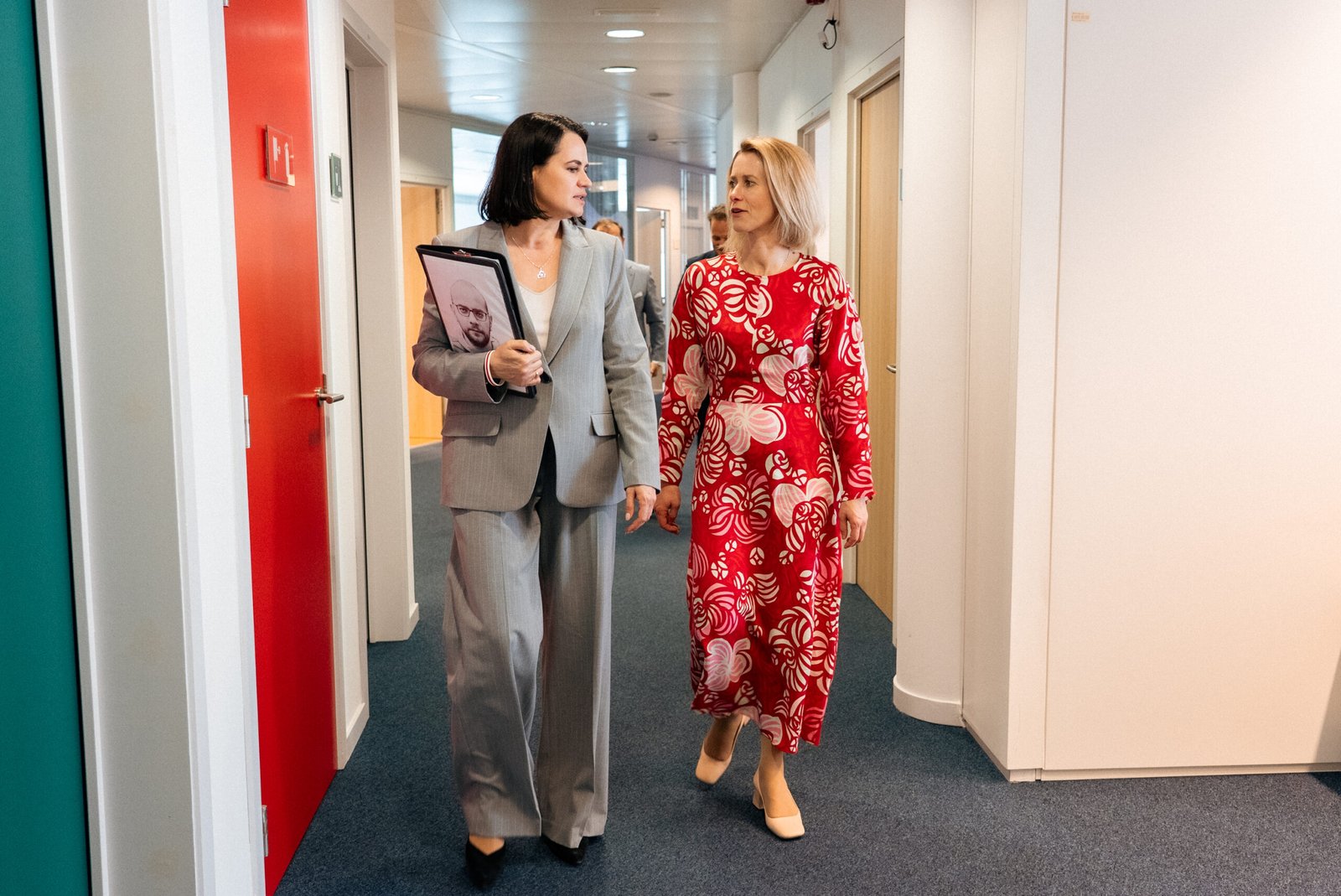
Recent developments in Ukraine have created a new dynamic for Belarus. Under pressure from Kyiv, Lukashenka has been forced to soften his rhetoric. The Belarusian democratic forces have launched a campaign to prevent Belarus from being dragged deeper into the war. The EU considers new sanctions against Minsk, while the United States has pledged further releases of Belarusian political prisoners. Sviatlana Tsikhanouskaya met with the Prime Ministers of the United Kingdom, President of the Czech Republic, EU High Representative Kaja Kallas, and took part in the Ukraine Recovery Conference in Gdansk.
WHAT’S GOING ON?
Ukraine pressures Minsk. June marked a new phase in Ukraine’s approach to Belarus, following Sviatlana Tsikhanouskaya’s May visit to Kyiv and meeting with President Zelenskyy. On June 19, Kyiv gave Lukashenka seven days to disable Russian relay stations used to guide drones striking Ukraine, warning that Kyiv would consider them legitimate military targets. Within days, the transmitters stopped operating, although it remains unclear whether they were disabled by Minsk or Kyiv. Ukraine also warned Minsk of severe consequences if Belarus entered the war, while highlighting the regime’s military and fuel support for Russia. The tougher rhetoric increased pressure on Lukashenka, forcing him to publicly insist that Belarus would stay out of the war. The episode showed that pressure works, exposing both the regime’s vulnerability and its dependence on the Kremlin—and raising further questions about how much sovereignty Belarus still has.
Economic situation and public opinion. Fuel shortages following Ukraine’s strikes prompted thousands of Russians to travel to Belarus as “fuel tourists,” contributing to higher fuel prices. Concerns about an economic downturn are growing, as Belarus’s economy remains heavily dependent on Russia’s. Many Belarusians also fear mobilization and being drawn directly into the war. According to multiple surveys, the majority of Belarusians oppose the war and believe Belarus should stay out of it. Meanwhile, the regime continues to support Russia’s war effort by supplying military equipment and fuel. Two incidents involving Belarusian buses allegedly attacked in Russia appear to have been Russian provocations aimed at fueling anti-Ukrainian sentiment among Belarusians.
Threat of escalation. Belarusian and Russian propaganda continues anti-Ukrainian and anti-Western messaging. There are signs that Belarus is preparing for a broader escalation involving its territory, though direct participation of the Belarusian army remains unlikely. Military exercises continued throughout May and June; 6 Russian drones were detected in Belarusian airspace between 15 and 21 June 2026. Russian military infrastructure development also persists. Ukraine had to bolster its Northern defences. Preventing Belarus from entering the war remains the top priority of the Belarusian democratic forces, alongside strengthening anti-war sentiment. BELPOL also released a video featuring Belarusian citizens captured by Ukraine while fighting for Russia, aiming to discourage Belarusians from joining the Russian military. Sviatlana Tsikhanouskaya convened an informal Security Council, bringing together representatives of the United Transitional Cabinet, the Office, the Coordination Council, BELPOL, iSANS, and other partners to discuss possible scenarios and contingency plans in the event of mobilization or escalation.
Political prisoners and ongoing repression. In June, U.S. Special Envoy John Coale, responding publicly to Sviatlana Tsikhanouskaya, reaffirmed continued U.S. commitment to secure the release of political prisoners and called for an end to politically motivated prosecutions. Yet repression has not eased: some prisoners released through U.S.-facilitated efforts have since faced new criminal cases in absentia, while their families remain under pressure. At the UN Human Rights Council, Tsikhanouskaya and Belarusian human rights defenders warned that repression has become less visible but no less severe. In June, security services targeted people linked to the European Humanities University, reportedly threatening students’ relatives with prosecution unless they withdrew. UN Special Rapporteur Nils Muižnieks stated that Belarus likely has more political prisoners per capita than any other country.
INTERNATIONAL WORK
In June, Sviatlana Tsikhanouskaya and the Belarusian democratic forces visited the United Kingdom, the Czech Republic, and Brussels; participated in events organized by the Council of Europe and PACE; and convened a meeting of parliamentarians in support of a democratic Belarus.
Ukraine Recovery Conference. Sviatlana Tsikhanouskaya participated in the Ukraine Recovery Conference in Gdańsk, where she presented the democratic forces’ vision for Belarus’s role in regional security and Ukraine’s reconstruction. She met with European leaders and former Polish President Lech Wałęsa, stressing that Belarusians will help rebuild Ukraine after the war—and that a free Belarus will also need reconstruction after decades of dictatorship.
Kosciuszko Conference In Gdansk. On June 2, the Kościuszko Forum organized by the Polish MFA and the European Center of Solidarity, was held in Gdańsk, bringing together Belarusian democratic forces and diplomats, the European Commission, the Council of Europe, and leading figures from Belarusian culture and media. The discussion focused on how to strengthen Belarusian national identity as a key tool for resisting the “Russian world” and Russification.
United Kingdom. On June 2–4, Sviatlana Tsikhanouskaya visited London, where she met Prime Minister Keir Starmer, Minister for Europe Stephen Doughty, and members of Parliament. She addressed the International Alliance of Parliamentary Groups “For a Democratic Belarus”, spoke at Chatham House and University College London, and presented the Concept for Constitutional Court Reform of a future democratic Belarus. The talks focused on support for political prisoners, accountability for the Lukashenka regime, sanctions, and strengthening UK–Belarus cooperation.
Czech Republic. On June 10–11, Tsikhanouskaya visited Prague, where she met President Petr Pavel, Foreign Minister Petr Macinka, Senate Speaker Miloš Vystrčil, and Prague Mayor Bohuslav Svoboda. Discussions focused on support for democratic Belarus, European security, political prisoners, and cooperation with Czech institutions. She also met the Belarusian community and visited exhibitions by Belarusian artists.
EU. On June 16–18, Tsikhanouskaya visited Brussels, where she met EU High Representative Kaja Kallas and European Economic and Social Committee President Séamus Boland. She addressed the European Economic and Social Committee (EESC), stressing the importance of maintaining the strategic approach: isolate the dictatorship while supporting the Belarusian people, including independent media, human rights defenders, cultural initiatives, and the labour movement. Her meetings focused on sustaining EU support for Belarusian civil society, independent media, political prisoners, and keeping Belarus high on the European agenda.
Council of Europe. On June 23, the Contact Group between the Belarusian democratic forces and the Council of Europe held its regular meeting in Strasbourg. Representatives of the Belarusian democratic forces, civil society, and the Council of Europe discussed future joint projects. A Belarusian delegation, represented by the Coordination Council, took part in the PACE session, as well as in the session of the Congress of Local and Regional Authorities.
OSCE. During the summer session of the OSCE PA on July 4-8, the informal friendship group “For a Democratic Belarus” was created with almost 20 states represented. On July 7, the OSCE PA adopted a resolution on Belarus. At the same time, a guest-status delegation of the Belarusian democratic forces attended the OSCE PA session counterbalancing the Lukashenka’s one.
Poland. In June, Tsikhanouskaya made several visits to Poland. In Kraków, she delivered a lecture at the Kraków University of Economics and met former President Andrzej Duda. In Warsaw, she spoke at the College of Europe in Natolin. She also received the International King Eric of Pomerania Award in Darłowo in recognition of her contribution to democracy.
Lithuania. On June 12, Foreign Minister Kęstutis Budrys visited Sviatlana Tsikhanouskaya’s Office in Vilnius to meet 35 Belarusian organizations in Lithuania, who presented their work in Lithuania and shared the key challenges facing Belarusians today.
France and Germany. In June, Diplomatic Advisor Dzianis Kuchynski visited Paris, where he held meetings at the French Presidential Administration, the Ministry for Europe and Foreign Affairs, and the National Assembly. Kuchynski also visited Berlin, where he met with representatives of the Federal Chancellery and the Foreign Office. The discussions focused on maintaining a firm policy toward the Lukashenka regime and avoiding any sanctions relief until systemic change takes place in Belarus.
Ireland and Italy. Sviatlana Tsikhanouskaya’s Office facilitated meetings between Belarusian civil society organizations and representatives of the governments of Ireland and Italy to discuss continued support for independent media, NGOs, humanitarian assistance, and democratic initiatives.
Ecumenical Patriarchate. In June, Tsikhanouskaya addressed Ecumenical Patriarch Bartholomew, thanking him for supporting Belarusian Orthodox believers in exile and the Belarusian Orthodox parish in Vilnius. The letter of Sviatlana Tsikhanouskaya highlighted the importance of preserving Belarusian spiritual and cultural identity for hundreds of thousands of Belarusians forced to leave the country.
INSIDE THE MOVEMENT
Coordination Council. June marked the beginning of the full work of the newly elected 4th convocation of the Coordination Council following the May elections. The Council held its first plenary session, during which members approved the committee structure and re-elected Artsiom Brukhan as Speaker.
Accountability for the regime’s crimes. The Office of Sviatlana Tsikhanouskaya published the Concept for Accountability for Repression in Belarus, outlining how crimes committed after 2020 could be investigated and prosecuted in a future democratic Belarus. The paper proposes preserving evidence, protecting victims’ rights, and establishing a hybrid tribunal combining Belarusian jurisdiction with international expertise.
Preparing for a Post-Lukashenka Belarus. Belarusian democratic forces have published new draft laws on the Prastora.info platform. The latest proposals cover key state institutions, including the presidency, government, the judiciary, local self-government, anti-corruption, public administration, and transitional justice, providing a legislative framework for democratic reforms after political change.
Security Meeting. Sviatlana Tsikhanouskaya convened a closed informal Security Council, bringing together representatives of the United Transitional Cabinet, the Office, the Coordination Council, BELPOL, iSANS, and other partners to discuss possible scenarios and contingency plans in the event of mobilization or escalation, as well as cooperation with Ukraine.
Sanctions. Sviatlana Tsikhanouskaya’s deputy, Pavel Latushka, submitted to Kyiv additional evidence of the Lukashenka regime’s involvement in Russia’s war against Ukraine. BELPOL provided an updated list of companies and institutions supporting the Russian war effort for sanctions consideration. Belarusian human rights defenders also updated documentation on political prisoners and evidence of transnational repression.
Belarusian culture in exile. Tsikhanouskaya visited the Depatriation exhibition at the Free Belarus Museum in Warsaw and an exhibition of Belarusian artists at Prague’s Rudolfinum Gallery. Both projects highlighted the importance of preserving the memory of the 2020 protests, Belarusian identity, and artistic freedom despite repression and exile. Sviatlana Tsikhanouskaya also took part in the Belarusian culture festival “Varushniak”, which brought together hundreds of Belarusians in Warsaw.
Mission of Democratic Belarus in Ukraine. Following its official opening in Kyiv at the end of May, the Mission began practical work in June. Its representatives met with Ukrainian officials and experts to address issues affecting Belarusians in Ukraine, including frozen bank accounts. At the same time, intensive work is underway to develop joint Ukrainian-Belarusian projects and establish a coordination group to resolve the legal and humanitarian issues facing Belarusians in Ukraine.
POLITICAL POSITIONS
- Belarus being dragged into the war. Belarus must not become a co-aggressor. We demand the withdrawal of Russian troops and nuclear weapons from Belarus, an end to the use of Belarusian territory for aggression, and guarantees that the Belarusian army will not be deployed in the war. Preventing Belarus’s direct involvement remains our top security priority. The only effective way to achieve this is by raising the political, military, and economic costs of any attempt to drag Belarus into the war.
- Ukraine’s pressure on Minsk. Ukraine’s firm response has shown that deterrence works. Pressure should remain focused on the Lukashenka regime and Russian military infrastructure in Belarus while avoiding harm to Belarusian society. We support continued coordination between Ukraine and the Belarusian democratic forces to reduce Russia’s military presence in Belarus and prevent new attacks from Belarusian territory.
- U.S. efforts to release political prisoners. We welcome U.S.-led humanitarian efforts for the release of political prisoners. At the same time, we believe that prisoner releases must be accompanied by an end to repression, an amnesty, and the closure of politically motivated criminal cases. We know that the United States keeps these objectives in mind in its engagement with Minsk
4. Ukraine’s strikes on Russia. Ukraine’s successful strikes weaken Russia’s military capabilities and its ability to sustain the Lukashenka regime. A weaker Kremlin means fewer resources to finance repression and maintain military control over Belarus. The international community should use this moment to increase pressure on both Moscow and Minsk while expanding support for Belarusian democratic forces and civil society.
5. Lukashenka’s visits to China, Indonesia, Myanmar, and Russia. These visits are an attempt to break international isolation and seek political legitimacy and economic support from authoritarian partners. However, they are unlikely to bring significant benefits. Trade with Indonesia remains limited, cooperation with Myanmar is largely confined to the military sector, and China’s primary interest is a secure transit corridor through Belarus—something Lukashenka cannot reliably guarantee. The visits neither represent the Belarusian people nor reduce the regime’s dependence on the Kremlin.
WHAT’S NEXT
On July 14-15, Sviatlana Tsikhanouskaya is visiting the U.S. to address the Aspen Security Forum.
On July 16-19, Sviatlana Tsikhanouskaya will join Belarusians at the Tutaka fest – Festival of the Awakened – which gathers hundreds every year celebrating Belarusian culture, identity, language and art near the Poland-Belarus border.
On August 8-9 in Warsaw, Belarusian democratic forces are hosting the New Belarus Conference, the movement’s main annual political gathering. The anniversary will also be marked as the International Day of Solidarity with Belarus. The conference will include new political appointments, set strategic priorities for the coming year, and coordinate the next phase of the democratic movement. To register, please visit the link.