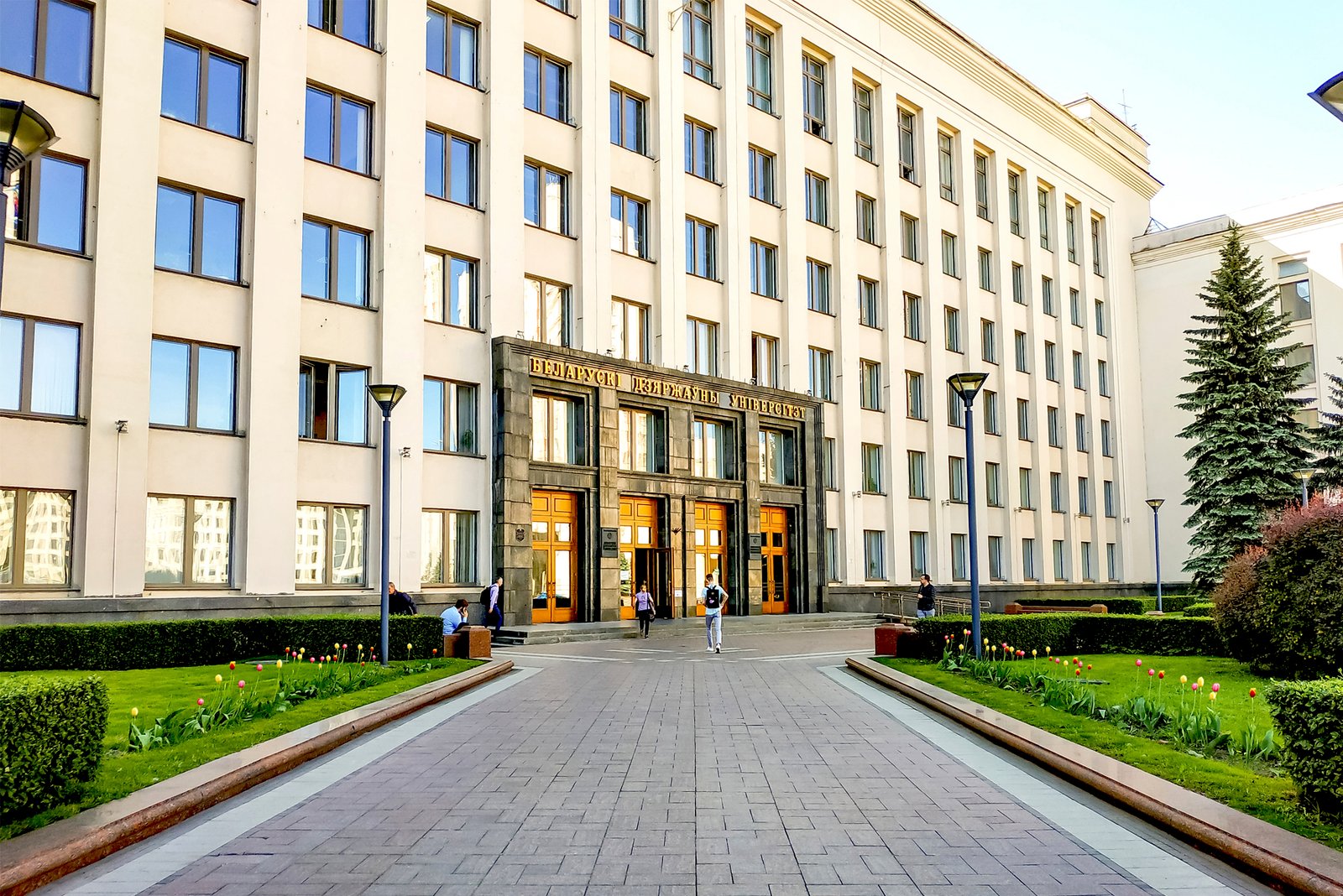




June 2026 was marked by a further escalation of pressure on Belarus’s academic community, the continued militarization of school education, and new attempts to isolate Belarusian applicants from international education. At the same time, outside Belarus, work continued on the concept for reforming the country’s education system, international academic cooperation expanded, and expert discussions took place on the future of Belarusian science, culture, and universities in exile.
Sviatlana Tsikhanouskaya’s Advisor on Education and Science, Pavel Tereshkovich, has prepared a detailed review of developments both inside and outside Belarus.
Developments in Belarus
Continued repression of the academic community
In June, a wave of searches swept across Belarus following the designation of the European Humanities University (EHU) as an “extremist organization”. In the first half of the month alone, at least 60 searches were carried out, targeting EHU graduates, current students, and their relatives. In several cases, parents were threatened with criminal prosecution unless their children withdrew from EHU within ten days. One known case involved criminal charges being initiated over tuition payments made as far back as 2016.
Aliaksandr Parkhomenka, a vocational training teacher at Secondary School No. 6 in Mazyr, was convicted by the Homiel Regional Court in June for “facilitating extremist activity”. The exact sentence has not been disclosed, but according to human rights defenders, he was sentenced either to restricted freedom in an open-type facility or imprisonment.
On similar charges, the Minsk City Court convicted Daniil Brykun, a student at the Faculty of Computer Systems and Networks of the Belarusian State University of Informatics and Radioelectronics. He received a sentence of restricted freedom served at his place of residence,
Individuals convicted of “facilitating extremism” are permanently barred from working in education.
Militarization of children’s summer holidays
Militaristic rhetoric continues to play a central role in the country’s summer children’s recreation campaign. This year’s campaign is held under the slogan “Seize the Moment – Let Summer Bring a Hundred Victories”. Officials emphasise that its main priority is “civic and patriotic education”, including ceremonial flag-raising events, performances of the national anthem, and screenings of themed films.
From June 10 to 16, the national finals of the children’s military-patriotic games Zarnichki, Zarnitsa, and Arlyonok were held at a military training ground in Brest. These military-style competitions target schoolchildren of all age groups. The scale of participation, including the integration of all competitions into a single nationwide program, significantly exceeds the level of youth militarization seen even during the late Soviet period.
Campaign to discourage studying abroad
In June, the regime launched a campaign titled “Five Reasons to Say ‘No’ to a Foreign University”. The first claimed that “several foreign educational institutions and foundations have officially been recognised as extremist organizations, meaning that their diplomas will become a ‘black mark’ in Belarus and returning home will become a major problem”. Other arguments included claims that graduates supposedly have “virtually no chance of finding decent employment” and that they spend years working as waiters, couriers, or carers simply to secure residence permits abroad.
Meeting of education ministers of the Shanghai Cooperation Organization member states
The 10th Meeting of Education Ministers of the Shanghai Cooperation Organization (SCO) member states took place in Minsk on June 16–17. Ministers and delegations from India, Iran, Kazakhstan, China, Kyrgyzstan, Pakistan, Russia, Tajikistan, and Uzbekistan participated. The meeting concluded with the signing of a protocol outlining cooperation priorities for 2027–2029. Participants also presented the Minsk Initiative, which proposes establishing a scientific and educational consortium bringing together SCO universities and high-tech corporations. The transformation of the SCO Network University was also discussed.
Such meetings are generally ceremonial in nature, while more substantive cooperation tends to develop through bilateral partnerships.
International cooperation in education
In June 2026, Education Minister Andrei Ivanets held a series of meetings with international partners, including the Vice Minister of Education of North Korea, Ri Chang Sik; the Deputy Minister of Science and Education of Azerbaijan, Firudin Gurbanov; and the Ambassador of China to Belarus, Zhang Wenchuan.
The very limited information released about the meeting with the North Korean delegation indirectly suggests that the authorities in Belarus prefer not to draw excessive attention to the development of ties with Pyongyang. At the same time, China is increasingly becoming Belarus’s principal international partner in education and science. This is reflected in Chinese investment in educational projects — including biotechnology, foundry engineering, and additive manufacturing programs — a threefold increase in the number of Chinese students studying in Belarus, and the expansion of the network of Confucius Institutes in Belarus to six.
Developments abroad
Seminar on the education reform project for Belarus
The first seminar within the project “Belarus Forum: Educational Reforms for a Democratic Belarus” took place on June 11–14 in Krzyżowa, near Wrocław, Poland. The seminar — and the project as a whole — was organised by the German Society for East European Studies (DGO e.V.) in partnership with the Krzyżowa Foundation for Mutual Understanding in Europe. The project’s goal is to develop proposals for reforming Belarus’ education system, drawing on the experiences of Poland and Germany. Participants included Belarusian experts, university lecturers, school teachers, civil society activists, and invited education researchers from Poland. Together, they discussed a broad range of issues, including the de-ideologization of school education, personnel policy and lustration, academic freedom and university autonomy, internationalization, and the future of Belarusian education in exile.
Conference “Culture Captive to the Past”
The interdisciplinary academic conference “Culture Captive to the Past” was held on June 11–13 at the Ivan Lutskievich Belarusian Museum in Vilnius. The event was supported by Scholars for Belarus by akno e.V. More than 40 researchers specialising in history, ethnology, sociology, heritage studies, literary studies, and art history took part. Discussions focused on the role of cultural canons in Belarusian culture, history, and heritage, as well as their reinterpretation and transformation.
Raman Skirmunt Forum
The 4th Belarusian–Polish Expert Forum named after Roman Skirmunt took place in Warsaw on June 18–19. The public program featured presentations of several research projects, including a study monitoring the influence of the “Russian World” ideology and Russian soft-power institutions in Belarus, a public opinion survey comparing attitudes towards Belarusians in Poland, Lithuania, Latvia, and Ukraine, and an analysis of possible scenarios for Belarus following a potential peace settlement in Ukraine.
Presentation of Hanna Engelking’s monograph
The Belarusian-language edition of Polish researcher Hanna Engelking’s monograph “Collective Farmers: An Anthropological Study of the Identity of Belarusian Village Residents at the Turn of the Twentieth and Twenty-First Centuries” was presented in Warsaw on June 18 as part of the public program of the 4th Belarusian–Polish Expert Forum named after Raman Skirmunt. The book is a major scholarly work based on extensive field research conducted in Belarusian villages between 1993 and 2011. It examines how the Soviet experience of collectivization, atheization, repression, and war shaped a distinct mentality and identity that continues to influence Belarusian society today.
Conference “Beyond Displacement: The Future of Universities and Scholars in Exile”
The conference “Beyond Displacement: The Future of Universities and Scholars in Exile” took place in Vienna on June 8–10. It was organised by the Central Project Management Agency (CPVA), EU4Belarus, and the Central European University. Participants focused on safeguarding academic freedom in the face of authoritarianism, strengthening the resilience and mission of universities in exile, and exploring innovative models of teaching, research, and civic engagement under conditions of forced displacement. Belarusian scholars presented research on history, historical memory, religion, identity, culture, and resistance. The conference program also included workshops on publishing in international academic journals, preparing grant proposals, and building academic careers.