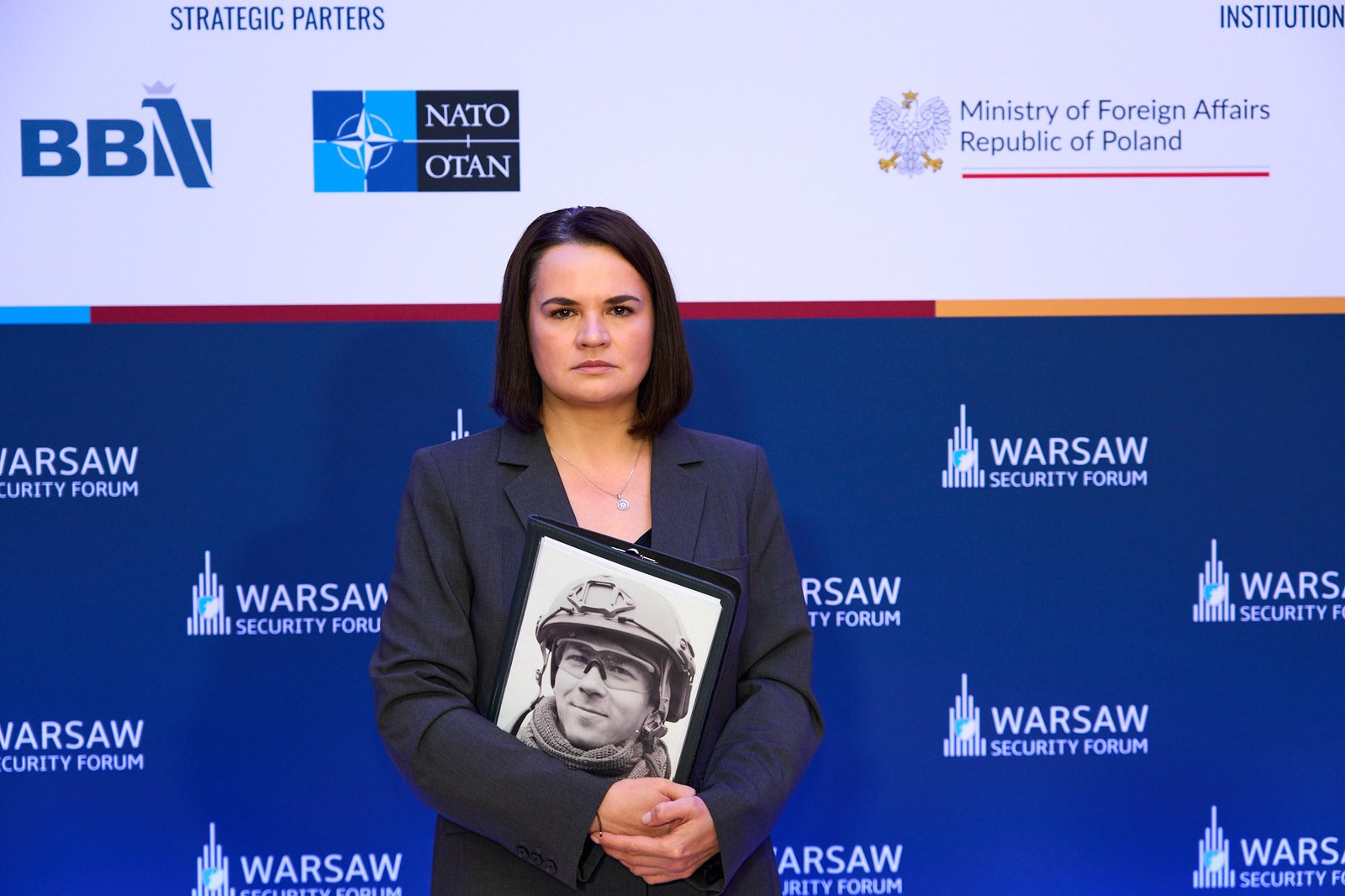




“Dear Excellencies, dear friends,
First of all, I want to thank BELPOL and the German Marshall Fund for organizing this discussion and bringing together such distinguished experts.
Belarus shows perfectly how democracy and security are connected.
In 2020, Belarus was seen primarily as a human rights and democracy issue. But after Russia’s full-scale invasion of Ukraine in 2022, it became clear that Belarus is also a major European security issue.
Russian troops invaded Ukraine from Belarusian territory. Our country became a launchpad for aggression.
I often think about how different history might have been if the Belarusian democratic uprising had succeeded in 2020.
Perhaps we could not have prevented Russia’s war. But we could have prevented Belarus from being used to attack Ukraine. And perhaps many lives could have been saved.
Belarus became an accomplice in Russia’s war not because of the will of the Belarusian people, but because of Lukashenka.
He traded Belarusian sovereignty for Putin’s support, which allowed him to stay in power after losing the 2020 election.
And we should not portray Lukashenka as a victim of Moscow.
It was his conscious choice.
As a result, nine million Belarusians have become hostages of the regime, while our country’s independence is being systematically undermined.
And what we see today gives us no reason to believe that Moscow and Minsk are preparing for peace.
Quite the opposite.
They are expanding military infrastructure, deepening military cooperation, and increasing Russia’s military presence in Belarus.
This is exactly what today’s BELPOL report reveals.
I want to thank the BELPOL team for their extraordinary work. They have brought together valuable evidence of how Lukashenka’s regime is militarizing Belarus and supporting Russia’s war machine.
The report shows the scale of Belarus’s involvement, despite Lukashenka’s attempts to hide it or deny responsibility.
Russian troops, military facilities, training grounds, infrastructure connected to nuclear weapons, and Oreshnik missiles.
Infrastructure reportedly used to support Russian drone operations against Ukraine.
Supplies of military equipment, components, and diesel fuel to Russia. Hybrid operations against European countries. And efforts to recruit Belarusian citizens into Russia’s war.
None of this would be possible without Lukashenka’s cooperation.
Lukashenka is not a guarantor of Belarusian sovereignty. He is one of the main threats to it.
This report is important because it gives policymakers, journalists, and security experts a clearer picture of what is happening.
But evidence alone is not enough. We need action.
First, we must raise the cost of further militarization. Sanctions against the regime and its military-industrial sector must remain in place and be properly enforced. We must close loopholes that allow Russia to use Belarus to bypass restrictions.
Second, we need accountability. Those who help Russia wage this war must face consequences. Evidence collected by BELPOL, Isans, United Transitional Cabinet, should be examined and used by the relevant authorities.
Third, we must support Belarusian society.
The Belarusian people oppose this war. In 2020, we voted for change. Despite years of repression, many continue to support Ukraine.
We must clearly distinguish between the regime and the people.
Lukashenka is Putin’s accomplice. But the Belarusian people are our allies in building a safer Europe.
Dear friends,
I am glad that this year we have made important progress in our relations with Ukraine and President Zelenskyy.
Ukraine has strengthened cooperation with Belarusian democratic forces. We have opened our mission in Kyiv, and our contacts are becoming more systematic.
Alongside Warsaw and Vilnius, Kyiv is becoming another important center for our movement.
For Ukraine, it is clear: as long as Belarus remains under Lukashenka and dependent on Russia, it will continue to pose a security threat.
But a free and democratic Belarus can become a reliable neighbor and a strong partner of Ukraine.
I believe closer cooperation between Ukraine and Belarusian democratic forces can create new opportunities for change in our country.
And we must be prepared for different scenarios.
If Ukraine succeeds, it can create new opportunities for Belarus.
If there is a ceasefire, the question of Russian troops, weapons, and military infrastructure in Belarus will remain unresolved.
And if Russia escalates, Belarus could once again be used as a platform for aggression.
In every scenario, Belarus will be in the center of attention.
This is why I ask all the experts and partners in this room to help us bring Belarus back to the European security agenda.
Use this report. Discuss its findings in your capitals. Bring them to governments, parliaments, and security institutions.
We need a clear strategy towards Belarus. If a new window of opportunity opens, we must be ready to help free Belarus from Russia’s grip and Lukashenka’s dictatorship.
Thank you”.