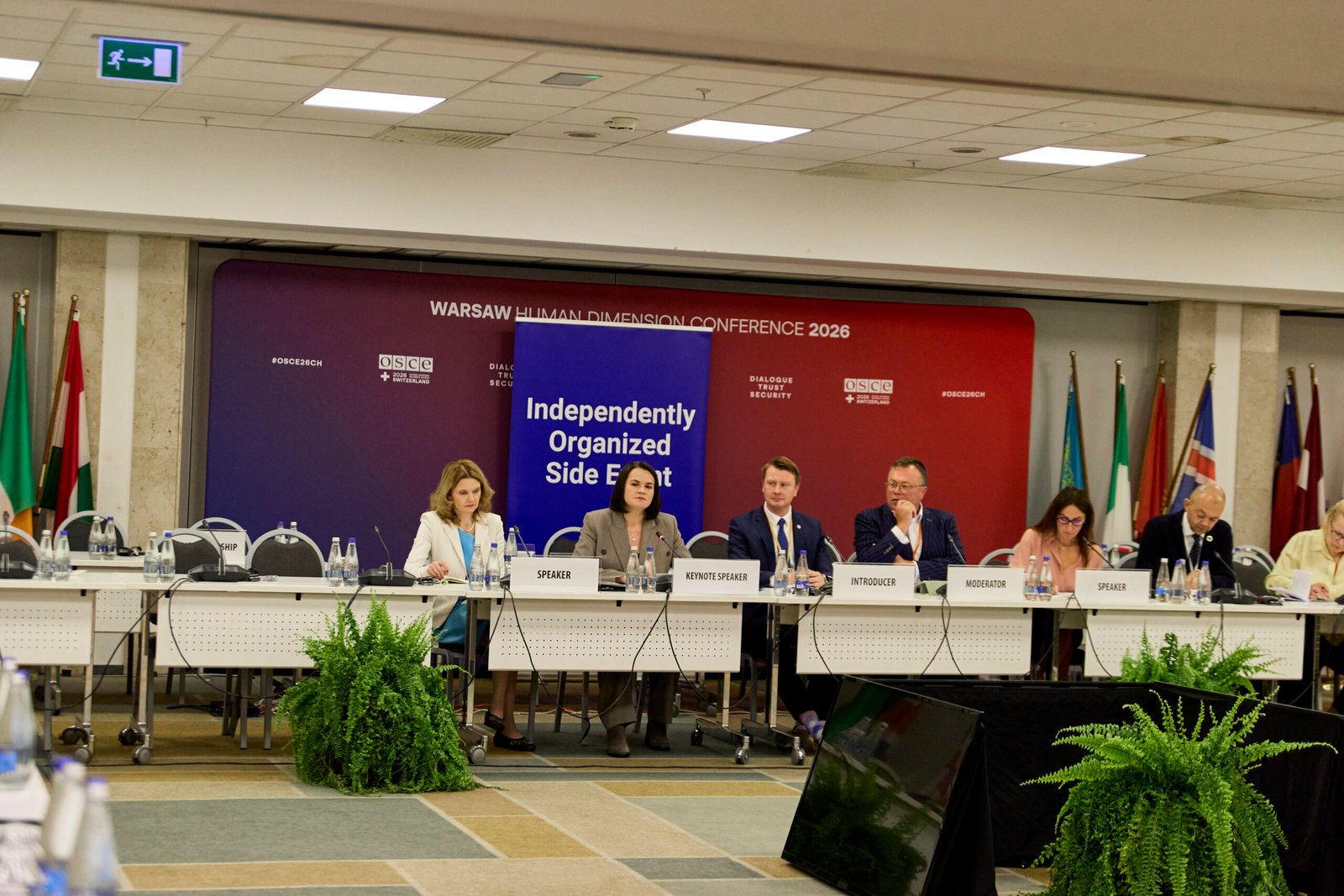




On October 6, Sviatlana Tsikhanouskaya delivered a keynote speech in Warsaw at the event “Transnational Repression in the OSCE Region”. The discussion was held as part of the OSCE Warsaw Human Dimension Conference and focused on the persecution of journalists, activists, and others who continue to face threats after leaving their countries.
The event was organized by the Nordic and Baltic countries — Denmark, Estonia, Finland, Iceland, Latvia, Lithuania, Norway, and Sweden — in cooperation with the Office of the OSCE Representative on Freedom of the Media.
Ms. Tsikhanouskaya stressed that for hundreds of thousands of Belarusians, leaving the country did not mean an end to repression. The regime continues to target people through threats against their relatives, trials in absentia, property confiscation, passport cancellations, cyberattacks, and international wanted-person mechanisms.
“You can flee Belarus — but the KGB can still persecute your parents, confiscate your apartment, and sentence you in absentia to 15 years in prison”, she noted.
Documents and legal status for Belarusians
Sviatlana Tsikhanouskaya paid particular attention to Belarusians who cannot safely return home to obtain a new passport. She called on states to issue them travel documents and alien passports, provide secure and stable legal status, and, where necessary, recognize expired Belarusian passports.
“No journalist, activist, or former political prisoner should be left without legal status simply because Lukashenka refuses to renew their passport”, she stressed.
She also recalled the cases of people who were forcibly deported from Belarus without documents after being released from prison. In her view, release should be accompanied by the restoration of rights and the ability to decide independently where to live.
Protection from extradition to Belarus and pressure on relatives
Sviatlana Tsikhanouskaya called for greater scrutiny of requests from the Lukashenka regime for international wanted notices and extradition. She cited the cases of Vasily Verameichyk, who was extradited from Vietnam to Belarus, and filmmaker Andrei Hnіot, who faced the threat of extradition from Serbia.
According to Ms. Tsikhanouskaya, in 2026 alone, the democratic forces and their partners have so far helped prevent the extradition or forced return to Belarus of at least 15 people.
She stressed that persecution affects not only well-known politicians: if a student, activist, or member of the diaspora participates in a solidarity rally abroad, it can become grounds for pressure on their family in Belarus.
Support for independent media and accountability for repression
Sviatlana Tsikhanouskaya called on the OSCE and governments to protect journalists in exile and help independent media outlets counter hacking, phishing, and disinformation campaigns.
“When we protect Belarusian journalists in Warsaw or Vilnius, we are also protecting the right of people in Belarus to receive independent information”, she stressed.
Her other proposals included systematic documentation of transnational repression, information-sharing and early-warning mechanisms between states, targeted sanctions and investigations against those responsible for persecution, and bringing the issue to the UN level.
Ms. Tsikhanouskaya thanked Poland and Lithuania for their assistance to Belarusians and partner countries for supporting the International Humanitarian Fund, which has raised more than €3.3 million for political prisoners to support their rehabilitation, medical treatment, psychological support, and rebuilding lives after repression.
She called for efforts to stop new political arrests, persecution of families, and repression across borders, stressing that support for Belarusians and independent civil society is an investment in European security.