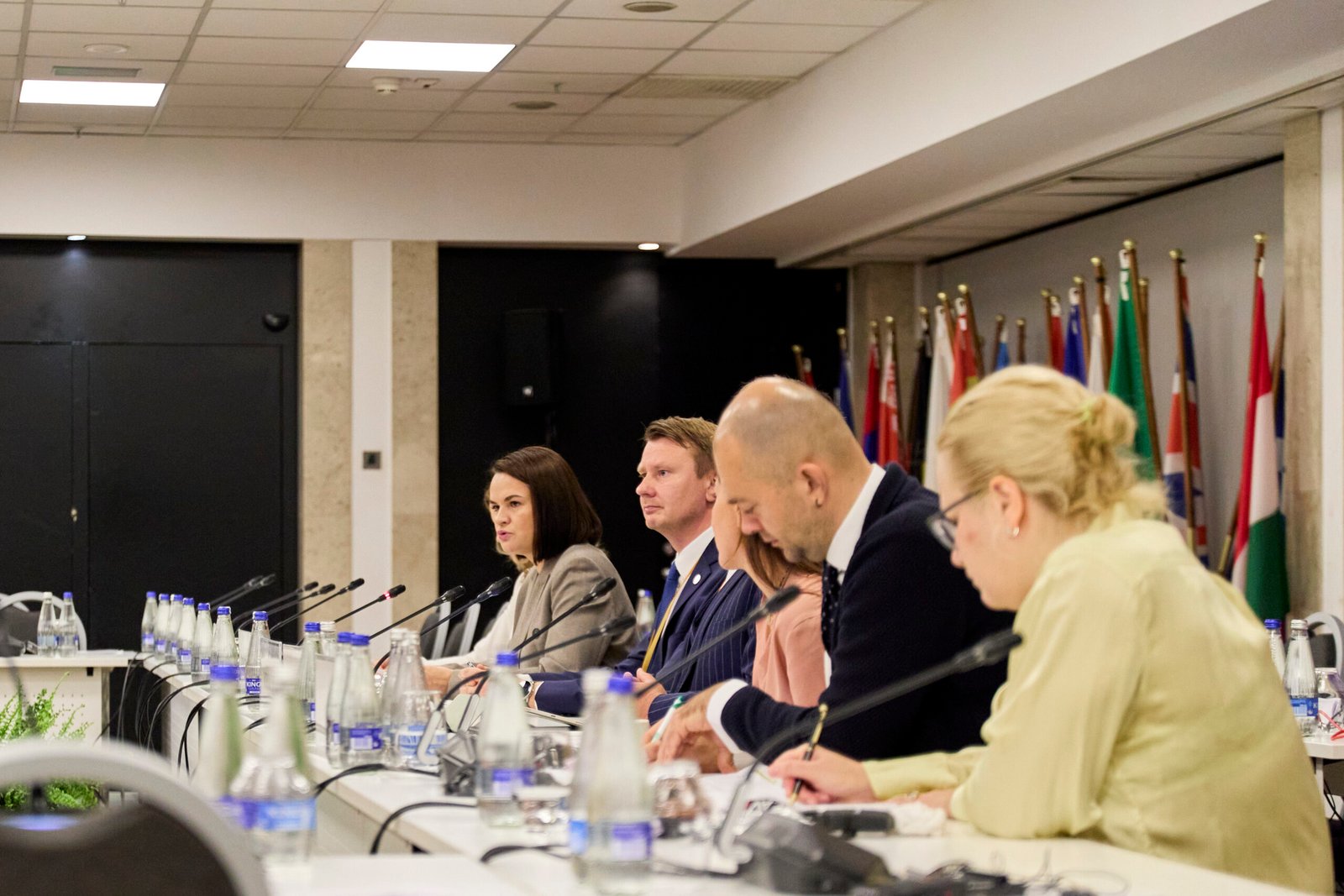




«Dear Ambassador Küngas,
Excellencies, dear friends,
First of all, let me thank Estonia and all the Nordic and Baltic countries — Denmark, Finland, Iceland, Latvia, Lithuania, Norway and Sweden — and, of course, the Office of the OSCE Representative on Freedom of the Media for organizing this timely discussion.
Four years ago, I raised the issue of transnational repression here, at the Warsaw Human Dimension Conference, for the first time.
Back then, it did not attract much attention.
Today, it has become a global challenge.
And it is no longer only a human rights issue. It is a security issue.
Russia and Lukashenka’s regime use transnational repression alongside other hybrid operations against Europe.
After the 2020 election, which we clearly won, the regime unleashed massive terror.
Hundreds of thousands of Belarusians were forced to flee. Many found safety in the European Union, Ukraine, Armenia or Georgia — and first of all in Poland and Lithuania.
Many thought: once I cross the border, I will finally be safe.
But you can flee Belarus — and the KGB can still harass your parents, confiscate your apartment and sentence you in absentia to 15 years in prison.
You can move your newsroom from Minsk to Warsaw — and your media can still be declared “extremist”, while people inside Belarus face prosecution simply for giving you information.
You can continue your human rights or political work from Vilnius — and still receive death threats, see suspicious people following you, or face attempts to hack your private accounts.
You can finally receive a residence permit in Germany — but then discover that your Belarusian passport has been cancelled and you cannot renew it at an embassy.
You can finally book a holiday — but still wonder whether a transit stop could end with detention because the regime has put your name into an international database.
This is how transnational repression works.
It is designed to create the feeling that there is no safe place.
Its goal is to silence dissent, break human dignity and take away people’s ability to act.
But it also aims to undermine international security.
Dictatorships deliberately exploit the openness of democratic societies and abuse international mechanisms.
They want to show that democracies cannot protect even their own residents.
Dear friends,
Let me describe some of the tools dictators use.
The first is documents — or rather, taking documents away.
Since 2023, Lukashenka’s embassies have effectively stopped providing normal passport services. To renew a passport, people are told to return to Belarus.
But for many, returning can mean arrest.
So people face an impossible choice: risk prison — or remain abroad without valid documents.
And this is not only about people who fled Belarus themselves. Some political prisoners released through U.S.-led negotiations were forced out of the country without passports or other documents, including Nobel Peace Prize laureate Ales Bialiatski and human rights defender Uladzimir Labkovich.
Just imagine.
You survive years in prison. You are finally free — but without a passport, without a home, sometimes without money, and without certainty about tomorrow.
The documentation problem affects hundreds of thousands of Belarusians abroad.
We are grateful to countries that issue alien passports and travel documents, provide residence permits, or recognize expired Belarusian passports.
We have also developed the New Belarus passport initiative as an alternative solution. It is not yet recognized, but its purpose is simple: a dictatorship should not be able to control a person by taking away their legal identity.
The second weapon is digital repression.
Sometimes we imagine dictatorships as old-fashioned systems.
They are not.
They use messaging apps, facial recognition, hacked databases, spyware, phishing and artificial intelligence.
My deputy in the United Transitional Cabinet Pavel Latushka has received multiple death threats against himself and his family. Polish authorities have opened three investigations into these threats.
Independent media face cyberattacks, phishing, fake websites, stolen accounts and coordinated campaigns to discredit journalists — like the recent attack against Nasha Niva.
This is especially dangerous because independent media remain one of our strongest links with people inside Belarus.
We have also documented attempts to recruit Belarusians through Telegram.
It can begin with an innocent offer of cooperation or money.
Then come requests for information about colleagues, photos from events, names of activists or travel details.
And if you refuse, threats can begin — including against your family back home.
This brings me to the third tool: coercion through families.
If the regime cannot reach you in Warsaw, Prague or Brussels, it reaches your parents in Hrodna, Brest or Minsk.
A Belarusian attends a solidarity rally in Warsaw.
Soon afterwards, security officers can appear at the family apartment in Belarus.
They search the home. Inspect phones. Interrogate relatives. Sometimes they confiscate property. Sometimes they demand that the person abroad stop their political activity.
The message is simple: we cannot reach you, so we will punish someone you love.
And you do not need to be a famous politician to become a target. A student, volunteer, journalist or local diaspora activist can be enough.
The fourth tool is the abuse of international law-enforcement mechanisms.
And this is especially important for the OSCE.
The regime puts opponents on wanted lists using charges that appear criminal rather than political — fraud, tax offences, “extremism”, ordinary criminal allegations.
Then it hopes another state will act automatically.
One tragic example is Vasil Verameichyk, a Belarusian former volunteer who fought for Ukraine.
He was detained in Vietnam and extradited to Belarus. Today, he is serving a 13-year prison sentence.
Another example is Belarusian filmmaker Andrey Hniot.
He was detained in Serbia following a Belarusian request and faced extradition for months. It took a major international and legal campaign before he was finally able to leave Serbia safely.
This is why requests from a dictatorship cannot be treated as ordinary law-enforcement requests. They require additional human-rights scrutiny.
Many countries that maintain agreements or cooperation with the regime have therefore become risky for Belarusians.
We have developed special travel-risk guidance to warn people about unsafe destinations. This year alone, our teams and partners have helped prevent at least 15 people from being extradited or returned to Belarus.
But this cannot remain the responsibility of activists and lawyers alone.
International mechanisms must not become instruments of dictatorships.
Dear friends,
Transnational repression does not end when somebody is released from prison. In many cases, that is when a new struggle begins.
This is why humanitarian support is also part of the response.
I want to thank Poland and Lithuania, which have become the main safe havens for Belarusians. They have welcomed tens of thousands of our people and worked to find practical legal solutions for those who cannot safely return home.
And I want to thank all the Nordic and Baltic countries organizing today’s discussion — Denmark, Estonia, Finland, Iceland, Latvia, Lithuania, Norway and Sweden.
All of them have joined and contributed to the International Humanitarian Fund for victims of repression in Belarus, created on our initiative.
Together with other partners, we have mobilized more than €3.3 million for rehabilitation, medical treatment, psychological assistance and support for people rebuilding their lives after repression.
I also want to thank the European Union and all governments working with Belarusian democratic forces to protect those escaping repression.
But we need to do more.
And today, here at the OSCE, I would propose seven concrete steps.
First — recognize transnational repression as a distinct human-dimension and security threat.
ODIHR and participating States should systematically document cases, identify patterns and exchange early warnings.
Second — protect journalists in exile.
I ask the OSCE Representative on Freedom of the Media to keep this issue high on the agenda.
Moving a newsroom abroad does not end repression. It changes its form: from raids to hacking; from arrests to threats against relatives; from censorship of journalists to criminalization of their audiences.
When we protect Belarusian journalists in Warsaw or Vilnius, we also protect the right of people in Belarus to receive independent information.
Third — stop the abuse of extradition and international police mechanisms.
Every request from a state without an independent judiciary should receive enhanced human-rights scrutiny.
No Belarusian should be sent back to persecution because somebody treated an authoritarian regime’s request as routine paperwork.
Fourth — solve the documentation problem.
Issue travel documents and alien passports. Provide secure residence permits. Recognize expired passports where necessary.
No journalist, activist or former political prisoner should become legally invisible because Lukashenka refuses to renew their passport.
Fifth — strengthen digital protection.
Governments and technology companies should work directly with independent media and civil society on cybersecurity, account protection, spyware, phishing and coordinated online harassment.
Sixth — impose consequences.
Officials and security officers responsible for transnational repression should face targeted sanctions, visa bans and, where possible, criminal investigations.
And we must continue the broader work on accountability.
The International Accountability Platform for Belarus, created following recommendations of the OSCE Moscow Mechanism, is preserving evidence for future proceedings. Evidence must be preserved now — not after the dictatorship is gone.
I also ask countries to support the ICC investigation opened following Lithuania’s referral, concerning alleged crimes against humanity, including deportation and persecution connected to the forced displacement of Belarusians.
Seventh — take this issue beyond this room.
We should raise transnational repression at the UN General Assembly, including in the Third Committee.
We should bring it to the UN Security Council through an Arria-formula meeting, as we did with Estonia on Belarus in 2020 and 2021.
And finally, we must continue to demand systemic change in Belarus.
Not cosmetic changes. Not just individual prisoner releases in exchange for sanctions relief.
We need an end to the system of repression.
That means no new political arrests.
No politically motivated criminal cases.
No threats against families.
No persecution across borders.
Until we see systemic change, we must maintain pressure and the political isolation of the regime.
And please continue supporting Belarusian independent media, civil society, human rights defenders, political prisoners, and democratic institutions.
This support, just like support for Ukraine, is not charity.
It is an investment in European security.
Europe must be free from war, dictatorship, terror, and political persecution — both within and beyond national borders.
Thank you».