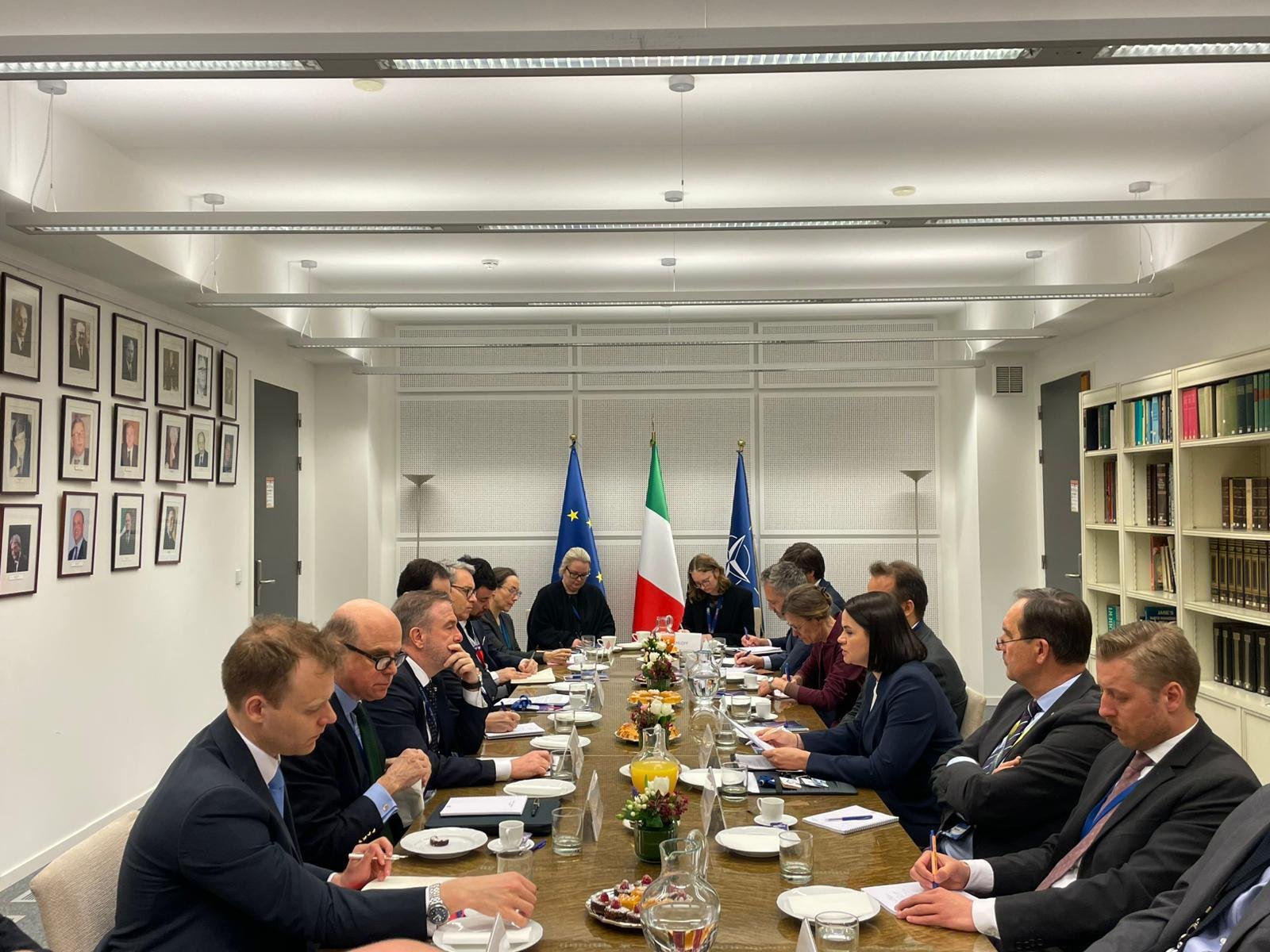




During her visit to Brussels, Sviatlana Tsikhanouskaya spoke at a briefing for ambassadors of NATO member states. The meeting brought together senior representatives of Allied countries, including permanent representatives and diplomats from Italy, the United States, the United Kingdom, Germany, France, Poland, Lithuania, Latvia, Estonia, Finland, and Sweden.
The discussion focused on the situation in Belarus in the context of regional security, the Lukashenka regime’s involvement in the war against Ukraine, hybrid threats to EU and NATO countries, and ways to further support the democratic forces and increase pressure on the regime.
In her remarks, Ms. Tsikhanouskaya thanked partners for their consistent support of the democratic movement and highlighted in particular the role of Italy, the United States, the United Kingdom, and EU member states. She noted that international pressure is already producing results – hundreds of political prisoners have been released thanks to sanctions and diplomatic efforts. She also emphasized the humanitarian efforts of the United States in securing releases and expressed gratitude to Lithuania, Poland, and Latvia for supporting Belarusians in exile.
Read the full speech below.
Sviatlana Tsikhanouskaya: “Your excellencies,
Dear friends,
First of all, let me thank Alessandro Azzoni and the entire Italian delegation for the invitation.
Despite the distance, Italy has become one of the strongest supporters of Free Belarus. Minister Tajani invited me to the G7 summit in Capri, and two weeks ago, I was received by President Mattarella and Prime Minister Meloni in Rome. Italy doesn’t recognize Lukashenka as legitimate, and keeps supporting our movement and our people. Grazie mille!
I have words of gratitude to each of your countries. What we achieved as democratic movement – thank to you and our partnership.
Just last week, we as democratic forces, concluded Strategic Consultations with FCDO, in London. And the week before – we had the Consultative Group meeting with Kaja Kallas in Brussels. We agreed that the pressure on the regime must continue until a real change comes. And yes, sanctions and isolation do work! They already force Lukashenka to release people.
Here, I want to thank the American administration, which is leading the humanitarian track on releasing hostages. As we speak, this very moment, President Trump’s Envoy John Coale conducts negotiations in Minsk, and we expect some good news later today. Hundreds were freed already, including my husband. But unfortunately, more than thousand hostages remain behind bars. I’m sure that President Trump has enough leverage to free them all, and stop the vicious circle of repression.
Separately, I want to praise Lithuania and Poland – who hosted thousands of Belarusians, fleeing terror, including released prisoners, who were immediately deported from the country.
It’s Lithuania, Poland, and Latvia, who face the most aggressive hybrid attacks from the regime, and who know well its nature. I don’t believe Lukashenka can be reeducated,and he can’t be appeased. Only strong and firm stance, and pressure – can force him for concessions. That’s why we support sanctions and pressure policy.
Evidently, the Belarus crisis is not only about human rights, it’s about security. The fates of Ukraine and Belarus are intertwined. If there will be a ceasefire, if Ukraine is strong, it will open the window of opportunity for Belarus.
If not for Russian support, Lukashenka would have collapsed back then in 2020. We clearly won those elections, and we will win again.
The problem is that Russia doesn’t see Belarus nor Ukraine as independent countries, and in Belarus it behaves in the same way as in occupied territories. And Russians need Lukashenka – because it is a cheap way to control the whole country.
Belarus has a strategic importance for Russia: it gives military balcony over Ukraine, allows provocations on the border. Belarus will be key in case of escalation or possible Russian attacks on Baltic states.
And the dictators are preparing for escalation. Facilities for nuclear weapons have been built. Military bases have been developed. Military training has been conducted. The system of war radars has been upgraded. Oreshnik missiles are reportedly being deployed – and they can reach many European capitals in minutes.
Of course, their primary goal is to blackmail Europe, but the threat is real.
Last month, the regime conducted a combat readiness inspection. Civilian surgeons received training for wartime injuries. Internal troops are being trained to use new weapons and vehicles. The regime continues to modernize Soviet-era equipment.
Lukashenka remains the key supplier of weaponry to Russia. Enterprises such as Peleng and BelOMO supply optical systems and components for Russian tanks. Cooperation with Russia and China enables large-scale production. Overall, more than 300 Belarusian state companies are involved. They also produce missile systems and drones.
Also, Lukashenka continues a hybrid war on Belarus neighbors. Just a couple of days ago, Vilnius airport was closed again because of a balloon alert. It continues to send illegal migrants to the EU. Months ago large tunnels built by Minsk on the border were discovered. It creates pressure on neighbors, but also distracts resources from Ukraine.
Lukashenka depends on this war, and he is one of its key beneficiaries. Basically, it helps his economy to survive. But this year is difficult for him. Sanctions brought effect. GDP is stagnating. Iran, which was the key partner in transiting sanctioned goods, is at war, which disrupts Lukashenka’s supply chains, including potash fertilizers. Surprisingly, this war can have an effect on Belarus, and weaken the Lukashenka regime.
And now, when he is weak, and fully dependent, we must not ease pressure. The very fact that Lukashenka releases people is also a result of such pressure. European sanctions can’t be lifted now: it would only strengthen Russia.
Of course, sanctions are not a goal, they are a tool. And here, we have developed a formula: American sanctions – to free people, European sanctions to free the country.
Because most of the American sanctions were imposed for human rights violations, while the European ones – for the war. So we believe that European sanctions must serve systemic change in Belarus, so it is no longer a threat to our neighbors.
We also see the regime’s involvement in sabotage and intelligence operations in neighboring countries. They work in the information space, spread anti-Ukrainian disinformation, but also attack political opponents. Often, they use mechanisms such as Interpol to prosecute activists abroad. Minsk denied Belarusians in exile consular services, and many can not renew their passports, which makes thousands of people abroad de facto stateless.
Of course, transnational repression needs a long separate discussion, and it becomes a big problem. I am glad that days ago the ICC opened an investigation into Lukashenka’s crimes against humanity, initiated by Lithuania. It gives us hope that soon the ICC will issue an arrest warrant on Lukashenka, and that could be a game changer for Belarus.
I think Lukashenka is much weaker than he wants to appear. The current situation is a dead end for him. Even his elites understand that change is inevitable, and whisper about transition. But Lukashenka doesn’t have a clear successor, and doesn’t have any backup plan. Recent events in Syria, Venezuela, Iran, and now Cuba – only intensify the uncertainty.
That’s why we must be ready for new momentum. I can’t say when and how it appears, but it will. And at that moment we must be well prepared. We as democratic forces need a clear action plan, but also we expect our partners to be ready to help us too.
The goal must be to ensure peaceful transition, free elections, and not allow Russia to interfere. We need a clear alternative to Russia. That’s why we have to strengthen alternative institutions of power, ready to take power when the moment comes.
And currently we campaign on two tracks: European future, to strengthen pro European moods. And second – the roundtable – offering nomenklatura a dialogue. A dialogue not between Lukashenka and the West, but dialogue with the society.
Luckily, most Belarusians, both pro-Lukashenka and pro-democratic, are against the war. They value independence. The pro-democratic majority supports Ukraine. The very fact of repression shows that the resistance continues. Only 4% of Belarusians want full unification with Russia. Belarusians are very different from Russians, and the war has shown it clearly.
So I am sure that, when the moment comes, we will be able to turn Belarus to Europe and democracy. But what is key – Ukraine must be strong, and Russia must be weak at that very moment.
That’s why we intensify cooperation with Ukraine. Two months ago, I officially met President Zelenskyy. Now I’m planning my first official visit to Kyiv. Kyiv will appoint a special envoy on Belarus, and we will open a democratic mission in Kyiv.
I believe that in case of changes, Ukraine, alongside the EU, will play a key role on Belarus.
We must not allow Russia to fix its control over Belarus. It’s my biggest fear and concern. If we don’t speak about Belarus now, if we don’t see Belarus as a key element of security – it will be very difficult to get it out of Russian claws in the future. That’s why I ask you – to speak about Belarus, that Belarus is Europe, and help Belarusians to take their country back when the moment comes.
I assure you that free Belarus will be the best security guarantee for Ukraine, for Europe, and for NATO alliance.
Lukashenka is not your ally, never was, and never will be – but Belarusian people ARE. Remember that military power alone is not enough without people ready to defend their values. See your support to the Belarusian cause as the investment in security as well.
My dear friends,
We have to finish what we started back in 2020. Peaceful transition of power. I know that the path to freedom can be long and difficult. But as we have such allies as you, I am sure we shall overcome.
Thank you. Slava Ukraini! Zhyvye Belarus!”