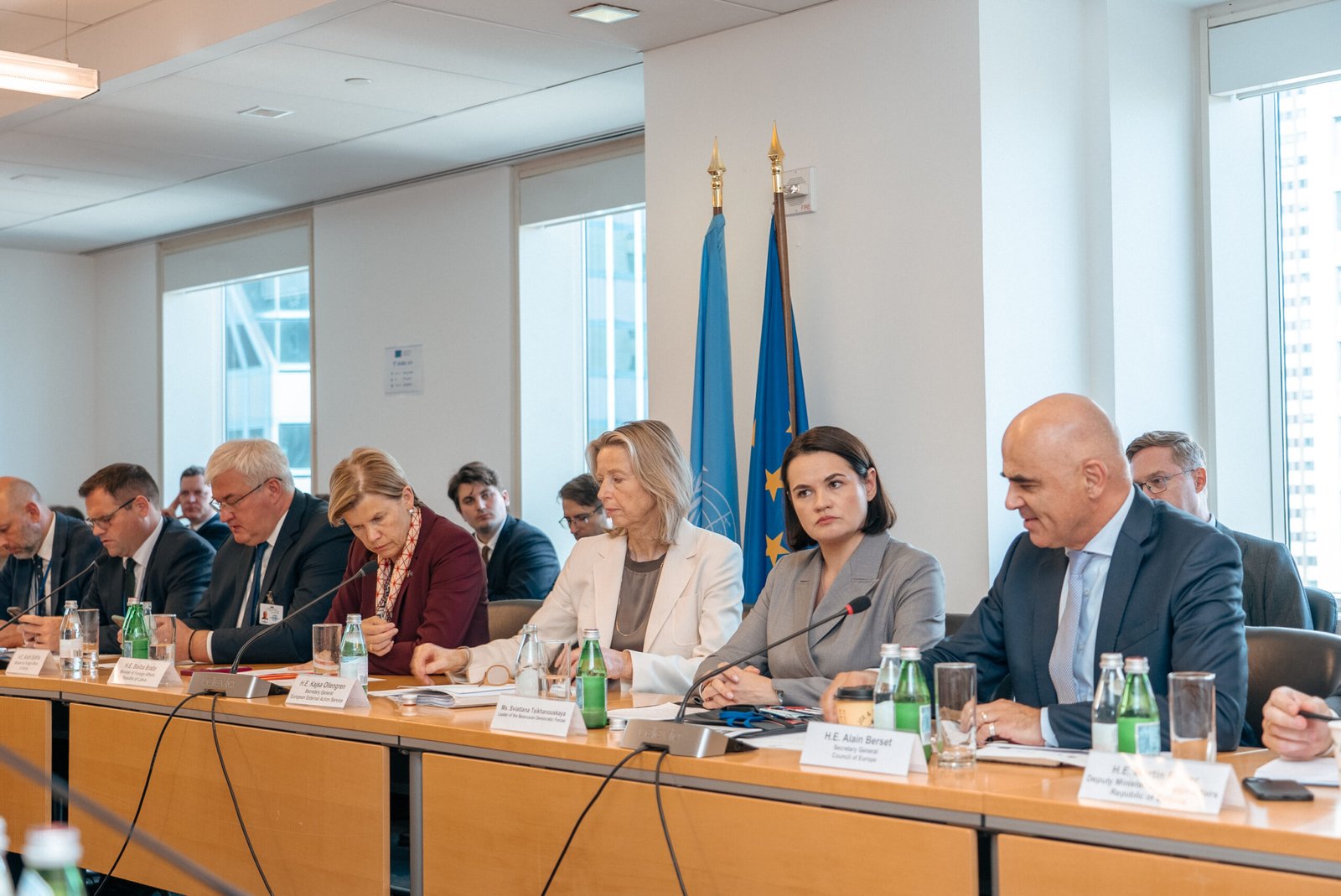




On September 21, a ministerial event was held in New York on the margins of the High-Level Week of the 81st session of the UN General Assembly, focusing on the situation in Belarus, its role in Russia’s war against Ukraine, and the implications of the Lukashenka regime’s policies for regional and international security.
The meeting was organized by Latvia and the European Union with the support of Sviatlana Tsikhanouskaya’s Office. Representatives of Ukraine, Lithuania, Estonia, Ireland, Sweden, and the Czech Republic also contributed to its organization.
Sviatlana Tsikhanouskaya spoke at the event alongside:
- H.E. Kajsa Ollongren, Secretary General of the European External Action Service;
- H.E. Baiba Braže, Minister of Foreign Affairs of Latvia;
- H.E. Andrii Sybiha, Minister for Foreign Affairs of Ukraine;
- H.E. Kęstutis Budrys, Minister of Foreign Affairs of Lithuania;
- H.E. Petr Macinka, Minister of Foreign Affairs of the Czech Republic;
- H.E. Alain Berset, Secretary General of the Council of Europe;
- H.E. Neale Richmond TD, Minister of State for International Development and Diaspora of Ireland;
- Mr. Martin Roger, Deputy Minister of Foreign Affairs of Estonia
- Mr. Gunnar Aldén, Deputy Director-General for Global Affairs at the Ministry of Foreign Affairs of Sweden
- Mr. Jamie Fly, Chief Executive Officer of Freedom House.
The discussion highlighted a key point: developments in Belarus have consequences far beyond the country’s borders. Domestic repression, dependence on Russia, the regime’s involvement in Russia’s aggression, transnational repression, and hybrid actions directly affect the security of neighboring countries and Europe as a whole.
In her remarks, Sviatlana Tsikhanouskaya called for clearly distinguishing the Lukashenka regime from the Belarusian people and Belarus from Russia. She stressed that Belarusians did not choose this war and the country’s future should be tied to an independent, democratic, and European Belarus that is not a source of threats but a predictable and peaceful neighbor.
A separate part of the discussion focused on repression inside Belarus. Ms. Tsikhanouskaya noted that the release of political prisoners is highly significant but does not in itself indicate systemic change. The repressive system remains in place: people continue to be persecuted under so-called “extremism” legislation, pressure extends to their families and relatives, and those who have been released remain at risk of renewed persecution. Therefore, Ms. Tsikhanouskaya noted, the goal should not simply be to reduce the number of political prisoners but to end politically motivated repression altogether and ensure the release and rehabilitation of those imprisoned.
Sviatlana Tsikhanouskaya also spoke about the recently released group of 25 political prisoners who were taken to Lithuania. She informed the other participants that, with support from the EU and the International Humanitarian Fund, they had been provided with accommodation, medical and psychological assistance, as well as legal support. Lithuania and Poland helped obtain documents for those who were expelled from Belarus without passports. At the same time, she stressed that these releases are taking place against the backdrop of new arrests and sentences.
Another topic of discussion was transnational repression, including trials in absentia, property confiscation, pressure on relatives, surveillance and threats against Belarusians in exile, and problems with passports and consular services. Ms. Tsikhanouskaya called on host countries to seek practical solutions for Belarusians with expired or revoked passports and to exercise particular caution when reviewing extradition requests from the Lukashenka regime and requests made through international police cooperation mechanisms when there are indications of political motivation.
A significant part of the discussion focused on the Lukashenka regime’s role in Russia’s war against Ukraine. Sviatlana Tsikhanouskaya emphasized that Belarusian territory and infrastructure continue to be used in Russia’s interests, while military cooperation between the two countries is deepening. She stated that new military infrastructure is being built in Belarus, and more than 600 Belarusian enterprises supply the Russian military with weapons, electronics, fuel, optics, and ammunition. Ms. Tsikhanouskaya added that in the event of a new escalation, Belarusian territory and infrastructure could be used by Russia again.
At the same time, she highlighted that Belarus’s future is intertwined with the outcome of the war in Ukraine. She observed the support for Ukraine provided by Belarusians, including those fighting on Ukraine’s side, helping Ukraine from inside Belarus, or having been persecuted for such support.
A separate part of her remarks focused on practical steps that Belarus’s democratic forces expect from the international community:
“First, maintain pressure until we see systemic change. Target sanctions at those responsible for repression and at companies supporting Russia’s war.
Second, we must pursue a full political amnesty. Release everyone. Stop the arrests. Close the absurd cases. People must have the right to live safely at home or return to Belarus without fear. I also urge you to increase contributions to the International Humanitarian Fund so that assistance is ready for the next releases.
Third, support accountability. Support the International Criminal Court’s investigation and the International Accountability Platform for Belarus. Ensure that the regime’s role in Russia’s aggression and the displacement of Ukrainian children is investigated.
Fourth, isolate the regime, not Belarusians. Maintain visas, scholarships, and mobility programs; continue supporting independent media and civil society. Help Belarusians without valid passports. Include a democratic Belarus in international formats.
Fifth, Belarus after Lukashenka. Start working with Belarus’s democratic forces now on the transition, economic stabilization, preventing Russian interference, and holding free elections. And give Belarusians a clear European perspective”.
At the UN level, Sviatlana Tsikhanouskaya called for bringing Belarus back to the center of the international agenda:
“I have five practical requests:
Bring Belarus back to the UN agenda. Begin work on a strong resolution on Belarus in the Third Committee and the General Assembly addressing political prisoners, transnational repression, and the regime’s role in Russia’s war.
Organize an Arria-formula meeting on Belarus and invite our experts, former political prisoners, and human rights defenders.
Put transnational repression on the international agenda. Hold a meeting in New York or Geneva involving government representatives, UN experts, INTERPOL, civil society, and our democratic forces.
Find a solution to the documents problem. Thousands of Belarusians cannot safely renew their passports. We need an internationally recognized solution for these people.
Protect the UN mechanisms on Belarus. Support and ensure funding for the Special Rapporteur and the Group of Independent Experts.
One more request for this week: when your leaders address the General Assembly, mention Belarus.
And my final request: give Ukraine everything it needs to defend itself and prevail. Because Ukraine is fighting for all of us”.
The key message in Ms. Tsikhanouskaya’s remarks was that the situation in Belarus should be viewed not only as a human rights issue but also as part of the broader discussion on Russia’s war against Ukraine, European security, and the future of the region.