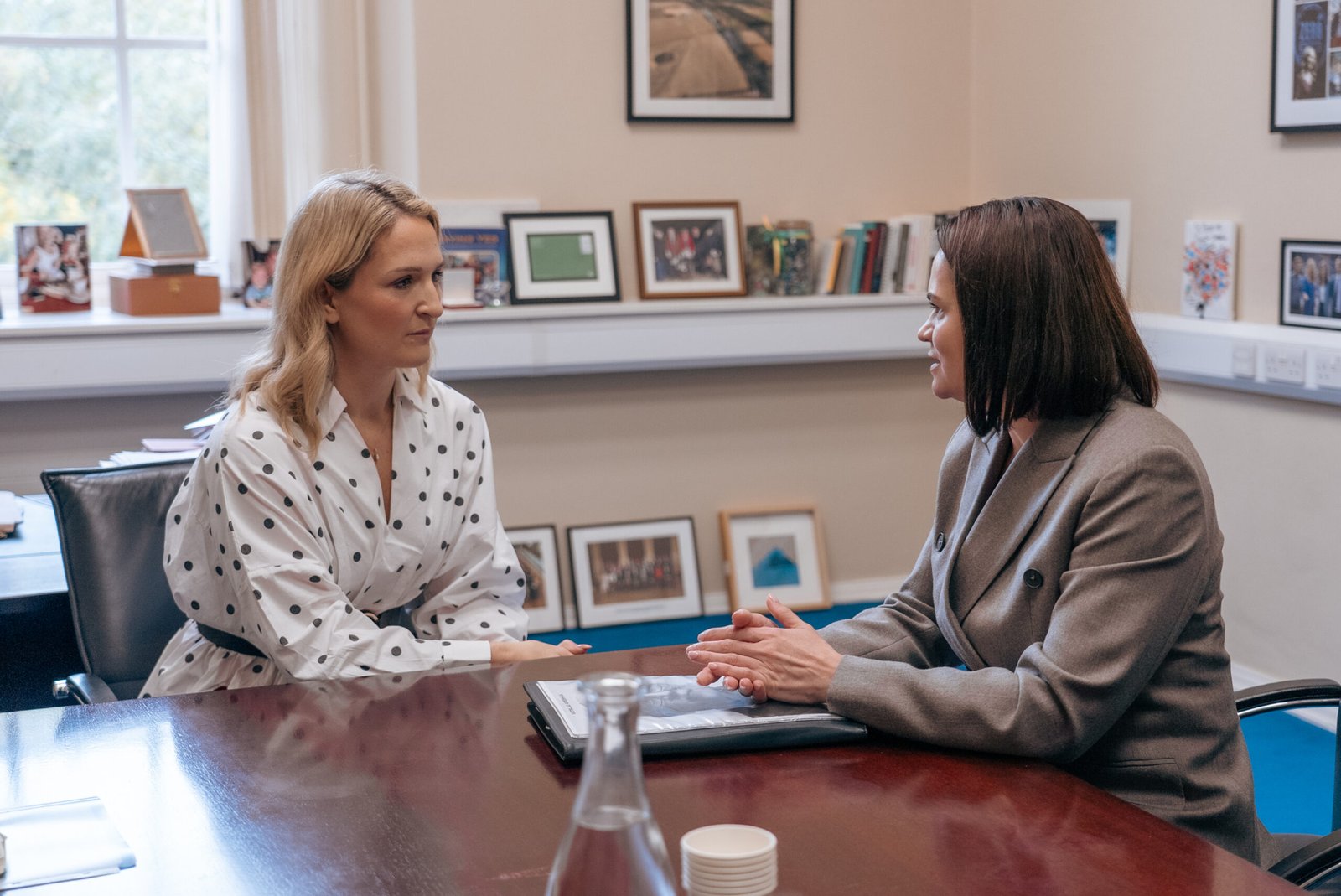


On October 28, Sviatlana Tsikhanouskaya met with Ireland’s Minister for Foreign Affairs and Trade, Helen McEntee, in Dublin. They discussed problems Belarusians face with travel documents, the release of political prisoners, sanctions against the Lukashenka regime, accountability for repression, and continued support for a democratic Belarus.
Documents and support for Belarusians in Ireland
A key issue was the inability of many Belarusians to renew their passports because the regime has barred its consulates from issuing new ones.
Sviatlana Tsikhanouskaya thanked Ireland for agreeing to accept expired Belarusian passports when people apply to renew their residence permits. However, problems remain with travel documents, particularly for children who have never held a Belarusian passport and former political prisoners whom the regime forcibly deported from the country.
Ms. Tsikhanouskaya presented Minister McEntee with specific cases of Belarusians in need of assistance, along with proposals for addressing these problems. Minister McEntee agreed to discuss the issues with Ireland’s Minister for Justice, including possible individual solutions and assistance with family reunification.
Political prisoners, sanctions, and support for the repressed
The parties discussed US negotiations with the Lukashenka regime on the release of political prisoners. Ms. Tsikhanouskaya stressed that while every release matters, repression continues and many people who are freed are forcibly deported from Belarus without documents.
Humanitarian efforts must continue but not at the expense of easing European sanctions. Sviatlana Tsikhanouskaya urged Ireland to maintain and increase pressure on the Lukashenka regime, including during the next review of sanctions in February.
She also thanked Ireland for contributing to the International Humanitarian Fund that supports individuals repressed in Belarus and encouraged additional contributions. The funds are particularly needed for medical treatment, rehabilitation, and support for former political prisoners released after years in detention.
Human rights and accountability for the Lukashenka regime
Sviatlana Tsikhanouskaya congratulated Ireland on its election to the UN Human Rights Council for the 2027–2029 term and invited Ireland to make Belarus one of its priorities.
Ms. McEntee and Ms. Tsikhanouskaya discussed the investigation into crimes committed by the Lukashenka regime at the International Criminal Court, which began following Lithuania’s referral. Sviatlana Tsikhanouskaya proposed that Ireland support the investigation.
Another topic was transnational repression, through which the regime continues to persecute Belarusians in exile: threatening their families, using international wanted-person mechanisms, and attempting to intimidate activists. Ms. Tsikhanouskaya proposed holding a joint event on the issue in Geneva.
The parties also discussed security threats posed by the Lukashenka regime and the Belarusian economy’s dependence on Russian defense orders. They agreed on the need for a united European position vis-a-vis Belarus.
Support for independent media, culture, and civil society
Sviatlana Tsikhanouskaya thanked Ireland for supporting independent Belarusian media, human rights defenders, and cultural projects.
The sides also discussed the Conference on Ireland–Belarus National Cultural Identities that took place in Dublin on October 27. Sviatlana Tsikhanouskaya proposed making the conference an annual event, with a different theme each year.
She also thanked the Irish Embassy in Vilnius and Ambassador Séadhna MacHugh for assisting Belarusian initiatives, organizing events, and supporting translations of Irish children’s books into Belarusian.
The sides discussed new joint projects, including initiatives in technology, democracy, and support for civil society.
Sviatlana Tsikhanouskaya: “Ireland holds a special place in my heart. I spent summers here as a child, and I know how powerful the support of the Irish people can be.
Today, thousands of Belarusians need that support. Some need help obtaining documents and reuniting with their families. Others need to recover their health after prison. And those who remain in Belarus need to know that the world has not forgotten them.
I am deeply grateful to Ireland for helping address people’s immediate needs. We want Belarus to become a free European country, and it means a great deal to have friends like Ireland supporting us on this path”.
The Irish side reaffirmed its readiness to continue supporting Belarus’s democratic forces, human rights and humanitarian initiatives, and efforts to find solutions to the document-related problems facing Belarusians.