



Developments in Belarus
Foreign student statistics
In July, Belarusian Education Minister A. Ivanets and Deputy Prime Minister Natallia Piatkevich repeatedly stated that 37,000 foreign students are studying in the country and that their number has increased by 10,000 over the past four years. They also claimed that one in three foreign students, or 12,300, are from China. At the same time, data published by the National Statistical Committee that same month showed a significantly lower number of foreign students: 24,500, with the figure having changed little over the past four years. The number of Chinese students was also lower, at 7,000 rather than 12,000. Experts believe the Statistical Committee’s data are more consistent with reality and with long-term trends in academic mobility into Belarus.
Continued political repression
Katsiaryna Zhohal, a history teacher at School No. 124 in Minsk, was convicted by the Minsk City Court of “facilitating extremist activity” (Part 1 of Article 361-4 of the Criminal Code) and sentenced to restricted freedom at her place of residence with forced labor. The sentence effectively means an indefinite ban on working in her profession.
Persecution related to the case involving the European Humanities University (EHU) continues. A search was conducted at the home of relatives of writer Sasha Filipenko, who studied at EHU for just one year in the early 2000s, before the university was closed in Belarus.
Electronic School
Beginning in September, 300 educational institutions in Belarus will start using the automated Electronic School system. It is expected to improve administrative efficiency, facilitate the transition from paper-based to digital record-keeping, and reduce teachers’ workloads. Electronic teachers’ gradebooks and student journals will be introduced. The system will be accessible not only to officials and teachers but also to students and their parents.
2026 university admissions results
Independent experts analyzed the results of student admissions to Belarusian universities. The most attention and public reaction focused on the significant decline in admission scores for medical programs. For example, the minimum score for a state-funded place at the pediatric faculty of the Belarusian State Medical University fell by 49 points, from 368 last year to 319. At the Faculty of Pharmacy, it fell by 98 points, from 381 to 283. At Vitsebsk State Medical University, it remained unclear until the very end of the admissions campaign whether all places would be filled. Experts attribute this both to a significant increase in the number of state-funded places in these programs and to the negative impact of what they describe as “academic slavery”, linked to mandatory work placements after graduation.
Militarization of education
In July, the first national review and competition for military drill and patriotic song was completed. Hundreds of schools reportedly took part. The winners — teams representing each region and the city of Minsk — met in the capital in early July.
The officially stated goal of the competition is to “strengthen young people’s civic engagement and respect for the history of the Armed Forces”.
In July, the final stage of the national military-applied competition “Breakthrough” was held. It is designed for university students and includes exercises in constructing fortifications, shooting, and operating UAVs. “Proryv”, together with “Zarnichka”, “Zarnitsa”, and “Orlyonok”, forms a system of military games covering all age groups, from younger schoolchildren to university students. These activities have no precedent in Belarus’s educational history and signal the further strengthening of militaristic trends in the country’s education and upbringing system.
International contacts
On July 7, 2026, the Education Minister of Belarus, A. Ivanets, met with the Ambassador Extraordinary and Plenipotentiary of Mongolia to Belarus, Gunaajav Baigalmaa. The talks focused on intensifying bilateral cooperation, vocational education, and professional development for teaching staff.
Developments abroad
New monograph by V. Shadurski
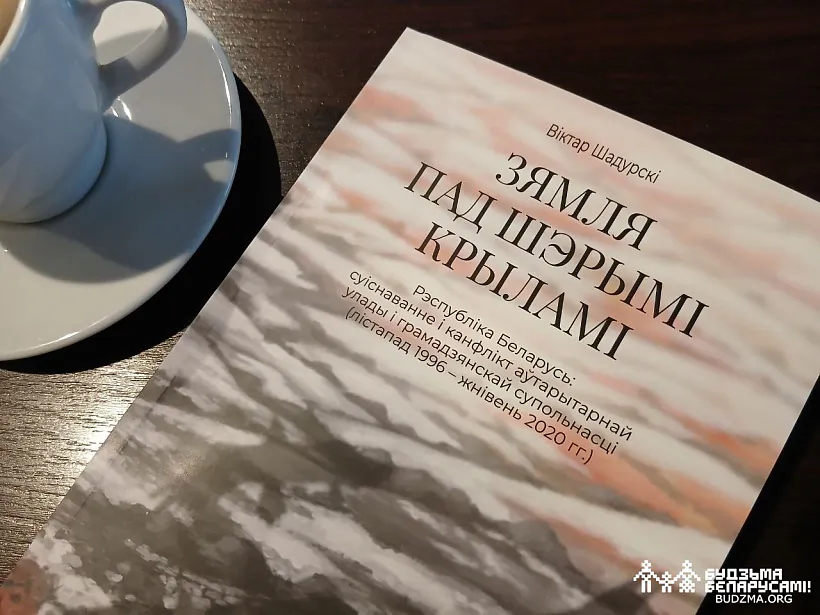
A new monograph by prominent researcher of contemporary Belarusian history Viktar Shadurski, “Land Under Grey Wings. The Republic of Belarus: Coexistence and Conflict of Authoritarian Power and Civil Society (November 1996 — August 2020)”, has been published with support from the Kamunikat Foundation. It analyzes the development of the administrative and repressive apparatus that enabled the authorities to suppress the mass protests of 2020. The book also examines the lack of transparency in Belarus’s electoral system, the evolution of the country’s socioeconomic model, and the main directions of its foreign policy.
Ales Bialiatski’s support for the Astafiej Vałovič Belarusian Research University
Nobel laureate Ales Bialiatski has joined the signatories of an open letter supporting the establishment of the Astafiej Vałovič Belarusian Research University. The project has already received support from Nobel Prize in Literature laureate Svetlana Alexievich, historian Marci Shore, philosophy professor Jason Stanley, former Swedish Ambassador to Belarus Stefan Eriksson, Gazeta Wyborcza editor-in-chief Adam Michnik, BNR Rada Chair in exile Ivonka Survila, Ukrainian historian Yaroslav Hrytsak, as well as researchers, educators, and experts from the United States, Canada, the United Kingdom, Austria, Belgium, Lithuania, Norway, Germany, Poland, Ukraine, and Belarus.
The Astafiej Vałovič Belarusian Research University is a civil society association registered in Poland to establish a national Belarusian higher education institution.
Digest of Belarusian Studies in exile for Q2 2026
The H-Belarus online platform published a digest of publications on Belarusian studies from abroad for the second quarter of 2026. It includes 27 publications, including monographs by I. Ramanava, M. Halavanava and T. Weiler, and N. Pankratava; a translation of poems by L. Hienijuš; and articles by T. Astrouskaya, S. Bedford, E. Korosteleva, K. Pierson-Lyzhina, and others.
Roundtable “Belarusian University in Exile: Experience, Responsibility, and the Future”
An online roundtable, “Belarusian University in Exile: Experience, Responsibility, and the Future”, was held on July 20, 2026. It was organized by the Belarusian Association of Education and Science. Around 20 experts, civic activists, and public opinion leaders took part in the discussion, which focused on Belarusian higher education institutions and initiatives in exile, including the European Humanities University, the Belarusian Academy, the Free Belarusian University, the Astafiej Vałovič Belarusian Research University, and other research, educational, and scholarship programs.
The discussion demonstrated that the issue of a Belarusian university in exile remains relevant. Speakers repeatedly emphasized the need to preserve Belarusian academic agency, maintain high standards of research and education, establish transparent governance mechanisms, ensure financial sustainability, and remain accountable to Belarusian society.