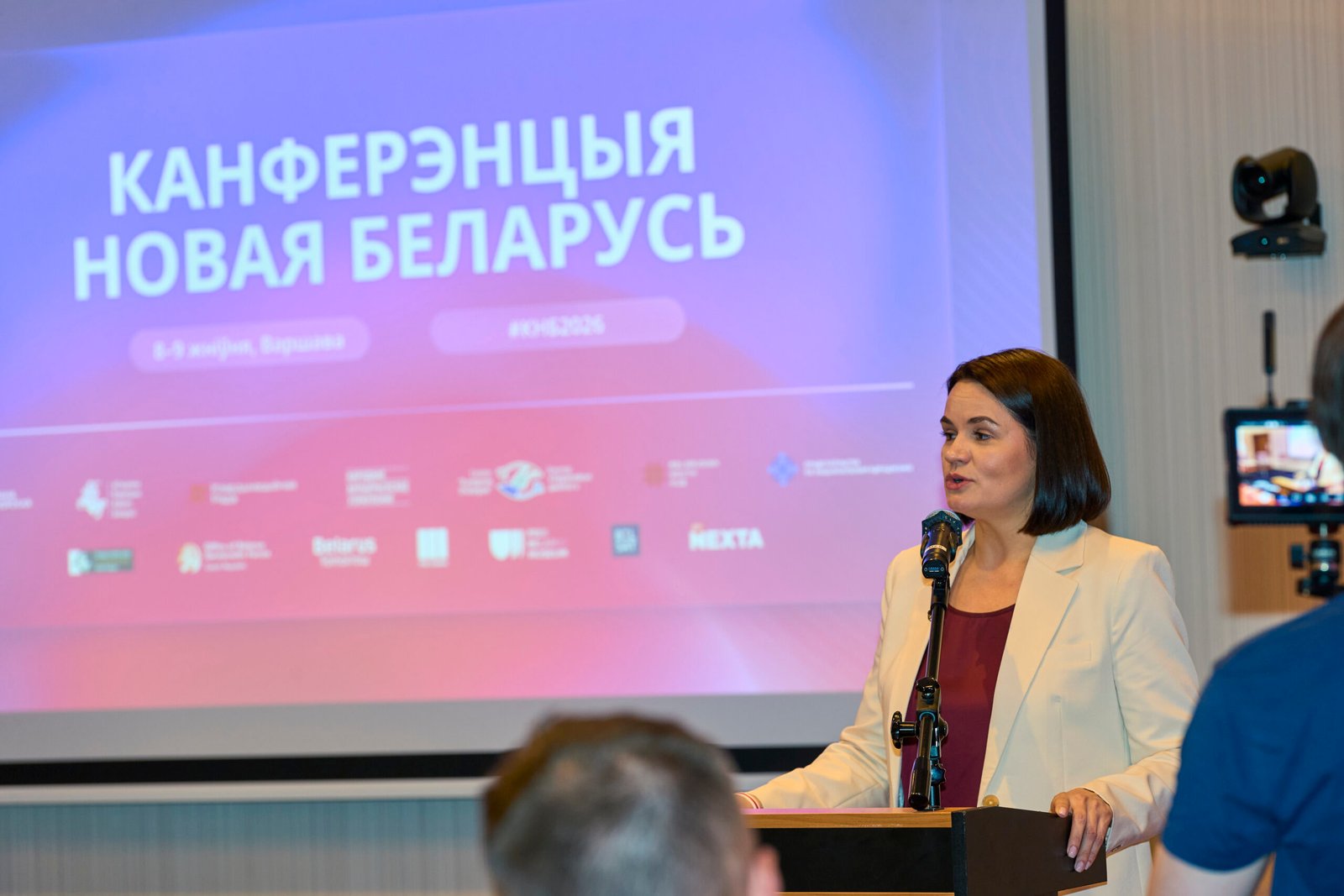




Belarusians marked the sixth anniversary of the 2020 protests, New Belarus Conference was held in Warsaw on 7–9 August, Sviatlana Tsikhanouskaya’s conducted multiple international meetings.
WHAT’S GOING ON?
Belarusians have marked the sixth anniversary of the 2020 elections and protests. On 9 August, rallies took place in Vilnius, Warsaw, and other cities, Sviatlana Tsikhanouskaya addressed Belarusians and the international community, stating that Belarusian uprising of 2020 remains unfinished. 15 countries, and international leaders like Roberta Metsola, Andrii Sybiha, issued statements of solidarity with Belarusians.
Around 300 participants — including former political prisoners, representatives of democratic forces, civil society, independent media, experts, and international partners — gathered for the New Belarus Conference in Warsaw on 7–9 August. It was jointly organized by the Office of Sviatlana Tsikhanouskaya, the United Transitional Cabinet, the Coordination Council, and Belarusian political parties.
Key results:
- Discussions focused on Ukraine, political prisoners, sanctions and accountability, economy, European integration, culture and education, social assistance, transnational repression, independent media, and preparations for a future window of opportunity.
- Nine political resolutions were adopted, setting common positions of the democratic forces, including “On Protecting Sovereignty and Preventing Belarus from Being Drawn into War” and “On the Priorities of Belarus–Ukraine Cooperation”.
- A new “Post-Lukashenka Belarus” campaign was launched, alongside continued work on the Round Table initiative and preparations for a future peaceful democratic transition.
- A roadmap for Belarus’s European integration was presented, together with a proposal for a dedicated EU instrument to support democratic transition and future integration.
- New practical and digital projects and tools were presented, such as telemedicine, for safe travel and resource-sharing among NGOs,
- The Ukraine direction was strengthened: Volha Zazulinskaya was appointed Head of the Democratic Belarus Mission in Kyiv. Yulia Mitskevich became Acting Representative for Social Policy, while Aliaksei Hrakhouski took over responsibilities for youth policy. New democratic delegations to PACE and the OSCE PA will also be formed.
- Democratic forces reaffirmed their priorities: release of all political prisoners and an end to repression, support for civil society and independent media, stronger cooperation with Ukraine, accountability for the regime’s crimes, protection of Belarusian sovereignty, and a European future for Belarus.
Release of political prisoners remains a key priority. The democratic forces continue working with the Trump administration through the diplomatic track to secure further releases. Sviatlana Tsikhanouskaya stressed that freeing prisoners is not enough: the goal must be a complete end to repression. Human rights defenders report that repression remains at a very high level, with new arrests continuing and no signs of systemic easing. Tsikhanouskaya called on international partners to maintain pressure on the regime until all political prisoners are free, repression stops, and real systemic changes begin.
The EU is targeting Belarusian companies that support Russia’s war. The 21st sanctions package, adopted in July, added the Mazyr Oil Refinery to the sanctions list. Before 2022, the refinery was a major supplier of gasoline and diesel to Ukraine. It lost most of that market after the regime joined Russia in its aggression. The democratic forces have also provided partners with evidence and lists of Belarusian companies and institutions involved in supporting Russia’s war effort.
INTERNATIONAL ENGAGEMENTS
Poland. Warsaw hosted the bulk of the movement’s August activity: the New Belarus Conference (7–9 August), the Women’s Breakfast (9 August), the Dignity Day rally (9 August), and the meeting with ambassadors and diplomats working on Belarus (11 August), which included representatives of Poland, Ukraine, and eight other countries. Polish public figures, including journalist Adam Michnik also joined the rally.
Czech Republic. On 9 July, the Czech Senate adopted a resolution in support of Belarus’s democratic forces, introduced by the Chair of its Committee on Foreign Affairs, Defense, and Security. The same week, a Belarusian citizen was granted ten years of international protection in the Czech Republic following a successful court appeal, with support from the Office of Belarusian Democratic Forces, Czech lawyers, and the BYSOL Foundation. The Office also announced the 3rd Women’s Political Leadership Academy, to take place in Prague from 13 to 18 September with support from the Rosa Luxemburg Foundation; applications closed on 13 August.
United States. On 16 July, Sviatlana Tsikhanouskaya took part in the panel “Continental Drift? Europe in Transition” at the Aspen Security Forum, alongside the EEAS Secretary General, Belgium’s Minister of Defense and Foreign Trade, and the Netherlands’ Minister of Justice and Security, moderated by The Washington Post. The panel placed Belarus’s trajectory within a broader discussion of European security amid pressure from Russia, reinforcing the democratic forces’ argument that Belarus cannot be treated as a side issue in transatlantic security planning.
Austria. On 15 July, Sviatlana Tsikhanouskaya’s Diplomatic Advisor, Dzianis Kuchynski, together with representatives of Belarusian civil society organizations, met the Director for Eastern Europe at Austria’s Ministry for European and International Affairs to discuss ongoing cooperation following previous visits. Separately, a new application cycle opened for the Sviatlana Tsikhanouskaya Scholarship at the Management Center Innsbruck for Belarusians pursuing English-taught degrees, with applications open until 31 March 2027.
Moldova. On 30 July, Sviatlana Tsikhanouskaya’s Advisor on Parliamentary Cooperation, Anatoli Liabedzka, met with the President of the Moldovan Parliament, Igor Grosu, and announced that a “For a Democratic Belarus” parliamentary group will be formally launched in Moldova in September, extending the network of legislatures institutionalizing support for the Belarusian democratic movement.
Lithuania. On 31 July, Dzianis Kuchynski attended a commemoration of the 35th anniversary of the Medininkai Massacre, affirming solidarity with Lithuania in preserving the memory of the 1991 attack. On 9 August, a rally was held in Vilnius marking the sixth anniversary of the 2020 protests, addressed by Mr Kuchynski. Separately, the Vilnius Office held a meeting between Mr Kuchynski and Lithuania’s Director of the Migration Department on humanitarian support and administrative procedures for Belarusians in Lithuania.
BELARUSIAN DIASPORA
As part of the TUTAKA Festival, held near the Polish-Belarusian border, Sviatlana Tsikhanouskaya hosted an informal meeting with an open conversation with participants. Gatherings like TUTAKA serve as critical lifelines at a time when the regime continues to pressure cultural expression inside Belarus – forcing several independent brands to cease operations and canceling traditional festivals. Responding to these crackdowns, Tsikhanouskaya has affirmed that Belarusian identity cannot be erased by administrative bans.
Mikita Melkaziorau Cup. On 1 August, Sviatlana Tsikhanouskaya attended the opening of the Mikita Melkaziorau Cup, honoring the memory of the journalist with a minute of silence, alongside representatives of FC Pahonia and the Embassy of the Netherlands — part of the movement’s continuing effort to preserve the memory of victims of repression through community and sporting initiatives.
ATTACHMENTS
Nine key resolutions, adopted by the Office of Sviatlana Tsikhanouskaya, the United Transitional Cabinet, the Coordination Council, and the Platform of Belarusian Political Parties, at the New Belarus Conference 2026 (7–9 August, Warsaw):
- On Protecting Education from Political Indoctrination, Militarization, and Russification;
- On Supporting Independent Belarusian Media.
Analytical report “Wanted by Dictator: Red Notice State” examines the practice of transnational repression employed by the Lukashenka regime against its political opponents outside Belarus. “Wanted by Dictator: Red Notice State” was prepared by the Legal Department of Sviatlana Tsikhanouskaya’s Office in cooperation with BELPOL, with the support of Cyber Partisans.