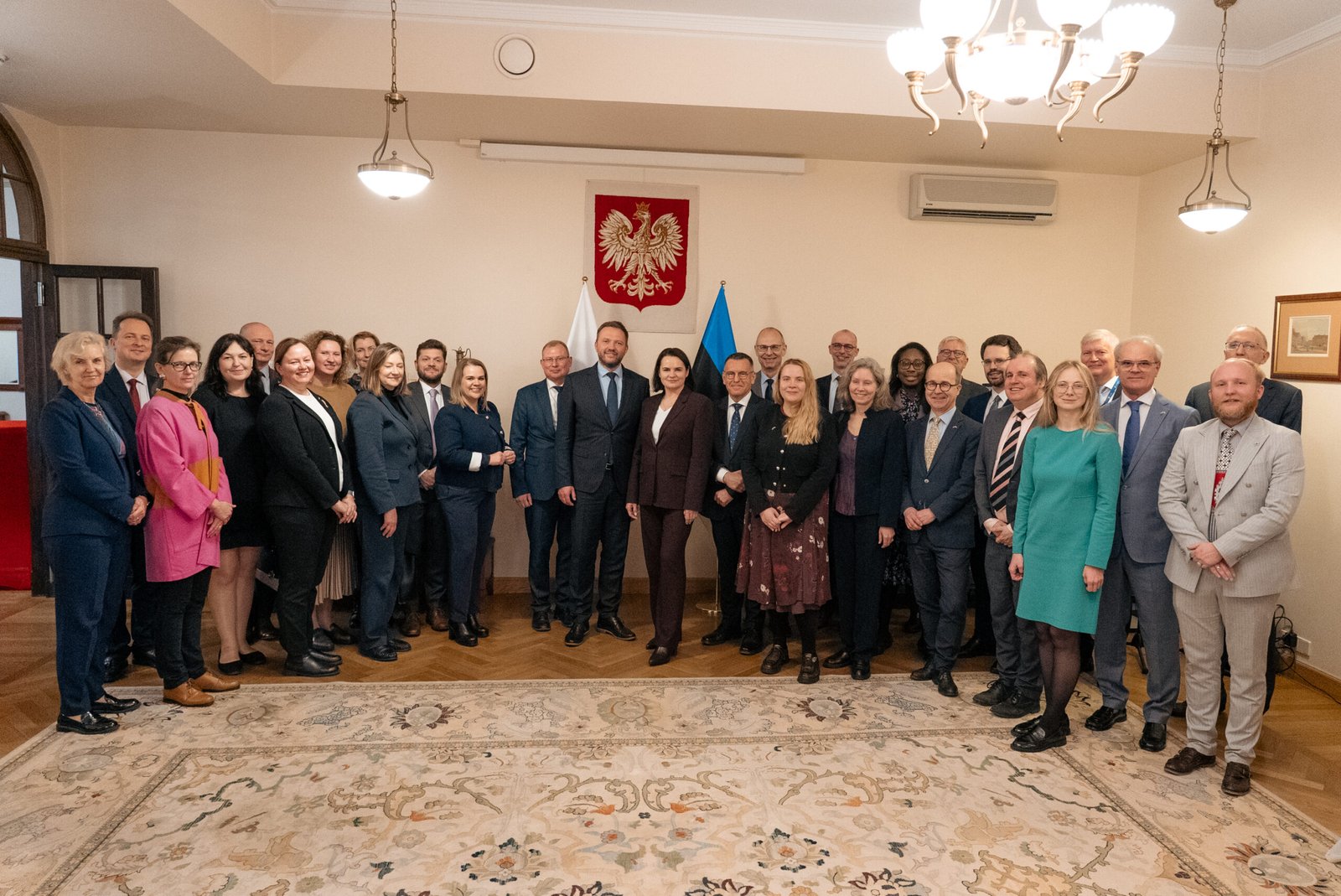


On October 29, Sviatlana Tsikhanouskaya met in Tallinn with special envoys for Belarus, representatives of foreign ministries, and officials from European Union institutions to discuss the release of political prisoners in Belarus, support for the repressed, Belarus’s independence, and international efforts to resolve the crisis in Belarus.
The meeting brought together representatives of the European External Action Service and the European Commission, as well as 17 countries: Estonia, the United States, Denmark, Finland, Latvia, Lithuania, France, Ireland, the United Kingdom, Germany, Sweden, Norway, the Czech Republic, Iceland, Canada, Ukraine, and Poland.
The meeting covered six main issues.
1. Release of political prisoners and further diplomatic efforts
One of the central topics was the release of Belarusian political prisoners and possible next steps to end repression in Belarus.
Sviatlana Tsikhanouskaya thanked the US administration, Special Envoy John Coale, and his team for their efforts, which helped secure the release of hundreds of people. She welcomed US diplomatic efforts and called for using international leverage to secure further releases.
Ms. Tsikhanouskaya also expressed her gratitude to the European Union and partner countries for continuing to put pressure on the Lukashenka regime and consistently raising the issues of political prisoners and human rights violations.
She emphasized that the release of prisoners must go hand in hand with an end to new arrests and political persecution. She noted that Belarus’s democratic forces support a broad political amnesty and the launch of an inclusive dialogue within Belarus as a way out of the political crisis.
2. Support for released political prisoners and repressed individuals
Participants discussed support for Belarusians who have been released from prison, including those who were forcibly deported from Belarus following their release.
They addressed the practical needs of the released: medical and psychological rehabilitation, documents, legal status in their countries of residence, accommodation, and assistance with reintegration after imprisonment.
Sviatlana Tsikhanouskaya thanked international partners for supporting the Viasna Human Rights Center, human rights organizations, and the International Humanitarian Fund. Fifteen countries have already joined the effort to support the IHF.
She also highlighted the assistance provided by Lithuania, Poland, and Germany in receiving released political prisoners and arranging the support they need after their release.
3. Support for independent media, young people, and Belarusian culture
The meeting also addressed international support for Belarusian independent media, human rights organizations, and educational and cultural initiatives. Ms. Tsikhanouskaya urged the partners to continue this support.
Participants discussed programs for young Belarusians, access to education, and support for the Belarusian language and culture.
Sviatlana Tsikhanouskaya noted that these initiatives are particularly important amid ongoing repression and Russification. They help Belarusians access independent information, preserve their national identity, maintain connections with one another, and develop the skills needed for future democratic change.
4. Russian military presence and Belarus’s economic dependence
The sides discussed threats to Belarus’s sovereignty stemming from Russia’s growing military presence and the Lukashenka regime’s increasing dependence on Moscow.
Ms. Tsikhanouskaya highlighted the use of Belarusian territory and infrastructure for Russia’s military purposes, as well as the threats this poses to neighboring countries and regional security as a whole.
They also addressed Belarus’s economic dependence on Russia, the involvement of Belarusian enterprises in fulfilling orders for Russia’s defense industry, and efforts to circumvent international sanctions.
Participants discussed the need to continue monitoring these developments and coordinate international action to safeguard Belarus’s independence.
5. A joint European, US, and Canadian strategy on Belarus
Another topic was further coordination of international policy vis-a-vis Belarus.
Participants discussed how to align the diplomatic efforts of the United States, the European Union, Canada, and other partners to help secure the release of political prisoners, end repression, and facilitate democratic change.
Sviatlana Tsikhanouskaya called for unity among international partners and a consistent policy toward the Lukashenka regime. She noted that humanitarian efforts to secure the release of prisoners must continue while international pressure over human rights violations is maintained.
6. Peace negotiations on Ukraine and Belarus’s future
A separate part of the discussion focused on possible negotiations to end Russia’s war against Ukraine and the implications for Belarus.
Sviatlana Tsikhanouskaya noted that Belarus’s future is directly linked to developments in Ukraine. A strong and independent Ukraine, she said, would create new opportunities for democratic change in Belarus and strengthen security across the region.
She stressed that Belarus must not become a bargaining chip in any potential agreements between Russia and the West. Any decisions concerning the future of regional security must respect Belarus’s sovereignty and address the need to end Russia’s military presence in Belarus.
Ms. Tsikhanouskaya also noted that international efforts should aim to free Belarus from its dependence on Russia and the Lukashenka regime, rather than preserve the country’s current system of government.
At the end of the meeting, Sviatlana Tsikhanouskaya called on international partners to remain united and continue their coordinated work on Belarus.
She emphasized that, despite differences in approaches and views, Belarus’s democratic forces share common goals: the release of all political prisoners, an end to repression, the restoration of justice, the protection of Belarus’s independence, and democratic change.