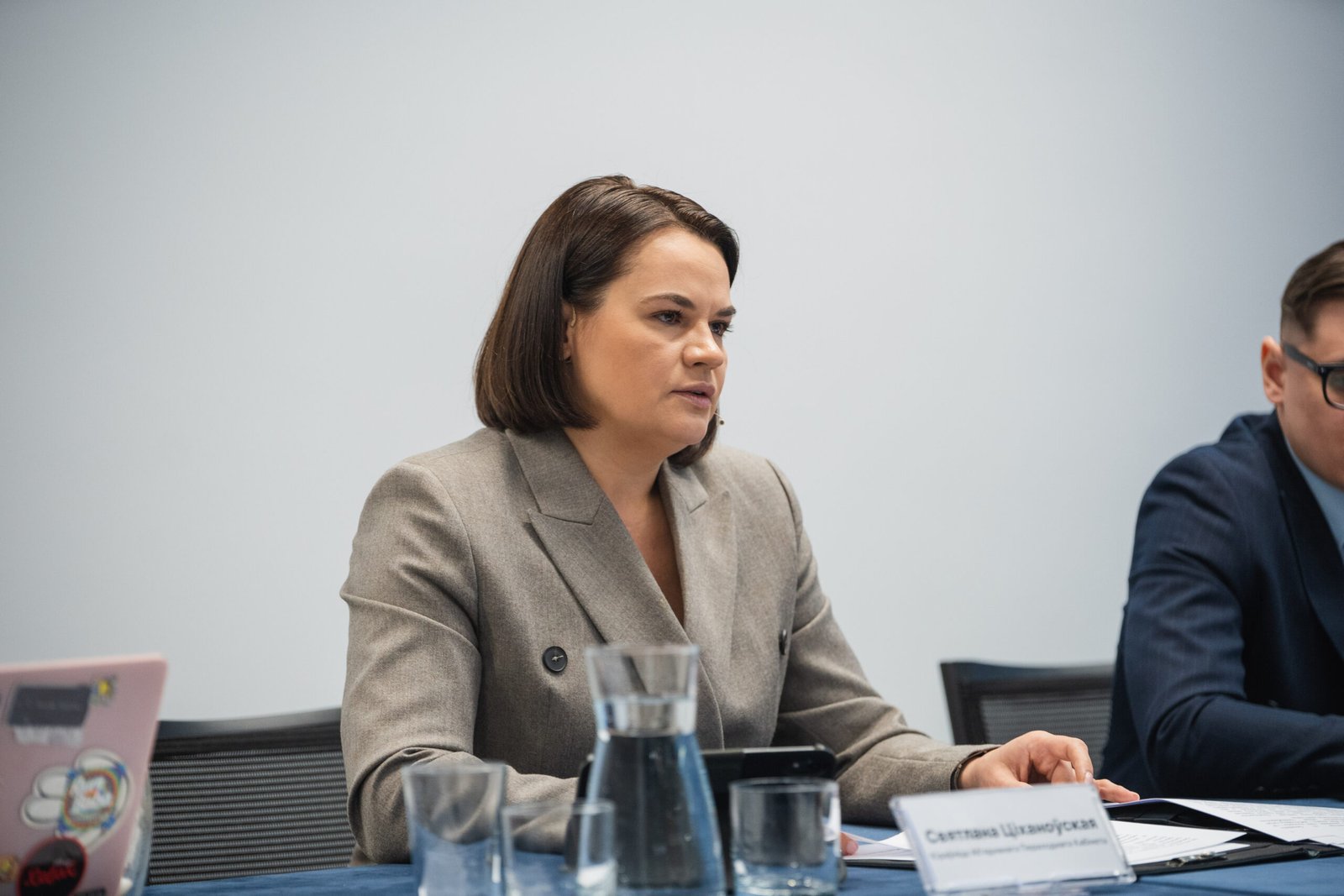




Dear Speaker Artsiom Brukhan,
dear delegates of the Coordination Council,
members of the United Transitional Cabinet,
dear Belarusians who are watching us online,
You know, in recent years I almost always start my speeches with words of gratitude. It may seem like a simple and ordinary thing, but it is precisely this – saying “thank you” to one another – that we so often lack.
We have all lost something: a home, a job, a career, our freedom. For some, loved ones remain in captivity. Every day brings new trials – pressure and threats from the security services, difficulties with legal documents in a foreign country, this constant, exhausting uncertainty…
But, despite all this, none of you has given up, surrendered, or given in. You continue to work, continue to believe, and do everything in your power – for more than five years now.
Believe me, a kind word, a small gesture of support, or a sincere “thank you” has incredible power. And I think that if we said “thank you” to each other more often, noticed the good more often, and avoided unnecessary toxicity, we would be moving together toward our goals much faster.
And today, I thank all the members of the Coordination Council for our collaboration over the past two years. Today’s hearing is proof that our institutions are working, interacting, and that agreements are being fulfilled. In fact, there is no need for any “vertical power structure” when there is a system built on the principles of democracy, mutual accountability, and transparency. And this system is the opposite of the “military-style” way of governing that the regime has imposed on the Belarusian people.
I thank you for your support, but also for the debates. We have to accept that the debates, discussions, and disagreements we have are normal. Their existence is a healthy sign in politics, and it would be much worse if there were complete silence and unanimity.
I thank all the factions, with the “Belarusians” faction in particular, who initiated this hearing. I very much hope not to disappoint Vadzim Prakopyeu, and I know he has a hundred questions for me. However, I’ll say right away, I can’t possibly have answers to all of them. Finding the answers is our JOINT task.
Of course, I thank the representatives of the United Transitional Cabinet and my dear Office – for the sleepless nights, working under deadlines, and very often – volunteering. I know that I can count on each and every one of us. And the fact that all the representatives successfully passed hearings at the Coordination Council in August shows that they are all in their right places.
The work that we do is thankless, but someone has to do it. And we are doing it. Today with us are Volha Zazulinskaya and Leanid Marozau, who just returned from Kyiv. They spent several nights under fire, in a bunker, in the cold, and worked on solving the problems of Belarusians in Ukraine by day.
Democratic forces today are doing what a normal state should do – solving the problems of its citizens, defending their rights, and upholding the country’s interests on the international stage.
The Lukashenka regime, however, does the exact opposite – it persecutes its own citizens and drives the country into isolation. The authorities are not concerned about the people, but about themselves, about their own survival. They are held together by fear and repression. People feel neither respect from the state nor any confidence in tomorrow.
In such a system, built on the whim of one man, officials are willing to carry out the most foolish orders. An example of this is the recent decree to turn off streetlights. To just do that and put people’s lives at risk, without any need, is another piece of madness from this regime.
Remember the phrase from back in the day: “When you leave, turn off the lights”. One wants to believe that turning off the lights is a subtle hint at the inevitable departure of the dictator, and with him, his entire inhuman system.
When that happens, many Belarusians will breathe a sigh of relief, and no one will definitely be sad to see him go. It’s no secret, either, that many officials call Lukashenka “Grandpa” behind his back and joke about his blue fingers. The resignation this week of Subotsin, the Chairman of the Vitsebsk Regional Executive Committee, is also telling – another symptom of the rot in Lukashenka’s vertical of power.
It is clear that a transfer of power is inevitable – with or without Lukashenka’s will – and we need to prepare for it. I’m not saying this will happen tomorrow – but when it does, our unity, our resilience, and the ability of democratic forces to mobilize will determine where and how the country moves forward.
In essence, Belarus has two alternatives: the status quo, a Belarus as a Russian satellite, or an independent country integrated into the European space. And today, it is the democratic forces that embody this alternative.
Undoubtedly, changes in Belarus will largely depend on the outcome of Russia’s war against Ukraine. There still is a possibility that a peace agreement will be signed. If this happens, attention will return to Belarus. And it is very likely that a new window of opportunity will open.
It will be very important for us to take advantage of this window of opportunity. We must not allow Russia to consolidate its control over Belarus – to avoid losing our sovereignty for good. And by preserving our sovereignty, we can restore democracy in Belarus and then put the country on a European path.
Many within the system share our views and are ready to negotiate with us. They understand that Lukashenka has lost agency, is completely dependent on Russia, and is leading the country into a dead end. And if this process is not stopped, we will lose the country.
That is why the Cabinet recently launched a campaign calling for a “Round Table”. This doesn’t mean it will happen today or tomorrow, but in this way we are laying the groundwork for a dialogue in the future.
Of course, a completely different scenario could also happen: if there is no de-escalation, a new wave of escalation could begin. We see that with the help of Lukashenka, Russia is ALREADY preparing for this, increasing its military buildup, and deploying Oreshnik and nuclear weapons on our territory.
Russia sees Belarus as a staging ground for another attack, for provocations against its neighbors. Of course, in this scenario, much will depend on our unity and our readiness to resist. But the best solution is to simply prevent such a scenario from happening.
In general, there can be many scenarios for how events unfold, and in each of them, Ukraine will play a major role. And that is why it is extremely important for us to support Ukraine today. Because the stronger Ukraine emerges from the war, the more chances for change there will be in Belarus.
In this context, the changes that have taken place in our relations are very important. This is not just our meeting with President Zelenskyy in Vilnius, which was truly a turning point. But also his previous speeches – in Munich, in Davos, at other forums – where he said that Belarus must become a democratic and European state.
It is critically important for Ukraine that we bring to a conclusion the work that we started together in 2020. For Belarus to become a predictable, peaceful, democratic, European state – not a province of the Kremlin. And Ukraine, it seems, is now ready to more actively support the Belarusian democratic movement.
We are waiting for the appointment of a Special Envoy. At the same time, we are preparing a visit to Kyiv. Yesterday, I was on calls with volunteers, veterans, and Ukrainian experts. I am planning meetings with Belarusians in Ukraine. This visit will be the beginning of long-term cooperation and another brick in the wall of change.
We will develop a joint strategy, and I hope we can resolve practical issues – compensation, legal stay, banking, and social guarantees. All of this will create the conditions for Belarusians to help Ukraine, and for Ukraine to help us.
And of course, new contacts with Ukraine will, I hope, open up opportunities for our communities and their initiatives. Like the Point of Invincibility, which was recently opened by the Sustrecha Center to help people who, due to Russian shelling, are left without heating and electricity in the cold.
The Belarusian issue today is impossible to separate from the context of the war. Undoubtedly, for us, the most important issues are the political prisoners, the repression, and the internal situation.
But the world looks at Belarus primarily through the prism of the war, and the threats that Lukashenka poses to Ukraine and the European Union.
It is the war that determines policy on Belarus, and because of the regime’s complicity in the war, ordinary Belarusians are also suffering.
The vast majority of European sanctions were imposed precisely because of the war and hybrid threats, and that is why the unhealthy debate dividing our community over whether to lift the sanctions now is not very productive.
The regime knows perfectly well what to do to have the sanctions lifted: first and foremost, to correct the reasons for which they were imposed. But it doesn’t do this; on the contrary, the situation is only getting worse: provocations at the border continue, the defense industry works for the Russian military machine, and weather balloons are launched towards Vilnius.
Belarus is being used as a financial loophole for Russia – and as its military foothold. And to lift the sanctions, you must first eliminate their root cause.
While European sanctions were mainly imposed over the war, the majority of American ones are over human rights. And we’ve developed a formula: American sanctions to free people, European sanctions to free the country.
We all agree that sanctions are a tool that must be used. But it must be used wisely – because the regime, as always, will try to deceive us.
And we see that sanctions work, no matter how much the regime tries to show otherwise. Thanks to sanctions, hundreds of people have already been released, including political leaders – Siarhei, Maryia, Viktar, Ales Bialiatski, Aliaksandr Yarashuk – and many others.
These releases were made possible by sanctions, as well as by the brilliant diplomacy of John Coale and the US administration. A year ago, few could have believed that this could happen – but there have already been several waves of releases, and the process continues.
These releases were made possible thanks to our work – because all these years we have been working to put the Belarus case on the international agenda and to interest the US administration as well.
We see that this process is far from perfect. Releases are happening, but people are being deported. Some people are released, but others are arrested. And now our task is not only to get people out of prison, but to stop the repression. For these releases to pave the way for long-term systemic change in the country.
One solution could be a general political amnesty – not just releases, but the complete closure of criminal cases and an end to the persecution – which would open the way for people to return home. We see what happened this week in Venezuela – which means it is possible in Belarus as well.
Together with international partners, we have developed a strategy, a roadmap, that can not only free people but also lead to systemic change. The US and the European Union have different tasks here.
The US has enough tools and its own power to free people and stop the repression. Especially since Lukashenka needs these contacts much more than the Americans need Lukashenka.
Europe has stronger cards when it comes to sanctions. And there is no need to pressure Europe to play them now. They will be needed at the next stage. Europe also doesn’t need to imitate President Trump’s tactics, especially when it comes to contacts with Lukashenka, because the effect could be the opposite.
And I also ask that we not create an artificial dichotomy, an artificial division in our community – that there is a strategy for sanctions and a strategy for negotiations. We are essentially talking about the same thing in different languages. Negotiations will not be effective without sanctions, and sanctions will not work without negotiations.
And if anyone thinks that Lukashenka, if we lift the sanctions, will suddenly become humane and release everyone, or start reforms, then believe me, that’s a big illusion that will freeze the situation. Any step must be accompanied by strict conditions.
Our common goal is, of course, to start a dialogue. But it must be a dialogue not between Lukashenka and the West. This must be a dialogue with the Belarusian people. As they say, “nothing about us without us”. Only such a dialogue will bear fruit. And we are always ready for such a dialogue.
Dear friends,
As I’ve already said, the releases will continue, and we are prepared for them. The recent waves of releases have shown how quickly we are able to organize – the Cabinet, human rights defenders, and civil society.
To receive all the released prisoners and provide them with all necessary initial assistance, we managed to organize an infrastructure involving about 30 organizations. The last group of political prisoners received unprecedented assistance in both Vilnius and Warsaw – financial support, housing for several months, and people underwent free medical rehabilitation and dental treatment. As one of the freed individuals noted: “The organizations helped with legal stay and housing after deportation; without that, I wouldn’t have been able to adapt.”
Of course, this was the result of a great deal of preparatory work. This wouldn’t have been possible without our wonderful initiatives, funds, and human rights defenders. This wouldn’t have been possible without the help of the European Commission, which we were able to mobilize in advance. It wouldn’t have been possible without the International Humanitarian Fund, which we created with partner governments. This is all also the result of the Cabinet’s work, which we can be proud of.
Of course, there will always be a need for more aid, but the most important thing is to have a system, and we have built it. And I am confident that the next groups of released individuals will not be left to face their problems alone.
Ukraine, the US humanitarian track, the system of assistance for political prisoners – these are just a few examples of the work of our institutions. But there are many other areas for which we are responsible and that we work on every day.
In recent years, we have managed to help thousands of Belarusians; we have pulled people out of critical situations, saved them from Interpol, overturned visa bans, and arranged for their legal stay in third countries.
Institutions – the Cabinet, the Office, the Coordination Council – are what sets our movement apart from others, and many nations that have found themselves in a situation similar to ours truly envy us.
We have a system, legitimacy, tools for internal democracy, and successes in solving practical issues. Most importantly, Belarusian society has agency, which allows us to say that the Belarusian people are not the same as the regime.
If it weren’t for us and our work, if it weren’t for the Kalinouski Regiment, if it weren’t for the media, human rights defenders, and all the incredible work of the diaspora – then this stigma of being a co-aggressor would have spread to the entire nation.
And if you ask what the main result of our work is, I would call it this: Belarusians are distinguished from the regime, and Belarus from Russia.
Of course, our institutions have no power, except for symbolic. We don’t control finances, we have no system of control or coercion. But we have influence on the international stage, perhaps less so within the country.
We have created something absolutely unique, when other countries work with the democratic movement in exile as if it were a government. They hold strategic dialogues, establish advisory and contact groups, appoint special envoys, or allow us to open our missions on their territory – I hope that we will soon open another one in Spain.
This means they trust us and accept us as equal partners.
Our structures are dynamic. New people are joining. One of the latest additions is the well-known sociologist Hennadz Korshunau, who will be my analytical consultant. Dzmitry Kuchuk recently joined us, and we are preparing a series of events for the 40th anniversary of the Chornobyl disaster. I am awaiting the Coordination Council’s decision to appoint Mikalai Kazlou as a representative in the Cabinet, who will work on issues concerning the security forces. Both Kuchuk and Kazlou were political prisoners until recently.
The release of political prisoners has given new energy. We have already established cooperation and communication with Ales Bialiatski, Pavel Seviarynets, and trade union leader Aleksandr Yarashuk. This week, I had a conversation with Viktar Babaryka – and I think we can develop a joint strategy, rather than splitting into small political centers. As I said: we have one strategic goal. Tactics can be different – and I think that’s okay.
Of course, I would like to see greater participation from both the traditional political parties banned in Belarus and from the broader community, and the best way to achieve this is for them to be represented on the Coordination Council.
I’ve already said that over the past year, we have significantly reorganized the work of the Cabinet and the Office. Today, the Cabinet is a cohesive, strong team. We work collegially, meet weekly, each person is responsible for their own area, and all decisions are made collectively.
We operate based on a common strategy. This includes the Coordination Council’s documents, the resolutions of the New Belarus Conferences, and the Platform 2025, which was signed by all key structures of the democratic movement.
We join initiatives from the diaspora, human rights defenders, experts, and cultural figures, and in turn, invite them to collaborate. We work together with the People’s Embassies, Cyber Partizans, BELPOL, the National Anti-Crisis Management (NAU), the Council for Culture, and many other partners.
I physically cannot list everything that has been done in recent years, so I will focus on the key results in the main areas.
First, legal accountability. Thanks to the titanic work of Pavel Latushka and the NAU team, the Office’s Legal Team, BELPOL, and human rights defenders, cases have been initiated at the International Criminal Court:
- on the mass deportation of Belarusian citizens (the referral was submitted by Lithuania – we are very grateful for this);
- for the illegal deportation of Ukrainian children to Belarus from occupied territories.
The issue of accountability for the Lukashenka regime is enshrined in the resolutions of the PACE and the European Parliament, and is regularly raised at the UN. The PACE resolution on the creation of an International Tribunal for the aggression against Ukraine also mentions the crimes of the regime in Belarus. Judges, prosecutors, and military enterprises have been sanctioned – this is a practical result of our work.
Second is mobility and legal documents. With our support, hundreds of Belarusians have received international protection and assistance with legal stay. In more than half of EU countries, we have managed to secure procedural easing: issuing alien passports, recognizing expired documents, and extending humanitarian residence permits. The latest examples are Spain, Denmark, and Norway. Or Lithuania, where residence permits are now issued for up to three years. We were able to avoid visa bans, although the visa problem remains very acute.
We pulled people out of critical situations, evacuated them even without passports. We helped those who fell victim to transnational repression. One example is the case of Andrei Hniot: through joint efforts, we managed to prevent his extradition to Belarus. We also established systematic cooperation with Interpol to stop abuses by the regime.
Third, social support. Here, we focused on the practical needs of Belarusians. Together with partners and human rights defenders, we have built a support system for the repressed and released political prisoners, the International Humanitarian Fund is operating, and working groups for the issues of Belarusians have been established in various countries, including Poland.
Fourth, the economy. Recently, Alisa Ryzhychenka presented the Belarus Economic Development Strategy through 2035 with concrete reforms. A group of experts has been created that is working on a package of economic changes.
Fifth, education and youth. A free online school has been launched, and our proposals have been enshrined in European documents. The EU has approved support packages: scholarships, educational programs, and online learning. This is the result of systematic advocacy.
Sixth, national identity and culture. We have implemented a series of media campaigns, joint projects with key cultural institutions, and opened doors for Belarusian organizations and creators. For us, culture is not secondary; it is an element of resilience and security.
Seventh, defense and security. We advocated for veterans and volunteer fighters and ran campaigns aimed at law enforcement. Last year, we prepared a comprehensive security document, the Red Paper, which was presented at international forums.
Eighth, foreign policy. Over the past year, I have held more than 200 bilateral meetings with foreign politicians, participated in the UN General Assembly, Munich, Davos, the Warsaw Security Forum, and summits of the European Political Community. We created the cross-party platform 8+100, the Alliance of Parliamentary Groups “For a Democratic Belarus”, the International Humanitarian Fund, and strategic dialogues with a number of countries and international organizations. We managed to preserve two mandates on Belarus at the UN and mobilize European support for Belarusian media, NGOs, and human rights defenders. We opened missions in Tallinn, Brussels, Kyiv, Prague, a center in Italy, and soon one in Madrid.
The war has, of course, made our work much more difficult. Advocating for Belarusian interests today is not easy. But the Belarusian issue remains on the international agenda – and that is, first and foremost, the result of our systematic work.
We sometimes get accused of being on some kind of financial pipeline. I want to stress once again – neither the Office nor the Cabinet distributes any funds. Foreign aid for Belarus is distributed directly by donors, through competitions and with strict accountability. My task is to mobilize this aid so that Belarusian media, human rights defenders, and initiatives can do their work.
In our situation, we need to be bold, and the biometric National Passport is one of those bold projects. Last year alone, almost half a thousand of our passports were issued, primarily to Belarusians whose documents were expiring. Yes, the passport has not yet received formal recognition and has a symbolic status, although we have confirmed cases where it has helped people in the process of legalizing their stay abroad. This year, we will continue our work on recognition and are preparing the necessary documentation for this purpose. We are working to make the passport an additional document for use by Belarusians in critical situations. We believe that the more passports are issued, the greater the chance of recognition. But even without recognition, this document already plays an important role: it draws attention to the problems of Belarusians, and thanks to this, some countries have begun issuing foreign passports to them.
Now, a few words about our plans for the near future.
We plan to open the Office in Warsaw, and, as you already know, I will continue my work based in Warsaw. At the same time, the Office in Vilnius will continue to operate and maintain its diplomatic accreditation.
In the last few days here in Warsaw, I have already met with a number of Belarusian organizations and initiatives. We discussed joint projects and events, and we already have a plan for the next six months. This year, I will strive to dedicate more time directly to Belarusians and Belarusian initiatives.
I expect that my presence in Warsaw will also be beneficial for closer contacts with the Polish authorities and for the Belarusian diaspora. Let me emphasize that this expansion will not harm our work, our plans, or our relations with partners – on the contrary, it will strengthen them.
As for our international work, we are working on visits to Kyiv, meetings with the European Union Advisory Group, the Council of Europe Contact Group, and we are also preparing Strategic Consultations with the United Kingdom in March. In parallel, the next session of the Strategic Dialogue with the United States is being prepared.
In May, another Conference of the Belarusian Diaspora is planned, as well as a Congress on Political Prisoners. Together with Libereco (Germany) and MPs from various countries, we are preparing a forum for the godparents of political prisoners, as well as a meeting of the Inter-Parliamentary Alliance in London. With Sweden, we are planning a separate conference dedicated to youth.
And, of course, we continue our work to secure the release of prisoners. We remain in constant communication with the US administration and are preparing to receive new groups of released prisoners. But our main goal is for every person to have a choice: to leave or to stay, and for the repression to be stopped.
Undoubtedly, one of the key events of this year will be the Coordination Council election. I don’t expect a high turnout given the repression, but this election will, I am sure, allow us to gauge the mood in the democratic community and ensure broad representation of various groups and initiatives.
The Coordination Council is recognized by international organizations and foreign governments, is represented in parliamentary assemblies, and it is in our shared interest to strengthen its agency and role.
I fully understand that neither the Council nor the Cabinet will solve all of the problems of the Belarusian people. But this is truly a unique political platform that gives us, the Belarusian people, representation and a voice when the state does not represent society.
I hope that before the election, the Coordination Council will be able to consider the candidacy of Mikalai Kazlou, as well as a number of bills for a New Belarus.
We are open to closer cooperation and communication. And, of course, I will be looking forward to your proposals and initiatives.
In closing, allow me to thank you once again for your dedication to our common cause.
I will be happy to answer your questions. Long Live Belarus!