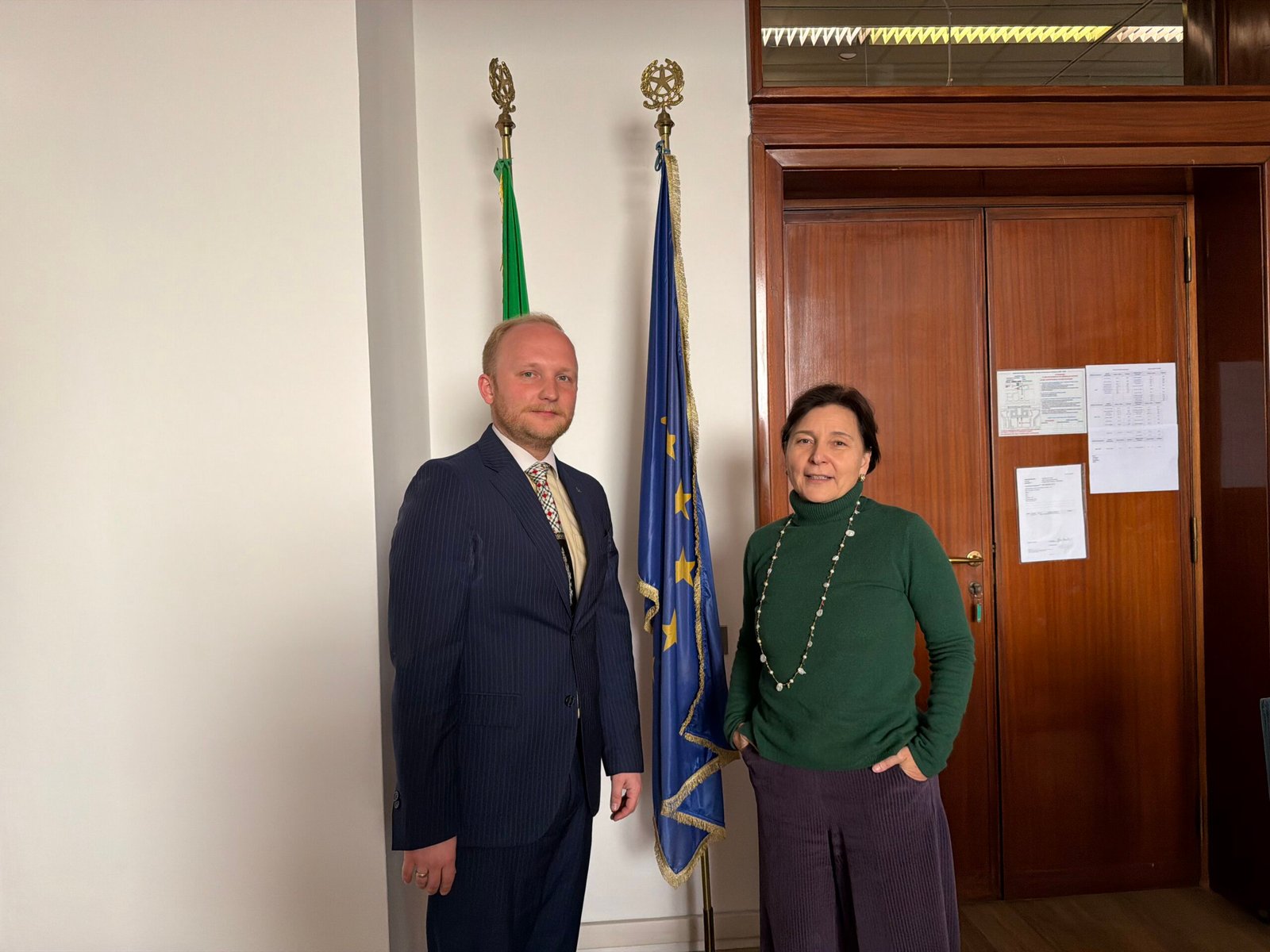




On April 2–3, Sviatlana Tsikhanouskaya’s Diplomatic Advisor, Dzianis Kuchynski, paid a visit to Italy aimed at finalizing the agreements reached during the leader’s previous visit, as well as ensuring their practical implementation and coordinating next steps. A plan for parliamentary work and for the activities of the Belarusian Democratic Community Center in Florence was also outlined. Sviatlana Tsikhanouskaya’s Advisor on Parliamentary Cooperation, Anatoli Liabedzka, and Head of the Belarusian Democratic Community Center in Florence, Yuliya Yukhno, also joined the meeting.
As part of the visit, meetings were held at the Italian Ministry of Foreign Affairs and at the Office of Prime Minister Giorgia Meloni. Talks included discussions with PM Meloni’s Deputy Diplomatic Advisor, Pietro Sferra Carini, and Deputy Secretary-General and Director-General for Political Affairs and International Security at the Ministry of Foreign Affairs, Cecilia Piccioni.
The parties discussed:
- implementation of agreements following previous visits;
- the situation of political prisoners in Belarus;
- further contributions to and activities of the International Humanitarian Fund;
- coordination between the US and EU approaches to Belarus;
- Italy’s role in the G7 in the context of Belarus;
- Schengen visa issuance for Belarusian citizens in Minsk;
- cooperation with Italian embassies in Vilnius and Warsaw.
The participants also discussed the results of the recent visit to Washington and synchronized positions with Italian partners, dividing efforts into two tracks: the American track — humanitarian, focused on freeing individuals; and the European track — political, focused on freeing the country. There is understanding and consensus around this approach. No external pressure should be exerted on European countries in this matter.
Information was also shared separately regarding released political prisoners, the condition of those deported from the country, and the situation of those who remain in Belarus.
The parliamentary dimension of the visit, coordinated by Advisor Anatoli Liabedzka, included meetings with:
- Giulio Terzi, Chair of the Senate Committee on EU Affairs. An agreement was reached to hold an event in the Italian Senate during the “Chornobyl week”, involving parliamentarians and representatives of the Belarusian democratic community;
- Deborah Bergamini, Vice-Chairman of Forza Italia. Discussions focused on support for Belarusian initiatives, joint projects in Florence, and cooperation with the party’s youth wing;
- Filippo Sensi, Chair of the “For a Democratic Belarus” Group. Discussions covered support for establishing a similar group in the OSCE Parliamentary Assembly, participation in the campaign marking the Day of Solidarity with Political Prisoners in Belarus on May 21 and the 40th anniversary of the Chornobyl disaster, internships for Belarusian youth, and an invitation to the Alliance congress in London.
The discussions also addressed the activities of the Belarusian community in Florence. Meetings involved Yuliya Yukhno of the Belarusian Democratic Community Center and covered support for its activities, development of the shelter, joint cultural and civic projects, and cooperation with local authorities and MPs.
Additionally, a meeting was held with the leadership of the Istituto Affari Internazionali (IAI), where joint projects between Italian and Belarusian expert communities were discussed.
Dzianis Kuchynski: “The most difficult part after high-level visits is to bring agreements to completion. That is why this visit took place immediately after top-level meetings — to formalize and finalize all decisions reached.
The visit to Italy was an important step in coordinating international efforts in support of a democratic Belarus and confirmed the readiness of Italian partners for further cooperation.
The next stage of work for the International Department will be a series of consultations with other European partners to synchronize positions following the recent visit to the United States. The key task is to ensure a balance between the US humanitarian track and the European political track”.