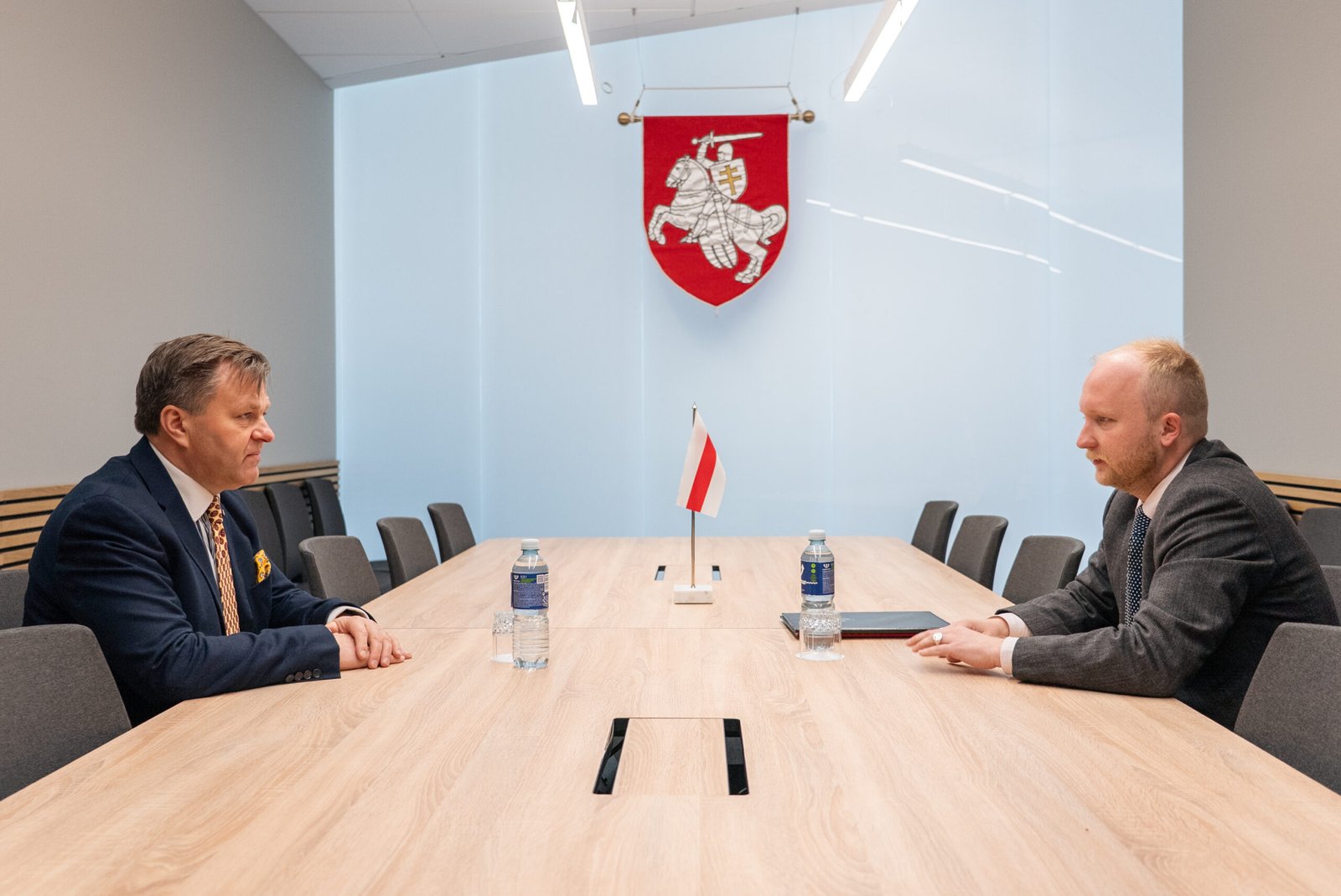




On April 27, the Director of Sviatlana Tsikhanouskaya’s Office in Lithuania, Dzianis Kuchynski, held a meeting in Vilnius with the Chair of the Governing Board of the European Humanities University (EHU), Mantas Adomėnas, who is also the Secretary General of the Community of Democracies.
The meeting took place against the backdrop of a situation requiring urgent and precise steps following the Lukashenka regime’s designation of EHU as an “extremist organization”. Prior to the meeting, a series of consultations had been held with the Lithuanian Ministry of Foreign Affairs, as well as with Belarusian civil society and the academic community.
The discussion primarily focused on security concerns. Early signals already indicate pressure and risks for those connected to the university: students, their families, lecturers, staff, and graduates. This may involve thousands of people.
The parties discussed a strategic direction — the preservation of EHU’s mission as a university in exile for Belarusians. The conversation addressed greater involvement of Belarusian researchers and lecturers, strengthening Belarusian-language and Belarus-related academic content, and making use of the potential of the Belarusian academic diaspora.
Support for students was also raised, including possible additional scholarships, tuition assistance, and real pathways to continue education in safe conditions. Sviatlana Tsikhanouskaya’s Office confirmed its readiness to act as a partner in finding solutions together with the Lithuanian side and international partners.
Dzianis Kuchynski: “I called for comprehensive and urgent decisions, first and foremost, to ensure the safety of students, their families, lecturers, and staff”.
The meeting discussed next steps to deepen cooperation following the signing of the Memorandum of Understanding between the United Transitional Cabinet and the Community of Democracies. The parties focused in particular on the safety of Belarusians living abroad.
Mr. Adomėnas and Mr. Kuchynski agreed to continue campaigns against transnational repression and discrimination, including cases of extradition and deportation. They also discussed practical ways to support Belarusians, including simplifying legal stay procedures, improving access to documents, and easing other administrative processes that remain difficult for many Belarusians abroad.