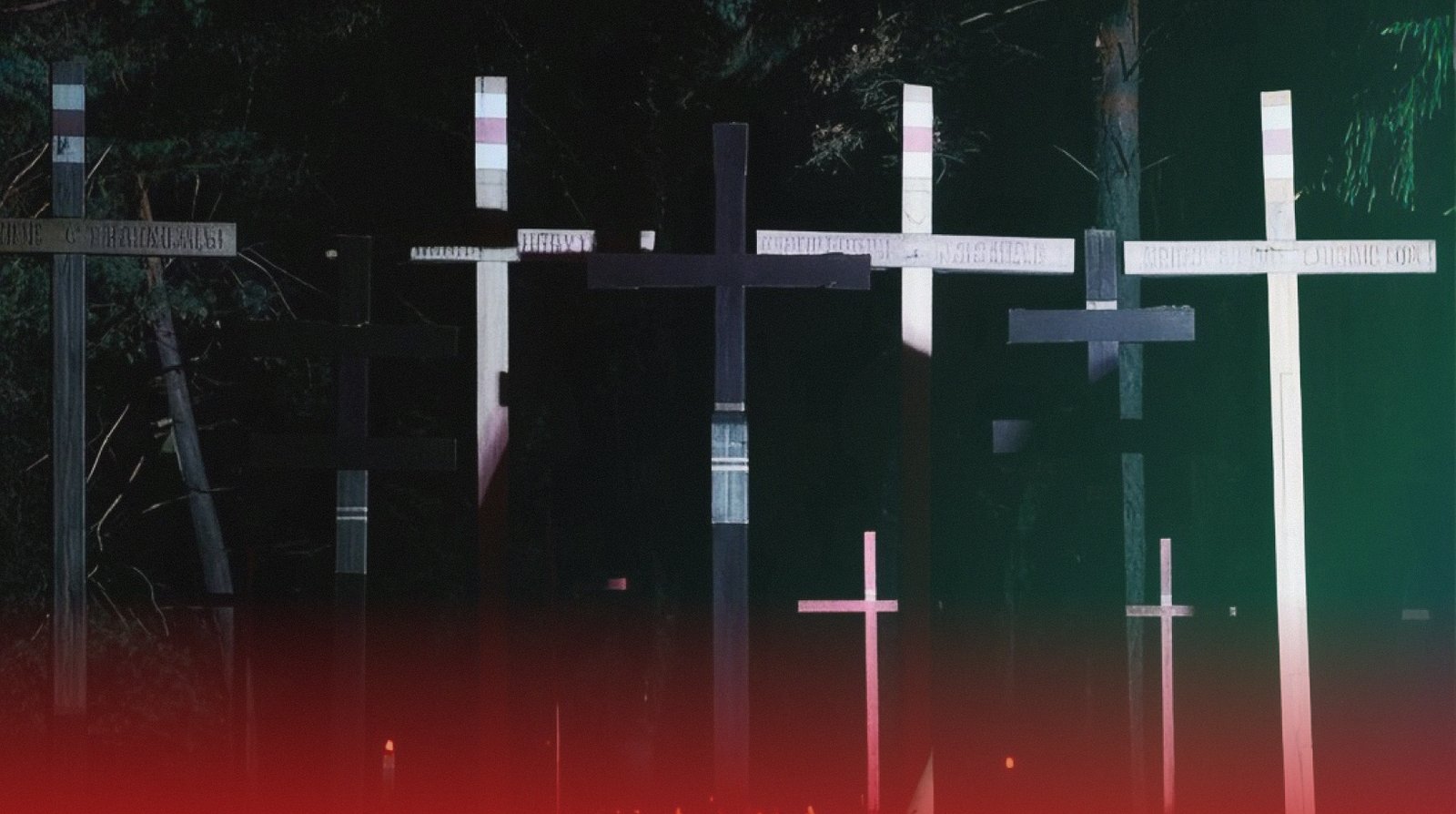


On October 29, Belarusians commemorate the victims of political repression on the day known as the Night of the Executed Poets. Sviatlana Tsikhanouskaya’s Advisor on Education and Science, Pavel Tereshkovich, speaks about the impact of Soviet-era repression on Belarusian history, the people responsible for carrying it out, and the parallels with repression in Belarus today:
“On this night in 1937, 132 members of Belarusian society’s elite were killed. They included at least 20 writers, which is where the name ‘Night of the Executed Poets’ comes from. We remember their names, read their works, and light memorial torches and candles. We do all this so that such a horrific night never happens again.
But for this to truly remain in history forever, we must also remember those who carried out this massacre. Boris Berman was appointed People’s Commissar for Internal Affairs of the Byelorussian SSR in March 1937. Before that, he had worked in intelligence in Central Asia. Before arriving in Belarus, he had been involved in fabricating the case against the so-called ‘Trotskyist-Zinovievist bloc’. According to Aleksei Nasedkin, who succeeded him as People’s Commissar for Internal Affairs, 80,000 people were killed in Minsk on Berman’s orders in less than a year.
‘He killed all the best Communists in the republic. He decapitated the Soviet apparatus. He exterminated the flower of the Belarusian national intelligentsia. He diligently sought out, found, dragged away, and destroyed everyone among the working people who stood out even slightly for their intelligence or dedication: Stakhanovite workers in factories, collective farm chairmen, the best team leaders, writers, scholars, and artists. The national cadres of Soviet workers raised by the Party. Eighty thousand innocent victims… A mountain of blood-soaked corpses reaching to the heavens…’
In May 1938, Berman was recalled to Moscow. In August, he was arrested, accused of spying for Germany, and executed. His case, as a victim of repression, was reviewed twice by judicial panels of the USSR and the Russian Federation. The verdict was unequivocal: he was not eligible for rehabilitation.
Today’s successors to Berman in Belarus do not shoot people in the back of the head with revolvers. But the essence of their work looks similar: seeking out, finding, dragging away, and ruining the lives of people distinguished by their intelligence and conscience.
Today’s universities have vice-rectors for security who play the role once held by the ‘troikas’ that signed execution lists without trial or investigation. They compile lists of people deemed disloyal and marked for dismissal. They are responsible for the sharp decline in the proportion of university faculty with advanced academic degrees, which has contributed to the overall degradation of higher education.
Just as in the 1930s, they and their colleagues are particularly hostile to the existence of the Belarusian language, culture, and literature. While books are no longer burned as they once were, lists of banned publications exist, publishing houses are being shut down, and literary newspapers and magazines are disappearing.
And they are also making painstaking efforts to erase from historical memory everything connected with the horrific repression their predecessors carried out in the 1930s against Belarusians, as well as Poles, Jews, Lithuanians, and Latvians. They will not succeed. Read above about the verdict against those who carried out these crimes”.