



Cracking the CRINK:
Belarus’s Relations with Russia, China, Iran, and North Korea
Victoria Leukavets, PhD
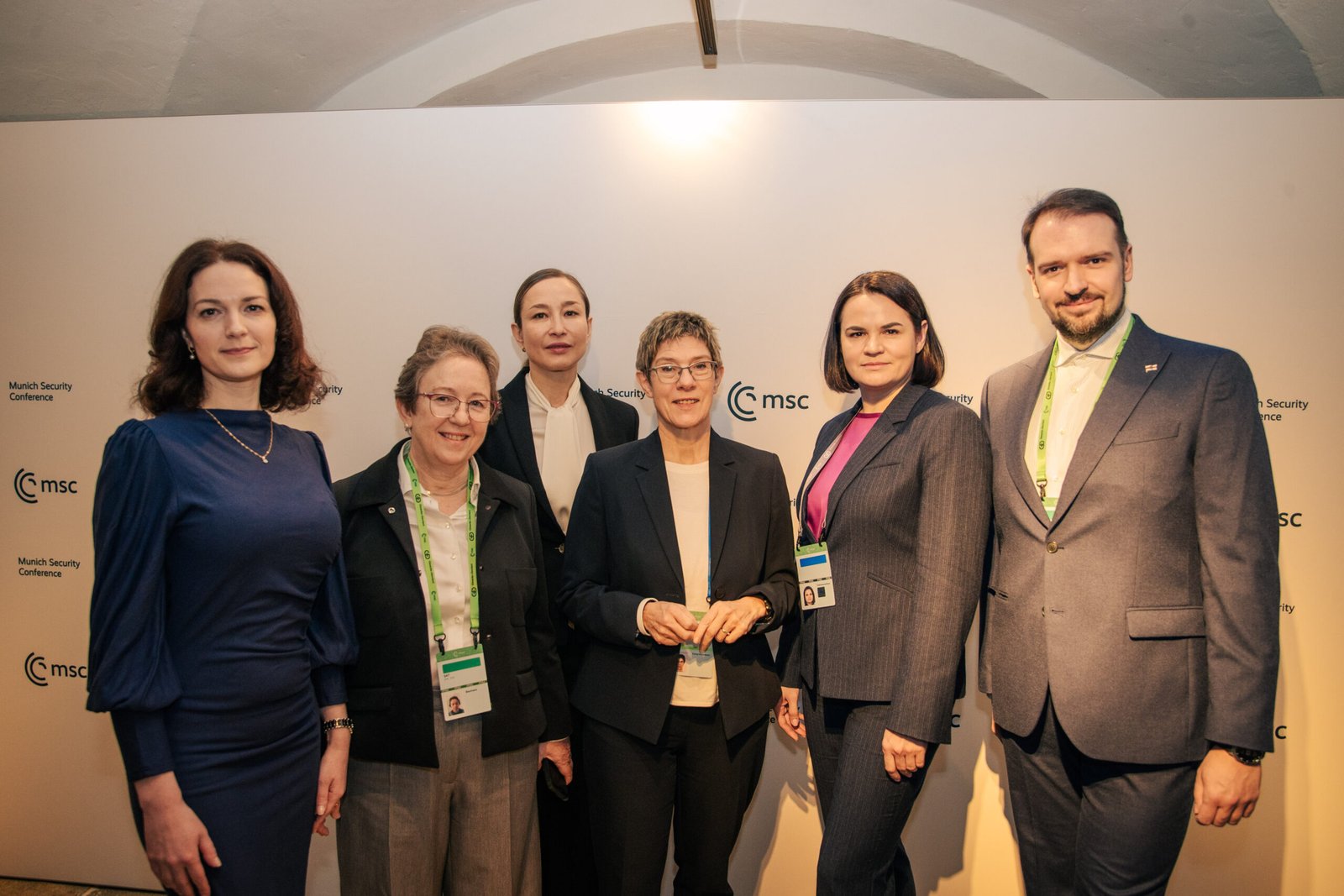
This policy brief builds on the discussion held during the Munich Security Conference side event “Belarus in the CRINK Axis and Beyond: Evaluating Authoritarian Alliances and Strategies for Western Response” and analyzes Belarus’s relations with the CRINK states — China, Russia, Iran, and North Korea. CRINK has been described by Andrea Kendall-Taylor and Richard Fontaine in Foreign Affairs as a new “Axis of Upheaval”: not a formal alliance, but an increasingly coordinated grouping of authoritarian powers whose cooperation erodes Western leverage and complicates the enforcement of sanctions and the effectiveness of deterrence.
In recent years, and particularly since Russia’s full-scale invasion of Ukraine, Belarus has intensified its engagement with each of these states. While Belarus’s relationship with Russia has been widely analysed, for example, in a detailed study by the Institute for the Study of War, its growing ties with China, Iran, and North Korea have received comparatively less analytical attention. Yet these relationships are politically significant and functionally asymmetric. China and Iran matter most in practical terms — China primarily in the economic, technological, and increasingly security-related domains; Iran above all in the military sphere. North Korea plays a more modest but gradually evolving role, particularly as Minsk tests limited trade cooperation under sanctions conditions.
None of these partnerships replaces Belarus’s deep structural dependence on Russia. However, they embed Minsk more firmly within a broader authoritarian ecosystem and provide limited, but potentially expanding, strategic maneuver space vis-à-vis the West.
The purpose of this brief is to provide a focused snapshot of Belarus’s relations with CRINK states beyond Russia, concentrating on two core areas: economic cooperation and security-military cooperation.
Belarus-China relations
- Nature of the relationship
Belarus’s relations with China have been officially framed as an “all-weather comprehensive strategic partnership” since 2022. The terminology is deliberate, intended to signal durability regardless of sanctions, political isolation, or geopolitical turbulence. For Aliaksandr Lukashenka, this rhetoric performs an important political functions: it projects resilience and counters narratives of international isolation.
This narrative was reinforced during Lukashenka’s visit to the People’s Republic of China on 2–4 June 2025, during which he met with Xi Jinping and senior Chinese officials and business representatives. The visit was described by Chinese media as “family-style diplomacy,” a formulation that suggests personal trust and privileged political access rather than purely transactional engagement. Such symbolism matters for Minsk. It allows Lukashenka to present Belarus domestically and internationally as a valued partner within China’s broader geopolitical architecture.
His participation in the summit of the Shanghai Cooperation Organisation and in China’s commemorations marking the end of the Second World War in September 2025 further reinforced this political messaging through visible, high-level interaction with Xi Jinping and other senior Chinese officials. The optics were carefully staged: Belarus positioned alongside key non-Western powers, integrated into alternative multilateral formats.
Yet symbolism should not be mistaken for strategic equivalence. The central analytical question is not whether the relationship is politically demonstrative, but how deep it runs in structural terms. The durability implied by “all-weather” rhetoric must therefore be assessed against the concrete patterns of economic interdependence, technological reliance, and military-industrial cooperation that define the partnership in practice.
- Economic dimension of Belarus-China cooperation
Economic cooperation constitutes the structural core of Belarus–China relations. China has emerged as Belarus’s second-largest trading partner, reflecting steady expansion in bilateral trade over the past decade, particularly since 2022. The trade in services and investment agreement signed in August 2024 and ratified in 2025 formalizes this trajectory. It is designed not merely to increase trade volumes but to institutionalize deeper market access, facilitate regulatory alignment, and expand cooperation in sectors such as logistics, finance, digital services, and industrial production. The agreement is expected to boost Belarus´s service exports to China by 12-15 percent and increase Chinese investments in the country by at least 30 percent. In practical terms, the agreement consolidates China’s role as a critical external economic anchor for Belarus under sanctions pressure.
Official figures highlight already expanding trade volumes; yet the structure of that trade reveals a clear asymmetry. Chinese exports to Belarus have grown substantially in recent years, especially after Russia’s full-scale invasion of Ukraine and particularly for such trade categories as vehicles, heavy machinery, electronics, telecommunications equipment, optics, and industrial components, also including categories of dual-use goods that are relevant for Russia´s military-industrial production.
By contrast, Belarusian exports to China remain concentrated in fertilizers, agricultural products, vegetable oils, and timber. Growth in these sectors has been modest and commodity-driven, reinforcing Belarus’s position at the lower end of value chains.
The result is a structurally imbalanced trade relationship in which Minsk relies on Chinese industrial and technological inputs while offering limited high-value exports in return.
Investment patterns follow a similar logic. Since 2008, Belarus has launched more than two dozen projects supported by Chinese financing, with a combined value exceeding five billion US dollars. However, much of this support has taken the form of tied loans that require Belarus to source a significant share of equipment, materials, and services from Chinese suppliers. By contrast, genuine Chinese direct investment has remained relatively modest. The overall effect is that Chinese financing integrates Belarus more tightly into Chinese-controlled production and supply networks, reinforcing dependence rather than building independent technological capacity.
Technological cooperation has expanded in parallel. Agreements covering microelectronics, optics, artificial intelligence, digital infrastructure, and space-related technologies suggest Beijing’s growing footprint in strategically sensitive sectors. The China–Belarus Industrial Park “Great Stone” has served as a flagship project in this regard, symbolizing integration into Chinese-led industrial and logistical networks. Yet here too, the pattern is one of asymmetric interdependence: Belarus gains access to components and platforms, but the core technologies and upstream control remain in Chinese hands.
Beyond technological and industrial cooperation, China has also expanded its educational and cultural presence in Belarus, strengthening its soft-power footprint in the country. According to iSANS analysis on Chinese influence in Belarus carried out in January-March 2025, at present, seven Confucius Institutes and two Confucius Classrooms operate in Belarusian universities and schools, promoting Chinese language training and academic exchange.
Educational cooperation has also begun to move into more specialized areas linked to economic cooperation. In 2024, Belarusian State University launched a degree program in International Economics and Trade in partnership with the Confucius Institute, with Chinese as the language of instruction. The program aims to train specialists capable of operating in both the Belarusian and Chinese economic environments, thereby supporting the expansion of bilateral trade and investment.
- The security dimension of Belarus–China cooperation
Alongside expanding economic ties, China–Belarus cooperation in the security sphere has developed steadily over time and carries growing strategic implications. In 2024, Belarus became the first European state to join the Shanghai Cooperation Organisation, institutionalizing its participation in a Eurasian security framework in which China plays a central role. Shortly thereafter, Belarus and China conducted joint “counter-terrorism” exercises near Brest, close to NATO’s eastern flank. While officially framed as routine drills, the timing and location conveyed a political signal: China is prepared to demonstrate military engagement on European territory alongside a Russian ally.
More consequential than exercises is the evolution of military-industrial cooperation. Under Western sanctions, Belarus’s defense sector has relied increasingly on Chinese components, particularly in optics and microelectronics. Belarusian firms assemble systems that incorporate Chinese-made optical and mechanical parts, which are then supplied to Russian defense manufacturers. This arrangement allows Russian procurement networks to access critical components indirectly, mitigating the impact of export controls. Belarusian enterprises specializing in semiconductors and precision equipment depend on Chinese materials and inputs to sustain production levels.
A notable example of earlier cooperation is the development of the Polonez multiple-launch rocket system, which was built with significant Chinese technical assistance. The system illustrates the hybrid character of Belarus’s defense-industrial base: Russian operational integration combined with Chinese technological inputs.
More broadly, Belarus and China have implemented joint military projects in several areas, including the production of heavy wheeled vehicles, missile systems, and their modernization, as well as cooperation in space technologies and military electronics. Since 2022, cooperation has expanded further to include unmanned aerial vehicle (UAV) technologies.
Taken together, Belarus–China relations are characterized by strategic depth and asymmetry. China does not replace Russia as Belarus’s primary security and trade partner. Instead, Beijing reinforces Minsk’s economic resilience and indirectly sustains Russia’s defense-industrial capacity through Belarusian channels. Belarus, in this configuration, functions as a logistical and industrial node within a wider authoritarian network, linking Chinese supply capacity with Russian military demand under conditions of sustained confrontation with the West.
Belarus–Iran: From Pragmatism to Security Convergence
- Political and economic cooperation
Belarus–Iran relations have intensified notably since Russia´s full-scale invasion of Ukraine in 2022. What previously amounted largely to pragmatic cooperation between two sanctioned states has moved toward closer political and strategic coordination, particularly in the defense sphere. Diplomatic relations between Minsk and Tehran date back to 1993. They began to deepen when Mahmoud Ahmadinejad became President of Iran in 2005, and the pace of this engagement has clearly increased over the last five years.
Political contacts have played an important role in this process. A key moment was Aliaksandr Lukashenka’s visit to Tehran in 2023, where eight agreements were signed covering economic, industrial, and technological cooperation. The visit signaled renewed commitment on both sides to expanding bilateral ties. Engagement continued in the following years. In January 2025, Belarusian and Iranian officials met in Minsk to discuss prospects for long-term economic cooperation and mechanisms to expand trade. In March 2025, the two countries signed an agreement on defense cooperation that included provisions related to military technologies and training. A month later, in April 2025, Minsk and Tehran also discussed expanding cooperation in civil aviation, including developing passenger and cargo air transport links between the two countries and the possible launch of direct flights between Minsk and Tehran to facilitate trade and logistics.
Furthermore, following high-level negotiations in Minsk in August 2025, Belarus and Iran signed a broad package of documents to expand bilateral cooperation across multiple sectors. The agreements included a joint statement by Presidents Aliaksandr Lukashenka and Masoud Pezeshkian on advancing bilateral relations, as well as memoranda covering environmental protection, healthcare, agriculture, forestry, standardization, media cooperation, tourism, and investment promotion. These agreements reflect the growing institutionalization of Belarus–Iran relations and demonstrate both governments’ intention to expand cooperation across several strategic areas.
Economically, cooperation between Belarus and Iran spans energy, agriculture, mining, and transport. In 2024, Tehran and Minsk agreed to open a trade center in Belarus. Iran’s ratification of a free trade agreement (FTA) with the Eurasian Economic Union in May 2025 is also expected to enhance commercial ties with Belarus, which is a member of the bloc. While these measures will not radically alter the economic position of either regime, they demonstrate the extent to which relations between Iran and Belarus have shifted dramatically in recent years, within a broader Russian-led international framework. FTA creates unique conditions for manufacturers from EAEU countries to access the Iranian market. Hence, the average rate of import customs duty on goods supplied from the Union to Iran will decrease from 20% to 4.5%. Its implementation will enable the EAEU and Iran to multiply trade turnover, which, in the medium term, may reach $12 billion.
- Military cooperation
The most sensitive aspect of Belarus–Iran cooperation concerns the defense sector, particularly the development and production of UAVs. Iran has been exploring the possibility of establishing production of Shahed-136 drones in Belarus, with the Gomel region—close to the Ukrainian border—often mentioned as a potential location. Such an arrangement would shorten supply routes to Russian forces, make production facilities less vulnerable to Ukrainian strikes, and create new opportunities for the Belarusian industry.
Belarus has also begun presenting its own drone projects. In 2024, during the military parade, it unveiled the Kochyovnyk unmanned aerial vehicle, which closely resembles the Iranian Shahed-136. Although it remains unclear whether Belarus can produce such systems independently, the similarities suggest close technological cooperation. These developments point to the possibility that Iran, Belarus, and Russia have been exploring more integrated forms of defense production, combining Iranian technology, Belarusian manufacturing capacity, and Russian military demand.
Recent developments in Iran introduce a new layer of uncertainty into these dynamics. On 28 February 2026, Iran’s Supreme Leader Ayatollah Ali Khamenei was killed in coordinated U.S.-Israeli airstrikes targeting senior Iranian leadership in Tehran. This event removed the country’s most powerful political and religious authority and triggered a complex succession process.
Aliaksandr Lukashenka reacted by sending condolences to the Iranian leadership and publicly condemning the killing as a “treacherous attack.” For Belarus–Iran relations, the immediate impact of the leadership crisis is uncertain. In the short term, political instability in Tehran could slow decision-making on some bilateral projects and delay the implementation of recently signed agreements. At the same time, the underlying drivers of cooperation between Minsk and Tehran remain unchanged. Both countries face extensive Western sanctions and have sought closer economic and technological cooperation to reduce dependence on Western markets and financial systems. For Belarus in particular, maintaining ties with Iran remains important for access to alternative trade routes, technological exchanges, and defense cooperation. As a result, even amid political uncertainty in Tehran, Belarus is likely to seek continuity in its relations with Iran and to preserve the cooperation frameworks that have expanded since 2022.
Belarus–North Korea: From Symbolic Alignment to Sanctions-Driven Trade Experimentation
Belarus–North Korea relations operate on two main levels: political signaling and sanctions-related trade experimentation.
In September 2024, during a meeting with Putin, Lukashenka proposed trilateral cooperation between Belarus, Russia, and North Korea, stating that “there will definitely be a role” for Minsk. However, this trilateral format has not been institutionalized; the signal matters. Belarus is openly aligning itself with the Russia–DPRK axis and normalizing coordination among heavily sanctioned regimes.
Alongside this political messaging, Belarus and North Korea have also appeared in reports concerning sanctions-related grey-zone trade. Investigations by journalists and monitoring organizations have suggested that Belarusian heavy-duty BelAZ trucks have been exported to North Korea via intermediaries in Russia, suggesting the possible use of indirect logistics routes that circumvent sanctions.
More recently, reports indicate that the Minsk Automobile Plant (MAZ) has established supply links with North Korean partners to obtain automotive and industrial components that have become difficult to source under Western sanctions. These reportedly include specialized steering systems and electronic modules routed through North Korean intermediaries. Such components could feed into Belarusian industrial production lines, including those connected to Russia’s broader defense-industrial supply chains.
At the same time, Belarus has begun exporting certain agricultural goods to North Korea. In December 2025, thousands of tons of Belarusian meat products were reportedly shipped to Pyongyang. Although the volumes remain relatively small, these exchanges may serve a broader purpose. Agricultural exports can function as a practical entry point for establishing commercial channels that may later facilitate the exchange of industrial goods and components. In this sense, the relationship appears less about large-scale economic cooperation and more about testing and developing alternative trade mechanisms under sanctions conditions.
North Korea cannot currently be considered a partner of equal weight to China or Iran in Belarus’s external relations. However, the relationship contributes to the gradual diversification of Belarus’s external contacts and to the development of sanctions-resilient trade networks. Even limited exchanges help normalize cooperation among sanctioned economies and expand the range of logistical and commercial channels available to Minsk.
Conclusion: The Future of CRINK – Expansion, Consolidation, or Fragmentation?
The evolution of Belarus’s relations with China, Iran, and North Korea illustrates how cooperation within the CRINK framework operates in practice. In recent years, Minsk has increasingly embedded itself within a wider network of sanctioned authoritarian regimes that exchange strategies for adapting to sanctions, develop alternative supply chains, and coordinate politically in international forums. These interactions also indirectly—or in some cases directly—support Russia’s war effort by facilitating access to technologies, components, and logistical channels that would otherwise be more difficult to obtain. Belarus is not escaping its structural dependence on Russia. Rather, it is becoming part of a broader authoritarian ecosystem that helps reduce Western leverage and complicates the enforcement of sanctions.
This broader ecosystem is closely connected to the geopolitical dynamics created by Russia’s full-scale invasion of Ukraine. The war has generated an urgent demand for military supplies, intensified the need to bypass sanctions, and reinforced a shared narrative among several regimes of confrontation with the West. In this sense, CRINK should be understood less as an ideological coalition and more as a functional wartime alignment. It links states that face varying degrees of Western pressure and that increasingly find practical advantages in coordinating economic, technological, and military resources. Hence, as long as the war in Ukraine continues and Russia remains heavily sanctioned, the incentives sustaining this alignment are unlikely to disappear. Cooperation within this network may therefore deepen, although deeper cooperation does not necessarily imply the creation of a formal alliance.
At the same time, CRINK remains structurally asymmetric, which limits the cohesion of the grouping. China is the economic heavyweight and technological power, Russia is the central military actor challenging the existing security order, Iran combines regional ambition with significant economic constraints, and North Korea remains the most isolated and opportunistic partner. Their interests overlap but do not fully converge. China, for instance, has little interest in uncontrolled escalation in Europe that could disrupt global economic stability. Iran’s regional priorities in the Middle East do not always align with Beijing’s broader economic calculations. At the same time, North Korea’s nuclear brinkmanship can create risks that are inconvenient even for its partners. For these reasons, CRINK is unlikely to evolve into a tightly institutionalized bloc comparable to Cold War alliances. Its cohesion will remain pragmatic and situational.
Recent developments in Iran illustrate both the resilience and the fragility within this alignment. Iran has become an important contributor to Russia’s wartime capabilities, particularly through the supply of drone technologies and expanding defense-industrial cooperation. At the same time, the killing of Iran’s Supreme Leader has introduced a new phase of political uncertainty in Tehran. A leadership transition may complicate decision-making and temporarily disrupt some external partnerships. If the current political system remains intact, Iran is likely to maintain its cooperation with Russia and continue engaging with partners across the network. However, deeper internal instability could weaken parts of the defense-industrial supply chains linking Iran to Russia and indirectly support broader cooperation among sanctioned states. Iran, therefore, represents both a pillar of CRINK’s wartime cooperation and a potential point of vulnerability within it.
Looking ahead, expansion of the CRINK network is more likely to occur through flexible layers of cooperation rather than through formal enlargement. Instead of evolving into a treaty-based bloc, the network may gradually widen through issue-specific partnerships and pragmatic alignments. Belarus already demonstrates how this process unfolds: while remaining closely tied to Russia, Minsk has expanded economic and technological cooperation with China, developed defense and industrial ties with Iran, and experimented with limited exchanges with North Korea. Other sanctioned or politically isolated states, such as Myanmar and Cuba, may also seek economic or strategic benefits from similar forms of engagement.
In practical terms, cooperation within the CRINK network deepens through several reinforcing mechanisms. Defense-industrial collaboration is one of the most important, as the war in Ukraine has highlighted the central role of production capacity, drone supply, and access to components in sustaining modern warfare. Sanctions adaptation represents another key dimension, with participating states developing more sophisticated mechanisms for re-exports, alternative payment systems, and intermediary logistics routes. Operational learning also plays a role: the war in Ukraine has become a testing ground for drone warfare, electronic warfare, and battlefield adaptation under sanctions constraints, and these lessons circulate across the network. At the diplomatic level, coordination around narratives of sovereignty, resistance to “Western hegemony,” and support for multipolarity further reinforces this alignment.
For Europe, the implications are both immediate and structural. In the short term, deeper cooperation among these states increases Russia’s capacity to sustain the war in Ukraine by providing access to technology, components, and alternative economic channels. In the medium term, it complicates deterrence and escalation management, as security developments in Europe increasingly intersect with dynamics in the Middle East and the Indo-Pacific. The trajectory of CRINK will therefore depend on several external variables: the course of the war in Ukraine, the durability of Western unity and sanctions enforcement, and political developments within key participating states, particularly Iran. The interaction of these factors will shape whether CRINK deepens into a more structured form of cooperation or remains a flexible network of states united primarily by shared pressure from the West.