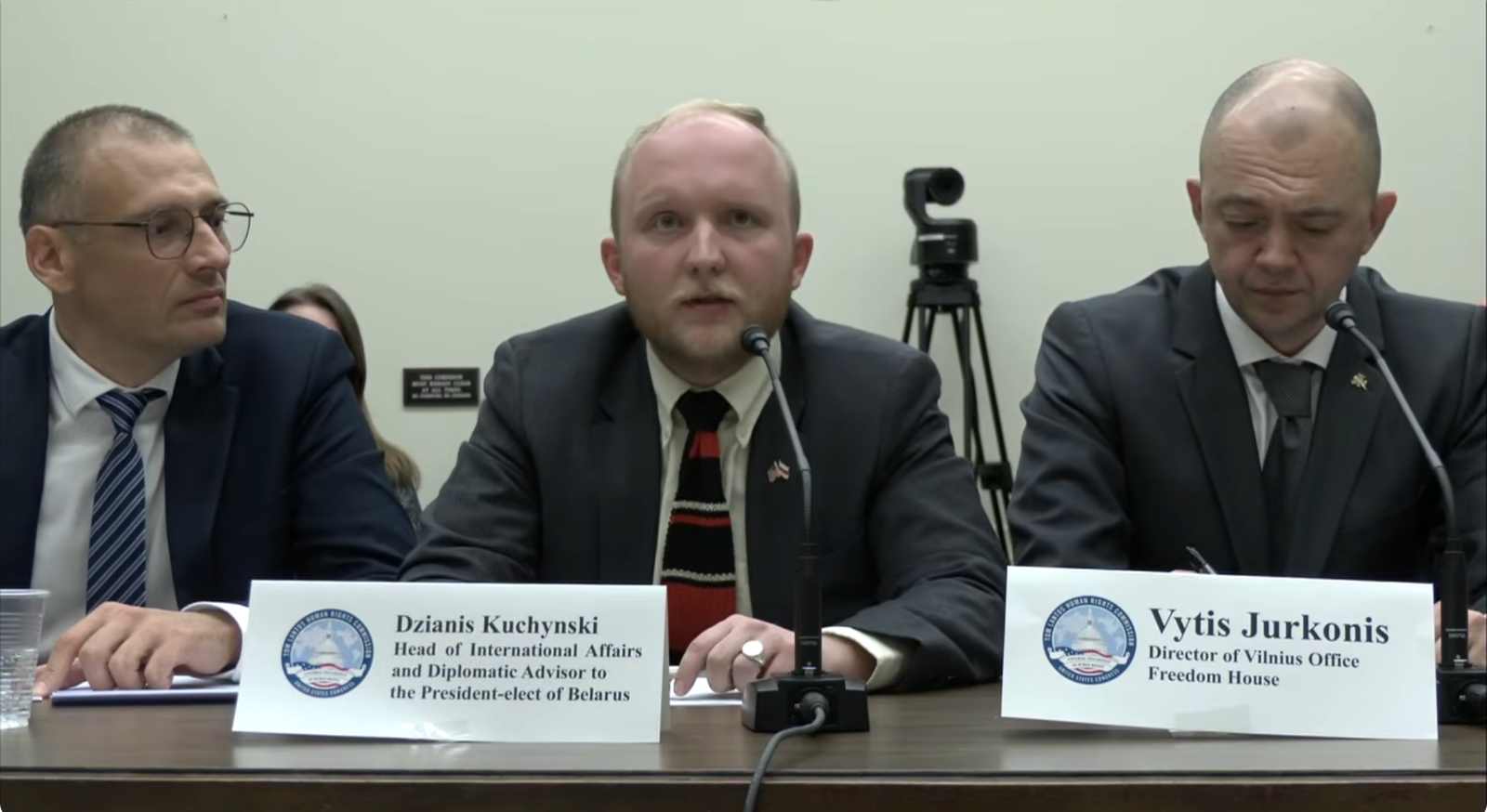




On February 3, Sviatlana Tsikhanouskaya’s Diplomatic Advisor, Dzianis Kuchynski, addressed a hearing of the US Congress’ Tom Lantos Human Rights Commission. He called for holding a third round of the Strategic Dialogue with the democratic forces of Belarus, as well as for stepping up efforts to secure the release of all political prisoners and to support Belarusian democratic institutions.
The hearing was chaired by Congressman Christopher Smith. Other speakers included Siarhei Tsikhanouski, Freedom House representative Vytis Jurkonis, and international human rights lawyer Jasmine Cameron.
Dzianis Kuchynski:
“Chairman Smith, Co-Chairman McGovern, Members of the Commission,
Thank you for convening this hearing and for your steadfast leadership on Belarus. We are fortunate that support for freedom in my country has remained a bipartisan course in the United States.
I appear before you today as Dzianis Kuchynski, Diplomatic Advisor to Sviatlana Tsikhanouskaya, the democratically elected leader of Belarus.
Today, Belarus remains a country where truth is punished, compassion is criminalized, and freedom is treated as extremism.
Political prisoners are tortured by cold, isolation, and silence. Families are blackmailed. Lawyers are stripped of their licenses for defending the innocent. Journalists are imprisoned for reporting facts. Clergy are arrested for public prayers. Workers, teachers, doctors, and students are forced to choose between obedience and exile.
And yet Belarus is not only a domestic tragedy. The Lukashenka regime has become something even more dangerous: a weapon in Putin’s hands.
It is a platform for Russia’s war against Ukraine. A hub for sanctions evasion. And a launchpad for hybrid attacks against our neighbors. We have seen giant balloons carrying contraband cigarettes across the Lithuanian and Polish borders, orchestrated migration crises, and drones flying into the territory of NATO allies.
Since 2020, more than 65,000 people have been subjected to politically motivated detentions. As of today, at least 1,149 political prisoners remain behind bars. Conditions for political prisoners are worsening, not improving.
Many have recently been placed in ШИЗА — punishment isolation cells with no heating. And during the current temperatures in Belarus, which have reached up to –30°C. It´s a real torture.
And this is not abstract. This is also personal. One of those targeted is Artsiom, the son of Anatol Liabedzka, an advisor to President Tsikhanouskaya and someone well known to the Chairman.
Artsiom is not just a “case.” He is a young man. A son. A father if 7 years old daughter Palina. A life being broken — simply because his family stood for democracy.
Some prisoners are held incommunicado for months or years: Andrei Navitski, Mikalai Bankou, Aliaksandr Frantskevich, and Mikalai Statkevich.
I must speak separately about women political prisoners, because their situation is an emergency within an emergency.
Recently released editor of media outlet Zerkalo, Maryna Zolatava, shared with me the cases of the most vulnerable women who remain behind bars. Her message was urgent and clear: we must focus attention on those imprisoned the longest, those with serious illnesses, and elderly women.
One such case is Iryna Melkher (Мельхер), a 70-year-old woman with severe health issues. And also my university mate, Human rights defender Marfa Rabkova, who has been sentenced to 15 years in prison.
Over the past 18 months, negotiations with direct U.S administration engagement resulted in the release of more than 300 political prisoners.
This is a significant humanitarian and diplomatic achievement by President Trump.
On behalf of Sviatlana Tsikhanouskaya, we deeply appreciate the Administration’s successful work on this humanitarian track.
In particular:
Special Presidential Envoy John Coale, who has done an extraordinary and very difficult job to save our countrymen’s lives.
Our partners at the White House and State Department: Deputy National Security Advisor Andy Baker, Senior Director Charles McLaughlin the Vice President’s senior advisor Spiro Ballas.
And Deputy Assistant Secretary Chris Smith,
And Mr. Chairman, if I may, it truly brings a small smile, even in such dark circumstances, to see the same name carried by the same unwavering commitment to freedom. Belarus is fortunate to have not one, but two champions named Chris Smith—yourself in Congress, and DAS Smith at the State.
I also want to thank the Belarus Affairs Unit, which works through the U.S. Embassy in Vilnius. And, among other things, it helps to coordinate all the logistics of the releases.
I personally participated in all five release groups last year. I saw what freedom looks like after torture. And yet new arrests continue every week. Lukashenka releases some hostages—and then takes new ones. We must continue to work together to stop it.
Dear Members of Congress,
Humanitarian work does not end when prison gates open. We need to keep helping our heroes to restore their lives after their release. That is why we need sustained support for trusted partners, including Freedom House’s and the National Endowment for Democracy emergency assistance programs, which play crucial roles in supporting victims of repression and other partners, such as IRI and NDI, that help sustain our civil society.
We also express deep gratitude to Poland and Lithuania for hosting released prisoners and providing them with a new life.
Dear members of the commission,
Allow me also to share some recommendations the Administration and Congress can take:
First, continue and intensify efforts to secure the release of all prisoners and prevent Lukashenka from taking new hostages, and stopping of transnational repressions.
Second, expand emergency humanitarian assistance — medical care, rehabilitation, and relocation.
Third, sustain strong support for Belarusian democratic institutions—the Office of Sviatlana Tsikhanouskaya, the United Transitional Cabinet, and the Coordination Council.
Fourth, maintain pressure through sanctions and leverage, with clear guardrails: any relief must be tied to real, verifiable improvements in Belarus.
Fifth, we strongly welcome the Belarus Democracy, Human Rights, and Sovereignty Act of 2025. This legislation is a critical step toward reauthorizing and strengthening America’s commitment to free Belarus.
And finally, it is essential that the United States continue the Belarus–U.S. Strategic Dialogue with democratic forces.
Dear Members of the Commission,
Lukashenka wants the world to believe the situation in Belarus is calming down. In reality, repression has only been intensified. We must continue to act decisively to save lives whenever possible.
And the U.S. track DOES save lives. Meanwhile, the European track with strong sanctions remains a crucial safeguard to save the country. This balance must remain coordinated.
And when pressure and strength create openings, it must be used—both to secure releases and to advance irreversible change. We believe that a free and sovereign Belarus is within the national interests of the United States. It would mean fewer risks to NATO’s eastern flank and less space for authoritarian and anti-American influence. It would also mean one more predictable trade partner and a place for American investments
We look forward to continued partnership until every political prisoner is free, repression ends, and Belarus returns to democracy.
Thank you for standing with the Belarusian people.
Long Live Belarus!
God Bless These United States of America!”