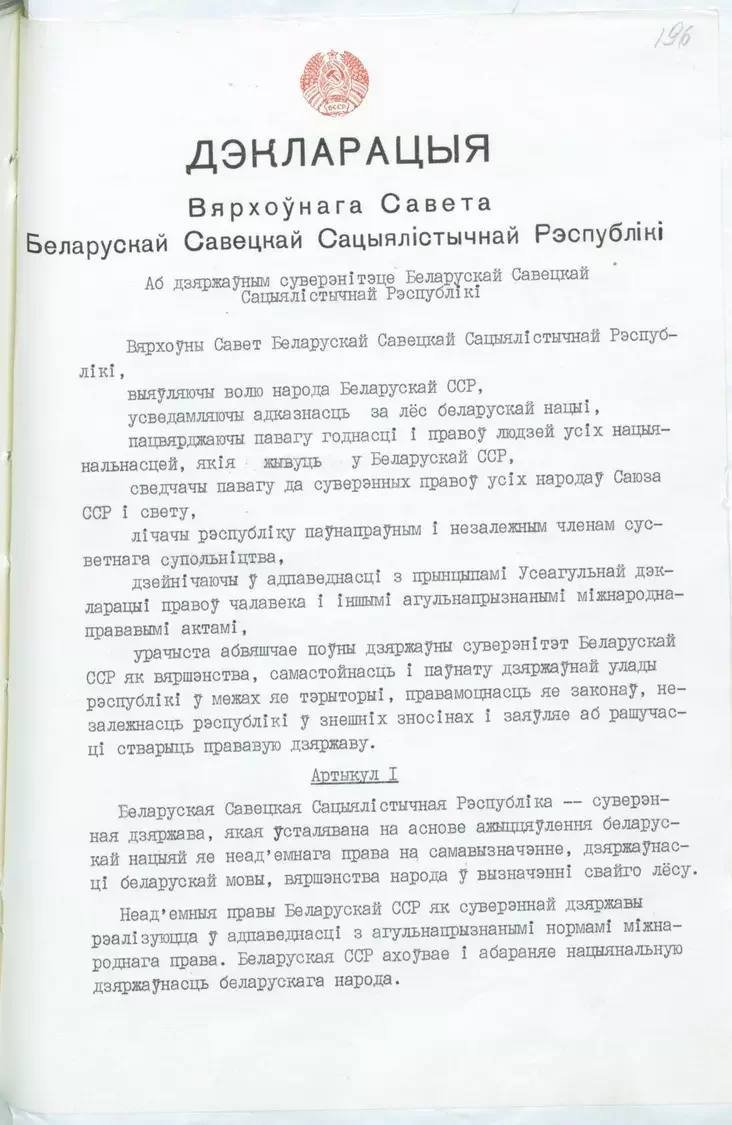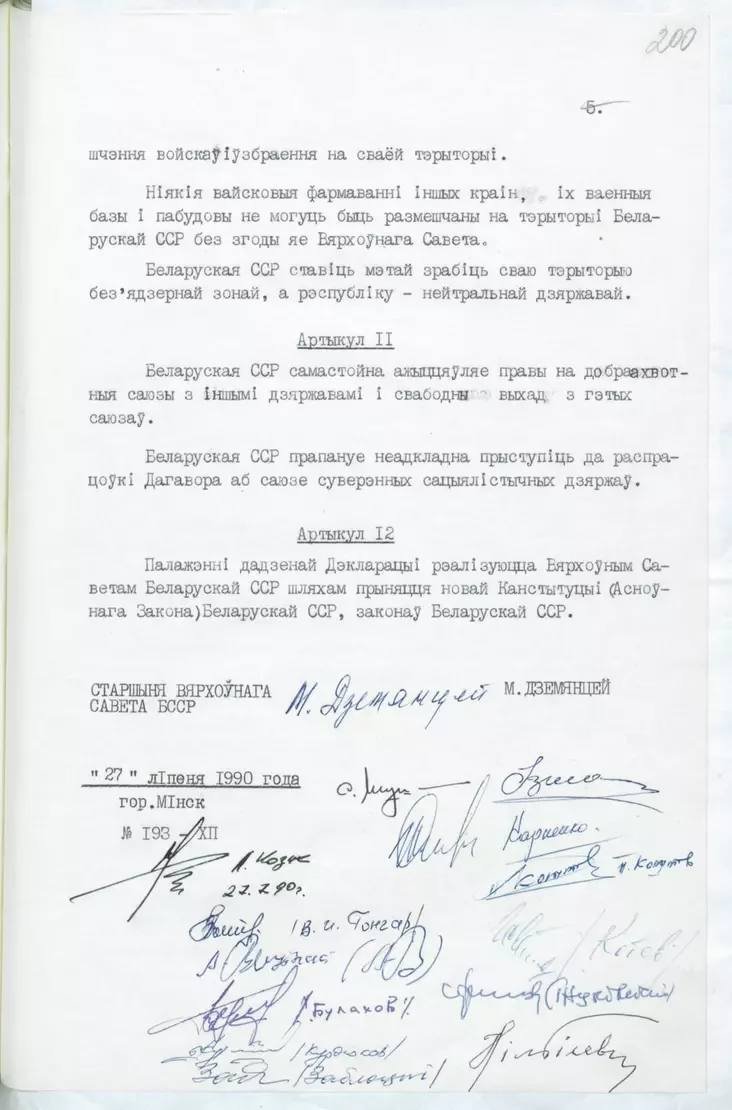




Pavel Tereshkovich’s: “On July 27, 1990, 229 members of the Supreme Soviet of the Belarusian SSR approved the Declaration of State Sovereignty. It became a major milestone in the chain of dramatic events that led to the collapse of the Soviet Union and opened the way for our country’s independence.
The USSR, established in 1922, proved incapable of surviving under the conditions of glasnost proclaimed by Mikhail Gorbachev — that is, without violence and coercion. The constitutional provision granting union republics the right to leave the USSR was no longer just a symbolic clause on paper. The Estonians were the first to invoke it, declaring their sovereignty on November 28, 1988. They were followed by the Latvians, Lithuanians, and Azerbaijanis. In the spring of 1990, the Baltic nations went further and declared their withdrawal from the Soviet Union.
There were also people in Belarus who understood that the Soviet empire was approaching its end. In April 1990, the country held its first relatively democratic parliamentary elections. The majority of seats went to representatives of the Communist Party nomenklatura — factory directors and collective farm managers who had been shaped by a system of near-military discipline. At the same time, opposition leaders, primarily from the Belarusian Popular Front, also entered parliament. They made up no more than about 10 percent of the members. During the first parliamentary session in May, they presented a draft Declaration of Independence. The Communist majority dismissed them as lunatics.
However, the situation changed dramatically in June. The turning point came from an unexpected direction: the Russian Federation declared its own sovereignty. Boris Yeltsin did so in an attempt to limit Mikhail Gorbachev’s power. In response, Gorbachev sought to “reassemble” the Soviet Union by negotiating a new Union Treaty that he intended to lead. To that end, all republics that had not yet done so were instructed to declare their sovereignty. The Communist majority in the Belarusian parliament had little choice but to comply.
Even so, drafting the declaration was far from straightforward. Many members of the Communist majority wanted to turn it into an empty document — or to derail the entire idea altogether. Debates continued until the very last day of the parliamentary session, raising the risk that the declaration would never be adopted. The democratic opposition realized that whatever amendments they proposed, the majority would reject them anyway. During the final vote, they left the chamber. “If that’s how it is”, the Communists decided, “let’s vote in favor”.
What did the declaration actually say? It proclaimed Belarus’s full state sovereignty, affirmed that sovereignty belonged to the Belarusian people, and declared that the country’s land, natural resources, and mineral wealth belonged to them. It provided for the creation of a national bank and monetary system, established the supremacy of Belarusian laws and the Constitution on the country’s territory, affirmed Belarus’s right to compensation for the damage caused by the Chornobyl disaster, committed the state to ensuring the use of the Belarusian language in all spheres of public life, and declared the country’s intention to become a neutral, non-nuclear state.
Did the Soviet Union collapse because of this? Not immediately. A year later, after the failed August 1991 hardline coup, the same Supreme Soviet granted the Declaration constitutional status. Belarus became independent. On December 8, 1991, following the Belovezh Accords, the Soviet Union ceased to exist as a geopolitical reality.
There is another reason why this history matters today. The “window of opportunity” that many have been discussing in recent weeks may emerge from an entirely unexpected and improbable chain of events. And we must be prepared when it does”.