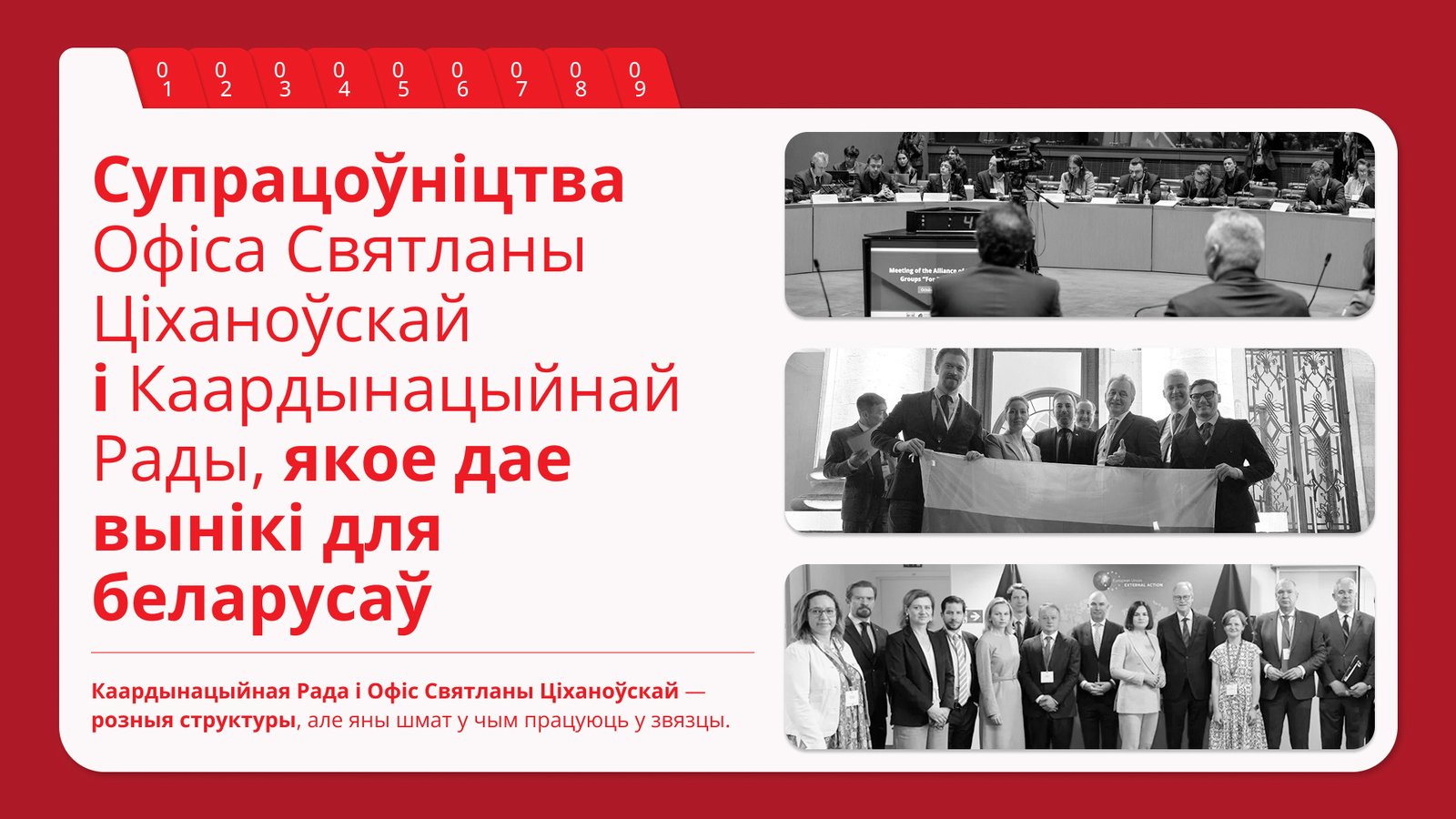




While the Coordination Council and the Office of Sviatlana Tsikhanouskaya are separate bodies, they work closely together in many areas. Here are several examples of how this cooperation delivers practical results for Belarusians.
1. Presence in the Parliamentary Assembly of the Council of Europe
Sviatlana Tsikhanouskaya’s Office initiated and advanced a PACE resolution on Belarus. This helped secure the presence of the democratic forces in the Assembly and led to the creation of the position of Special Rapporteur on Belarus.
The Coordination Council also gained the opportunity to form a delegation to the Congress of Local and Regional Authorities of the Council of Europe.
Result: Representatives of the Coordination Council can promote issues important to Belarusians in PACE and work with parliamentarians, politicians, and officials from more than 46 countries.
2. Ongoing dialogue between Sviatlana Tsikhanouskaya’s Office and the Coordination Council
Representatives of Sviatlana Tsikhanouskaya’s Office take part in Coordination Council hearings, meet with factions, and cooperate with committees. Sviatlana Tsikhanouskaya has also repeatedly addressed the Council and answered questions from delegates.
Result: Positions across democratic structures are better aligned, and joint work becomes more coordinated and effective.
3. Work on laws and reforms for a New Belarus
One of the Office’s strategic priorities is preparing reforms and legislation for a future democratic Belarus. A draft Constitution and a package of legislative proposals have already been developed.
Some of these initiatives have been discussed within the Coordination Council.
Result: The Council is gradually moving toward the role of a proto-parliament through practical work on future reforms.
4. Representation in the EuroNest Parliamentary Assembly
The Office secured the unfreezing of 10 seats for the democratic forces in the EuroNest Parliamentary Assembly. Work is ongoing to obtain observer status.
Result: Representatives of the Coordination Council can regularly engage with the European Parliament and national parliaments of five countries.
5. Luxembourg Solutions on engagement with Belarusians in exile
Sviatlana Tsikhanouskaya’s Office co-authored a PACE resolution on Belarusians in exile and co-organized the Luxembourg Conference. This led to the adoption of the Luxembourg Solutions — recommendations for parliaments and international parliamentary bodies on engaging with Belarusian communities in exile.
Result: The Coordination Council received a ready framework for systematic work with parliaments and MPs on issues affecting Belarusians abroad.
6. Presence in the OSCE Parliamentary Assembly
At the initiative of Sviatlana Tsikhanouskaya’s Office, a process was launched to form the “For a Democratic Belarus” Group within the OSCE PA. Efforts are also underway to ensure representation of the democratic forces in the Assembly.
Result: The Coordination Council can directly engage in an international parliamentary body and counterbalance the presence of deputies appointed by the Lukashenka regime.
7. “For a Democratic Belarus” Alliance
The International Alliance of Parliamentary Groups “For a Democratic Belarus” has become a broad international coalition supporting Belarus, bringing together 25 parliaments and international organizations.
Result: The Coordination Council gains additional opportunities to work directly with national parliaments and develop bilateral ties.
8. Engagement with the EU and other countries
Representatives of the Coordination Council participate in meetings of the Belarus–EU Consultative Group and in strategic consultations with other countries.
Result: The Council can directly raise practical issues affecting Belarusians with executive authorities and seek solutions.
9. Why this cooperation matters
The Office of Sviatlana Tsikhanouskaya opens international opportunities and advances political decisions. The Coordination Council uses these opportunities as a representative body acting on behalf of Belarusians.
Result: This cooperation helps the democratic forces act more cohesively, better represent the interests of Belarusians, and gradually strengthen the Coordination Council as a functioning proto-parliament.