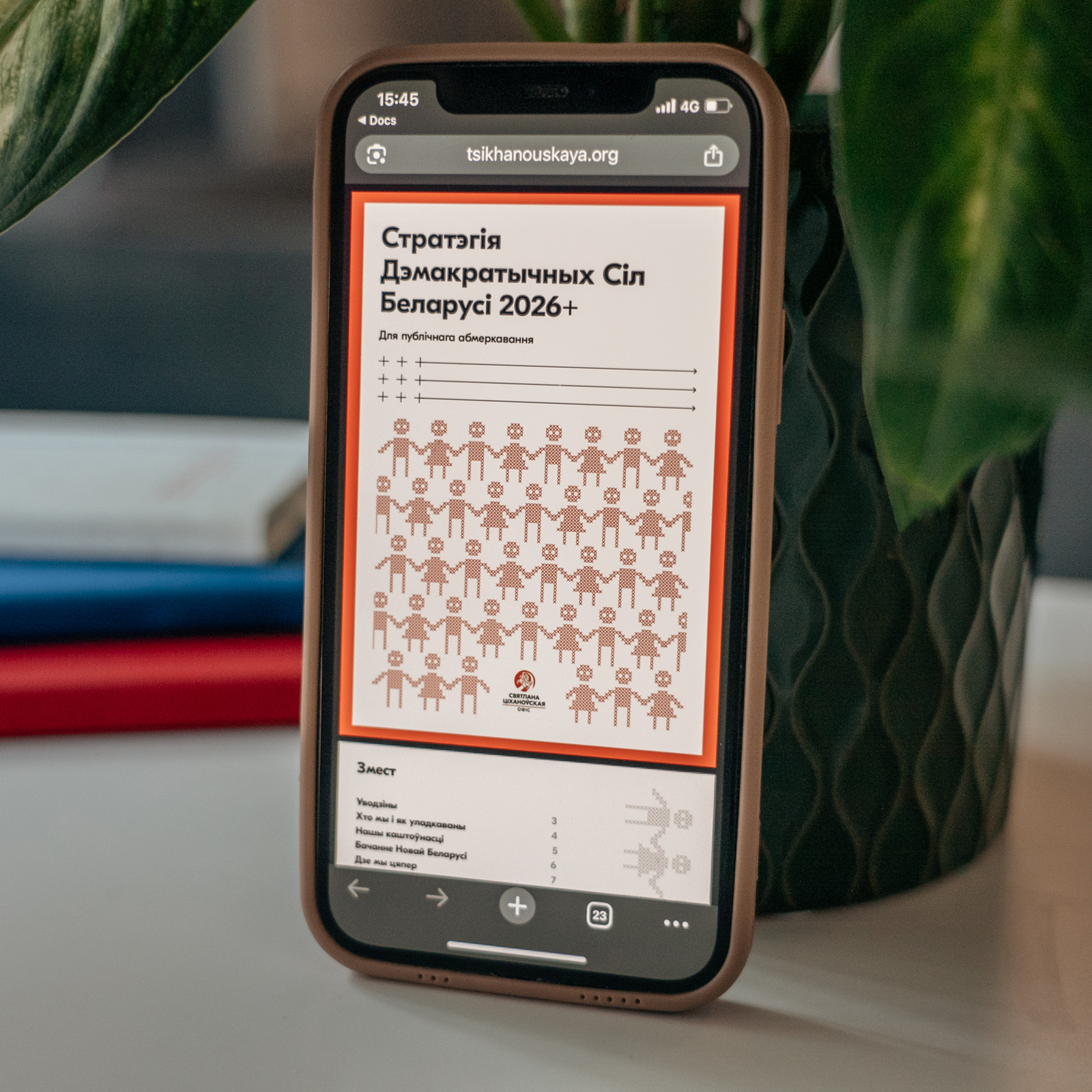

The strategy outlines the current situation, describes possible scenarios of change, and formulates six strategic goals. It serves as a practical guideline, showing everyone how they can contribute to democratic transformation.
2026+ Strategy of the Democratic Forces of Belarus
2026+ Strategy of the Democratic Forces of Belarus is a document submitted for public discussion that defines the common course toward a free and democratic Belarus. It brings together the efforts of various actors and proposes a clear framework for immediate action.
The strategy outlines the current situation, describes possible scenarios of change, and formulates six strategic goals. It serves as a practical guideline, showing everyone how they can contribute to democratic transformation.
Review the 2026+ Strategy of the Democratic Forces of Belarus
2026+ Strategy of the Democratic Forces of Belarus
2026+ Strategy of the Democratic Forces of Belarus is a document submitted for public discussion that defines the common course toward a free and democratic Belarus. It brings together the efforts of various actors and proposes a clear framework for immediate action.
Review the 2026+ Strategy of the Democratic Forces of Belarus
Q&A
-
This strategy is for everyone who wants a free and democratic Belarus but does not always understand their place in the common effort. Its purpose is to outline the overall direction and help each person see that even if you are not a politician or an activist, you can still play a meaningful role in change.
-
Change rarely follows a single pre-written scenario. A transition may begin through negotiations, mass mobilization, internal splits within the system, or external pressure — more often through a combination of factors. That is why it is important not to rely on just one option, so as not to be unprepared if events unfold differently.
-
The strategy sets a general direction and goals, not a rigid scenario that may fail in real life. Simply put, it is not “we know exactly how it will happen” but “we are ready to act under different circumstances”. This helps avoid debates about which scenario is more likely and instead prepares for different developments in advance.
-
The strategy is not a step-by-step instruction but a general framework. It answers the question, “Where are we going and how?” not “Who does what on Monday morning?” In the current conditions, a highly detailed public plan would either quickly become outdated or create risks for people inside the country.
-
Therefore, the strategy defines the overall logic and priorities, while specific actions, campaigns, and steps are developed by individual teams. In simple terms, it is a shared reference point that different actors can use to build their own plans. To understand the full logic and chosen directions, it is best to read the strategy itself.
-
Because the strategy is based on reality. Rapid change is possible, but it cannot simply be declared by the democratic forces. Repression continues inside the country, society is tired and more cautious, and Belarus is becoming increasingly dependent on Russia.
-
This requires resilience: preserving people, connections, structures, and ready solutions. If a window of opportunity opens quickly, it is important to be ready today. If the transition takes longer, it is important not to burn out and to maintain the ability to act.
-
Because the window for change is usually short, while expectations are very high. Without ready solutions, time is lost: basic issues are debated, frustration grows, and old practices quickly return. That is why key draft laws and decisions must be prepared in advance — so that when change comes, reforms can be launched immediately, not just discussed.
-
It is also a matter of trust. When people understand in advance what will change and how it will affect their lives, change becomes less frightening and easier to support.
-
They should not take it on faith. Trust will not come from a well-written text but from how it is implemented: whether goals turn into actions, whether reporting is clear, whether mistakes are acknowledged, and whether the strategy is adjusted when something does not work. In short, this document should not be believed blindly — it should be judged by results.
-
Responsibility does not lie with a single structure or person but with the democratic forces as a network. The purpose of the strategy is to ensure that different parts of the movement have clear roles, shared goals, and the ability to align actions with outcomes. Responsibility is distributed, but not diluted: each actor is accountable for their part, and the overall result depends on coordination.
-
It is important to find your own role. For some, it is helping victims, donating, participating in diaspora initiatives, or supporting independent media. For others, it may be conversations with loved ones, promoting Belarusian culture, volunteering, offering professional support, or simply maintaining connections and solidarity. The essence of the strategy lies in many small actions that together build resilience. Even a small contribution matters.
-
The goal of public discussion is to make the strategy clearer, more honest, and more useful for those who can already rely on it. The document will be refined based on feedback: if people point out weaknesses, unclear wording, or missing topics, it will help make the strategy more practical and responsive.
Мы предлагаем вам обсудить эту стратегию вместе:
Перейти к обсуждению →