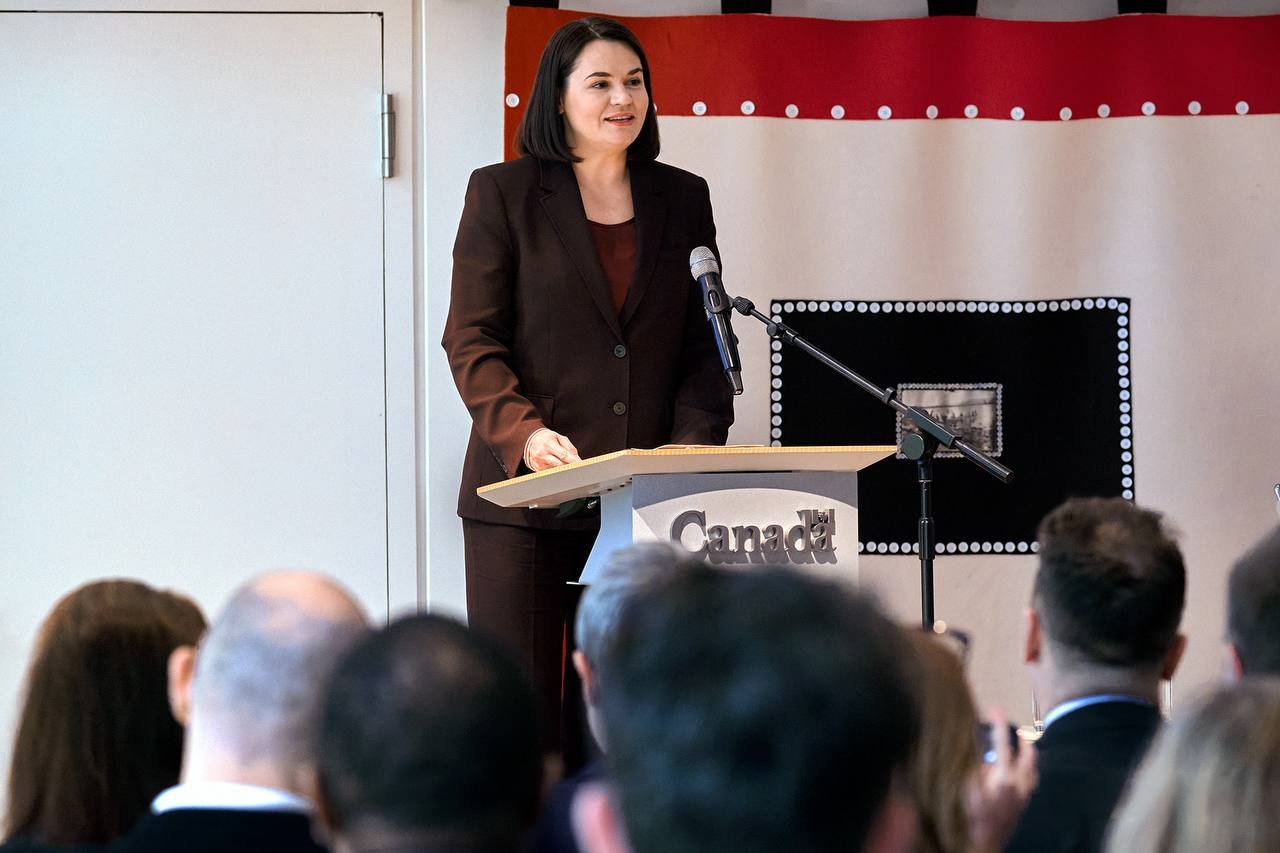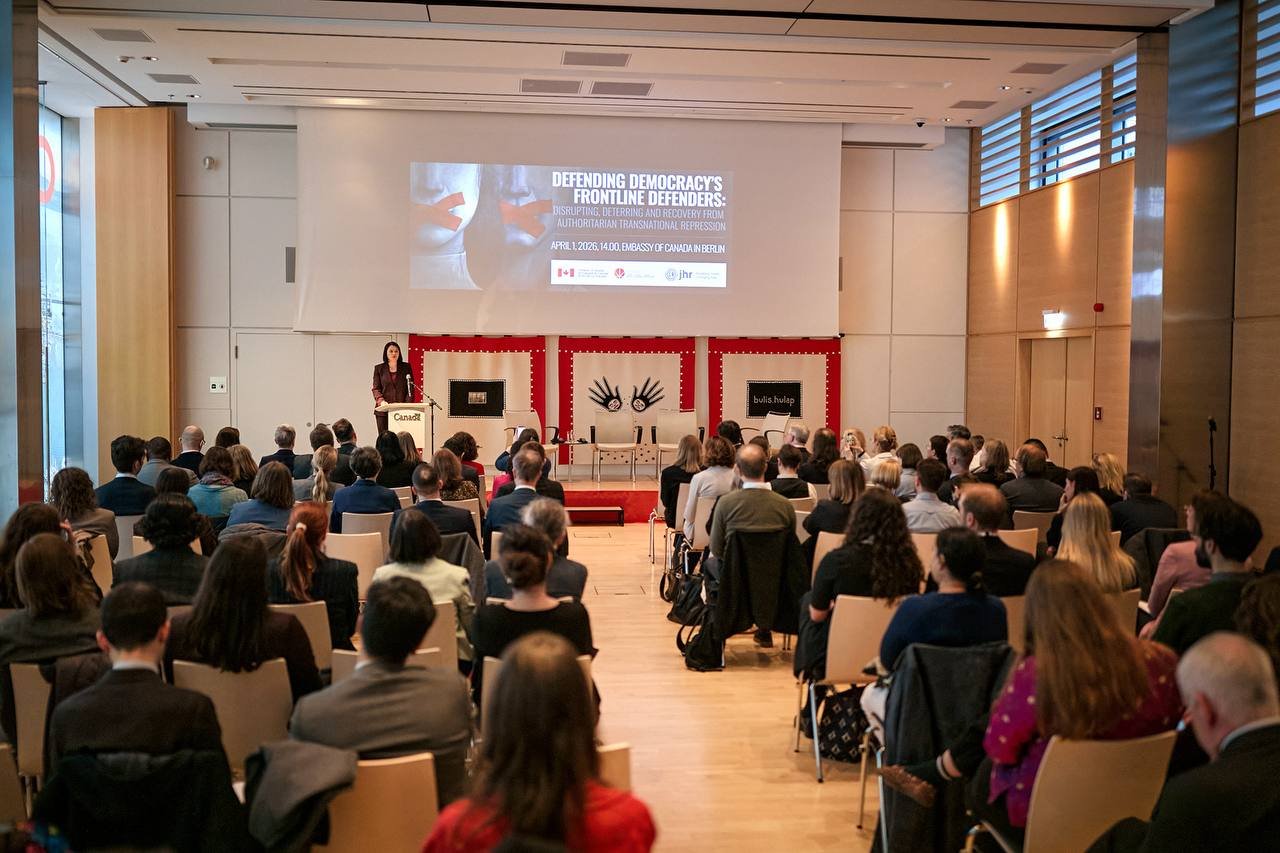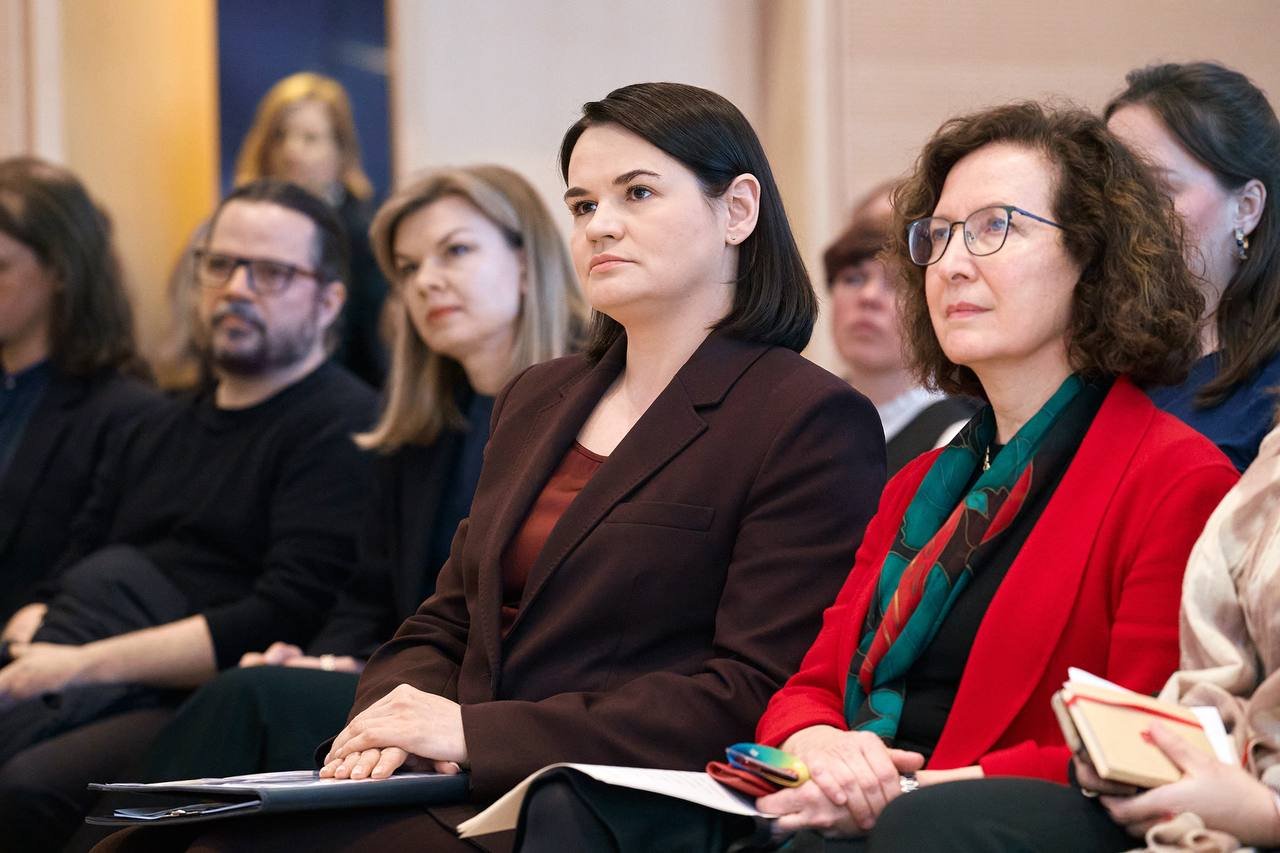




Today, Sviatlana Tsikhanouskaya is on a working visit to Berlin, where an international discussion took place titled “Defending Democracy’s Frontline Defenders: Disrupting, Deterring, and Recovery from Authoritarian Transnational Repression”. The event brought together diplomats, representatives of global media, and think tanks.
The meeting aimed to:
- develop practical policy recommendations;
- strengthen cooperation between policymakers, civil society, and the media;
- form a common approach to countering transnational repression.
Sviatlana Tsikhanouskaya spoke on transnational repression at a discussion organised by the Embassy of Canada to Germany | Ambassade du Canada en Allemagne and Journalists for Human Rights (JHR):
“Your excellency ambassador,
Dear excellencies, and dear German friends,
I’m happy to be in Berlin again. This city knows well from its own history, how precious freedom is. How easy it is to lose it, and how hard it is to get it back.
Just a few hundred meters from here, there was the Berlin wall, which separated the free world from tyranny for decades. No one believed it would collapse, but it happened when no one expected.
Yes, dictatorships often seem invincible until they suddenly collapse. It was in Berlin, USSR, recently Syria. We also see what’s happening now in Venezuela, or Iran.
Yes, dictatorships are becoming smarter, more advanced, but we must become better too, learn from the past, but also learn from each other.
Germany passed its own path to freedom, and now it’s helping those who fight for their own. Since 2020, the German Government and Bundestag – are our staunchest allies and supporters. They opened the Belarus service of Deutsche Welle. Created a Bundestag group “For democratic Belarus”, and dozens of Bundestag members adopted Belarusian political prisoners via the Libereco program. Germany has provided thousands of Belarusians with legalization, received our refugees, doctors, students. Recently, Germany kindly received Masha Kalesnikava and Viktar Babaryka – our political prisoners, released recently from Lukashenka’s Gulag, and here I want to praise the work of the German MFA in particular.
Your country is one of the leaders in issuing Schengen visas to Belarusians, and you clearly distinguish Belarusian people and the regime, and Belarus from Russia.
No matter who is in power – Germany stands firm for human rights, for democracy, for freedom of speech. And it understands that the Belarus case is not isolated, it’s also a German interest to have Belarus free, democratic and European.
I wish to name all friends and partners, such as Konrad Adenauer Stiftung, Ebert, Nauman, Hanns-Seidel (CSU), and Rosa-Luxemburg foundations – for all the projects we implemented together in last years. I am glad that the Belarus topic unites all parties across the political spectrum.
I am so glad that today’s event takes place in the Canadian Embassy, and I want to personally thank her excellency Vera Alexander for bringing us here.
You know that Canada plays a special role in our fight, and it has a special place in my heart too. Since 2020, Canada has provided support to hundreds of Belarusian initiatives and media.
We may have thousands of kilometers between our countries, but we share the same values.
One of the most brilliant projects Canada has, is the program supporting independent journalists – Journalists for Human Rights. And recently, you launched a special program for bloggers just released from prisons. It’s a brilliant example of flexibility, and of a quick reaction that we need so often. Your assistance will help many people to stand back on their own feet and return to life after years of isolation.
And it wouldn’t happen without amazing Marcus, Marcus Kolga who became a driving force of many Canadian projects for Belarus. Thank you, Marcus.
The topic of transnational repression you work on right now, should become a focus for the international community. We must bring it to the United Nations Security Council, but also to the UN General Assembly. I hope that this discussion today will be a good starting point for that.
Dear friends,
We often think of dictatorship as something from the past. But today, it is no longer just about batons and prisons.
It is about control. About surveillance. About digital totalitarianism.
Its goal is simple: to silence dissent, to break human dignity, and to take away people’s will, hope, and ability to change anything.
These regimes have no limits. They do not follow international rules. They are becoming more sophisticated, using technologies created in democratic societies to strengthen their own power.
In the past, repression was mostly limited to within a country. But today, even abroad, you cannot feel safe anymore. Dictatorships have learned to pursue their opponents wherever they are.
Allow me to begin with my own story. In 2020, after we won the elections, I was blackmailed by KGB agents: they told me if I didn’t leave the country, I’d never see my children again. After that, I was forced to leave Belarus.
I felt down. Kicked out of my home. Frankly, being a winner of the presidential election didn’t help much. My husband Siarhei was in jail, I was alone with my children. I lost everything but my bare life and my faith in our people – and our victory.
After I assumed my responsibility as a leader and dared to raise my voice for our people, who were protesting in the streets of Belarus, the regime decided to punish me.
A criminal case against me was opened. I was sentenced in absentia to 15 years in jail. I couldn’t defend myself in court. Today, if I decided to go home, I would be arrested right on the border.
This is not only my personal story. It’s a story of thousands of those who voted for me and left the country fleeing political persecution. And also of those who were forcefully deported from Belarus.
In the Cold War era, the Soviet regime tried to keep people in the country. Those trying to run, and jump over the wall, were harshly punished. Now it has changed. The regime itself is trying to push everyone, who are not loyal enough, out of the country.
Even released political prisoners, formally pardoned by the regime, are forced to leave. During last year, hundreds of people were freed as a result of American diplomatic efforts, but many of them were forcibly deported from the country.
Even releasing people, the regime tries to make their lives miserable. Those, who were allowed to stay, still can’t enjoy full freedom. They are limited in rights, and remain under thorough police “supervision”, can’t find a job, or even open a bank account.
And those who were deported – are deprived of passports, documents. Rendered de facto stateless. And it’s crucial that Poland, Lithuania, and Germany to provide them with residence permits and foreigners’ passports.
One of released prisoners, Illya Dubski, found out two days ago that his Belarusian passport was voided. It was cancelled by the authorities a year before expiration, without letting him know. Now, Ilya can’t return to Belarus nor travel to other countries.
At least 16 former prisoners, like Viachaslau Lazarau or Dzmitry Kazlou, have the same problem.
A recently released blogger Eduard Palchys is among them. He told me when we met this Monday: “It is a strange feeling, to be an international bum in the digital age.” Two weeks ago, Eduard saw his five years old for the first time only after his release.
Lawyers call such people “de facto stateless”. And yes, it’s a form of transnational repression.
It’s a problem not only for the former prisoners, but for all Belarusians who fled the country after 2020 escaping the persecution.
The regime canceled consular services to Belarusian citizens abroad. To renew their passports, they have to return to Belarus, which, for most of them, is impossible – they will simply land in jail.
Some venture to do it because of their family situation: to see their elderly parents. Unfortunately, many simply underestimate the danger. IT-specialist Siarhei Salazhencau, or journalist Pavel Dabravolski were arrested after they returned to Belarus, and have been sentenced to long years in prison.
Very often people are arrested right on the border. There are hundreds of such cases. The police are checking people’s phones. When they find something suspicious, like independent media channels, they arrest you on the spot.
Many people went back because they believed Lukashenka’s so-called “Return commission”. This was the case of Tatsiana Kurylina or Ihar Nemirovich. Despite their “repentance”, they were arrested, tried and sentenced. Tatsiana was released and deported to Ukraine in December last year. Ihar is still in jail, serving his 3 years sentence.
Many Belarusians face a dilemma: go back to Belarus and end up in jail, or stay abroad and become “international bums”. Most choose the second option, but their legalization process in some countries is quite slow and not always successful.
This is why we came up with the idea of the New Belarusian passport – or the passport of the New Belarus. The regime refused to issue documents – so we can. To prove identity and return people their rights.
Last year, we finally started issuing these passports, and 700 people received them already. It’s a digital ID document, meeting ICAO standards. It’s not a travel document yet. And we understand that recognition of this document will be a long process. But we know cases, when it helped people to legalize.
It’s not the first time in history: during the Soviet occupation the Baltic governments in exile also issued their own documents. But it’s the first time that such documents meet modern international standards.
Otherwise, we ask the government to issue documents, like foreigners passports in Poland, Lithuania, or Germany, allowing people to travel.
Even when you are abroad, but your relatives are home – they still can become regime’s hostages.
Last year, on August 9, we held a huge rally of solidarity in Warsaw. Lisa, a Belarusian student in Poland, was there. Two days later, Lukashenka’s police came to her elderly parents in Belarus. They interrogated them, searched their flat. Went through their phones, downloaded info and contacts.
A criminal case against Lisa was opened. What for? Just for taking part in the rally. They identified her on a video on the internet. As part of the investigation, the regime confiscated her grandparents’ village house.
This is what lawyers call “coercion by proxy”. This story is true, although the name is not. Many people are afraid to use their real names, in order to not appear in the media. Lisa doesn’t want her family to have more troubles. There are hundreds of stories like this.
Another kind of transnational repression is through abusing international mechanisms and agencies, such as Interpol.
Lukashenka’s police create fake profiles of political activists, charging them with made-up non-political crimes, like drug dealing or tax evasion, etc. After that they demand their extradition to Belarus from third countries.
One of the most known cases of extradition was that of a Belarusian veteran, former volunteer fighting for Ukraine – Vasil Verameichyk.
Vasil is a professional military officer. In 2020, together with hundreds of thousands of Belarusians, he took part in our peaceful protests, and was arrested several times. When the Russian invasion of Ukraine started, Vasil didn’ think twice: he volunteered to the first Belarusian regiment. He fought in many battles, saw many of his comrades die, and survived almost by miracle.
Last year, in Vietnam, he was identified by KGB agents, arrested by the Vietnamese police and extradited to Belarus. Where he was beaten, tortured and forced to make a confession video. In February this year, for allegedly “attacking a police officer” in 2020, he was sentenced to 13 years of prison.
Vasil’s mistake became a tragedy for him and his family. And a huge loss for our democratic movement.
This tragedy must not repeat. Belarusian citizens must not be extradited to Belarus, where they will face revenge of the dictator.
With this in mind, we created a special website pashpart.org, where we have a map of safe, relatively safe and dangerous countries for Belarusian activists.
Besides, my legal team managed to solve dozens of cases of unlawful extradition of Belarusians from third countries. One of the most well known was the case of Belarusian film director and political activist Andrey Hniot: he was held in Serbia under home arrest for half a year, waiting to be extradited to Belarusian prison. Finally, we managed to get him to safety.
We also work with the Interpol, trying to explain that Belarus is a country with no independent judicial system. Justice is used only as an instrument of revenge against the activists.
As you could see from my own story, there’s a large spectrum of methods of transnational repression. Trials in absentia, seizure of property, arrests of relatives, basically to hold them hostages. This is the case of my advisor Anatol Liabedzka, whose son Artsiom is behind bars. Or of Viktar Babaryka, whose son Eduard remains in prison.
Very often, the regime acts against its opponents without even a shadow of legality.
I’ll set apart and entirely skip the cybercrimes, such as attempts to hack personal accounts, which happen daily.
Besides that, almost all members of my team, of UTC and Coordination Council, were
-offered cooperation with the KGB,
-blackmailed with persecuting their relatives in Belarus, or
-received death threats – all that through social media accounts run by KGB or other repressive organs.
There was an attempt to physically attack the deputy head of the UTC Pavel Latushka.
I guess that you all heard or read about Stasi’s methods. The Belarusian KGB is clearly inspired by its Soviet and East German predecessors.
The fact that we live in exile under international protection doesn’t mean that we are safe.
Kidnappings and violent disappearances were used by Lukashenka in the 90s inside Belarus. But after 2020 this crime also became transnational.
A year ago, the speaker of the Coordination Council. Anzhalika Melnikava has disappeared, and we still don’t know her whereabouts.
What happened to Anatol Kotau, the former diplomat and opposition politician? While visiting Turkey last year, he disappeared. Reportedly, he was brought by yacht to Russian territorial waters. Where is he now? We have no clear answers.
Transnational repression concerns hundreds of Belarusians, not only politicians.
One of the illegal methods the regime uses is a simple fraud. To reach their goals, Lukashenka’s agents look for people in difficult life situations.
The KGB officials often pose as news agencies or journalists to hire people online – Belarusians, but also Ukrainians, – to make footage of our public events: demonstrations, meetings, lectures.
Last week, mass celebrations of Belarus Freedom Day took place all over the world. After the rally in Vilnius, Lukashenka’s propaganda showed footage of Belarusians who took part in the rally. The propagandist Raman Pratasevich openly threatened them, telling them they should, quote, “tremble in fear”, unquote. Such videos are later used by the police for face recognition and further persecution of activists.
Lukashenka’s agents also hire people to stage provocations against Belarusians in Lithuania and Poland – just like they are used to in Belarus.
I would like you to pay attention to one particular detail. People who escaped dictatorship, who served prison terms, who passed through torture, very often suffer from traumas and other psychological and existential challenges. And the weak are always the easiest prey for predators.
This is why I call our international partners: keep supporting our refugees, our civil society, human rights organizations, political prisoners and independent media. By making our community strong, we counter Lukashenka’s and Putin’s hybrid war against Europe.
The easier the legalization, the better the integration – the less vulnerable Belarusians will be to transnational repressions.
By protecting Belarusians abroad – journalists, activists, asylum seekers and asylum holders – European countries protect themselves from Lukashenka’s agents’ infiltration and influence.
Dear friends,
We must stop transnational repression. And we must continue the pressure on the regimes that continue such practices.
Yes, we see that American diplomacy gave hundreds of people freedom.
Some think that the dictator has been reeducated. But it’s not true. Repression continues. Transnational repression continues. He understands only the language of force.
Of course, we are extremely grateful to Trump’s administration, his special envoy John Coale, Chris Smith from the State department for these efforts. I call it a humanitarian operation led by the United States. .
We see that such an approach brings fruits. And I’m very happy for the released. I want all families to feel the same joy as I had when I met my husband after five years of isolation.
However, it all worked well also thanks to many years of pressure, European and Canadian sanctions as well. Without it, the regime would never have an incentive to free his political opponents. In exchange, the regime received some concessions and some sanctions were relieved.
Unfortunately, such an approach also has limitations. It can also create an incentive for the regime to take even more hostages. So we must make sure that not only people are freed, but no new hostages are being taken.
Let me say it clearly once again:
Repression, including transnational repression, must be stopped. Those responsible must be brought to account. And we, all Belarusians, should get our homes, our rights, our dignity and our country back.
Thank you. Zhyve Belarus!”
Photo: lookby.media