



Dear friends,
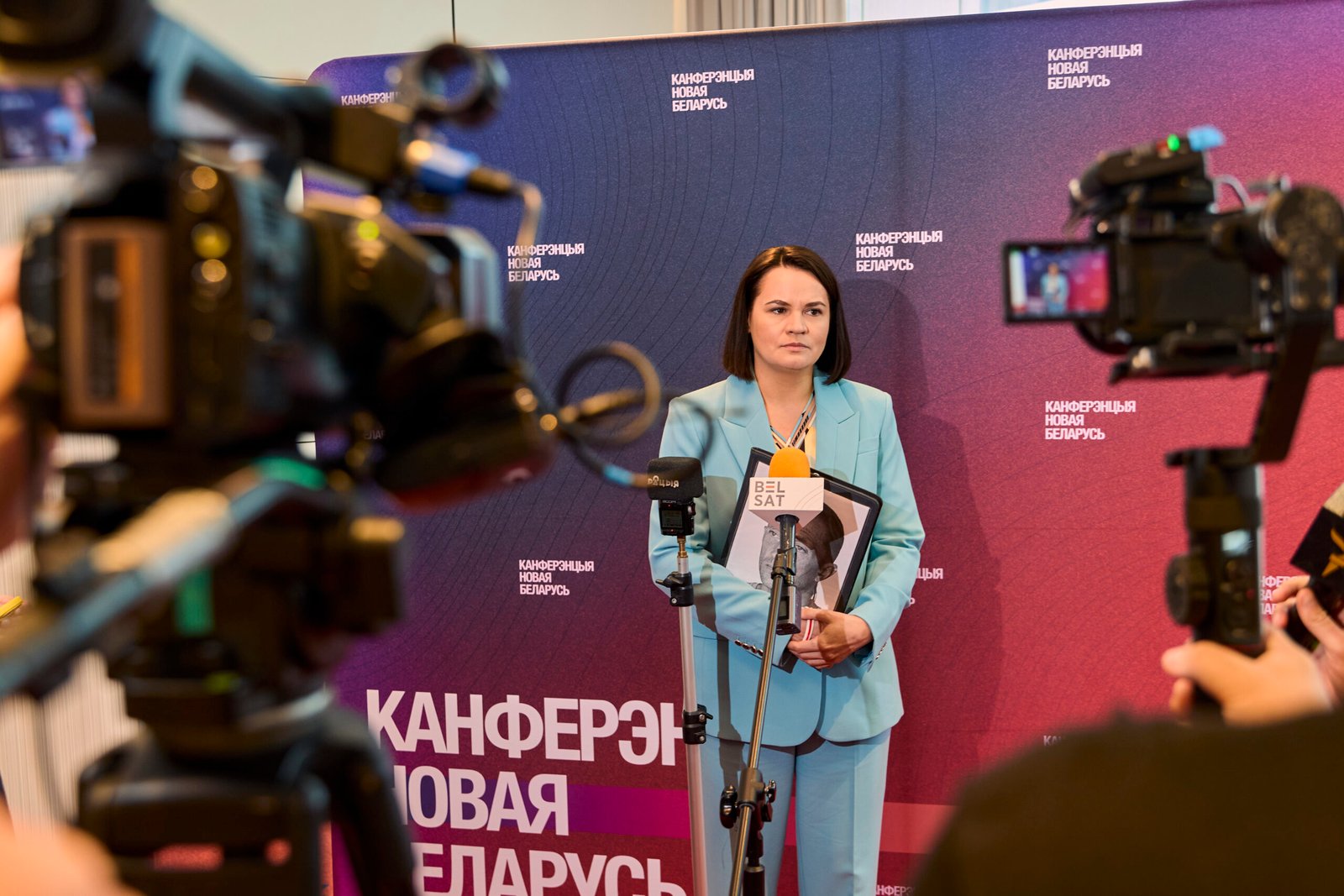
The two days of the conference have flown by. I was very happy to share them with you. And now it is time to reflect on the key outcomes.
Over these two days, we heard from political leaders — people who were behind bars only recently. We heard from representatives of the media and civil society, human rights defenders, journalists, and cultural figures.
We had substantive discussions on our strategy for relations with Ukraine, the economy, culture, education, transnational repression, and how to make use of the window of opportunity when it opens.
Ahead of the conference, we adopted nine resolutions outlining the key positions of Belarus’s democratic forces.
One of the resolutions, “Priorities for Belarus–Ukraine Cooperation”, was prepared in coordination with our Ukrainian partners. The number one priority is, of course, to prevent Belarus from being fully drawn into the war. I hope this document will help us take our cooperation to a new level. Now we need to turn these priorities into concrete projects.
You can find all the resolutions on the website. They were adopted by the Office, the United Transitional Cabinet, the Coordination Council, and the Platform of Political Parties. Overall, I am glad that our cooperation with political parties is improving and that we are maintaining unity on all key issues.
During the conference, several practical tools were presented for Belarusians, including tools to help Belarusians travel safely. Another tool will help civil society organizations share resources.
Updates were presented on the Try Slany Platform, as well as the Prastora Platform. You can already find draft reform projects for the future Belarus there, including laws on lustration and local self-government, as well as a new constitution.
Alisa Ryzhychenka proposed a model for financing democratic structures using digital tokens. Stanislau Salavei presented Raionka, a remote medical assistance system for Belarusians inside the country.
I am truly glad that Viktar Babaryka has returned to public life. He announced his new project, Belarus Network, which aims to help Belarusians solve practical problems independently and build their own communities.
During the conference, we once again emphasized that Belarus’s democratic forces are ready for dialogue. We are continuing the Round Table campaign and sending a message to people within the system: we are ready to talk in order to help Belarus overcome the crisis and preserve our country’s independence.
With yesterday’s discussion, we are launching a new campaign, Post-Lukashenka Belarus. We need to show both Belarusians and our partners what we envision Belarus looking like after the dictatorship. We want to show Belarusians an alternative to Russia.
We are continuing our campaign for a European future for Belarus. As Ales Bialiatski said yesterday, this is not a question of “whether I want it or not”. It is a question of our survival as a nation.
Dzmitry Kruk and BEROC presented a concept for a roadmap for Belarus’s European integration yesterday. It shows, step by step, what needs to be done to put the country firmly on the path toward European integration. It outlines what the European Union can offer Belarus, and what Belarus can offer the European Union.
We are proposing that the European Union create a dedicated instrument to support Belarus’s democratic transition and future European integration.
We ask the European Union to continue supporting human rights defenders, cultural initiatives, democratic structures, and independent media. Our media have not simply survived. Many have grown their audiences. Thanks to them, we can continue communicating with Belarusians inside the country.
At the same time, we will continue working with the United States to secure the release of political prisoners. The process is ongoing, and we expect more releases and are preparing to welcome people back to freedom. We will continue working to end repression and secure a full amnesty so that everyone can return home.
One of my favorite discussions at this conference was the panel on social support. It was perhaps the most practical and the most inclusive. Together, we have managed to build an assistance infrastructure. It is far from perfect. There are never enough resources. But it works. It saves lives. It helps people on both sides of the border.
One example of this work is providing vision treatment for members of the Kastus Kalinouski Regiment in Ukraine.
Dear friends,
Finally, I would like to announce several changes to our structures.
We are strengthening our Ukrainian track. As of today, Volha Zazulinskaya is officially appointed Head of the Democratic Belarus Mission in Kyiv. She will work with Ukrainian authorities, politicians, and local institutions — of course, in close contact with Belarusians in Ukraine, Belarusian volunteer fighters, the Kastus Kalinouski Regiment, and other units. I hope this appointment will also help address very practical issues facing Belarusians, including legal status.
Sviatlana Shatsilina was elected to the Coordination Council and will continue her work there, including on the Ukrainian track.
Yuliya Mitskevich will serve as Acting Representative for Social Policy. In the near future, I hope the Coordination Council will nominate a permanent candidate for this position.
Marharyta Vorykhava has become Chair of the Coordination Council’s International Affairs Commission and has stepped down from her position in the Cabinet. Aliaksei Hrakhouski will now oversee the youth portfolio.
We are also continuing to develop our international work. Soon, we will form new Belarusian democratic delegations to the Parliamentary Assembly of the Council of Europe and the OSCE Parliamentary Assembly.
We will strengthen our missions and representations in Kyiv, Tallinn, Prague, and Brussels. We will continue strategic dialogues with partner countries.
Once again, I want to emphasize: there is enough work for everyone. And I call on everyone who has the strength and the desire to get involved.
Dear friends,
Every year, during the New Belarus Conference, the United Transitional Cabinet recognizes Belarusians and international friends who have made a special contribution to the Belarusian cause. But I know that every one of you in this room deserves an award.
The nominations are put forward by Belarusian civil society organizations and initiatives themselves. So I ask you: if you know someone who deserves such recognition, nominate them.
And now, we can move on to the award ceremony.