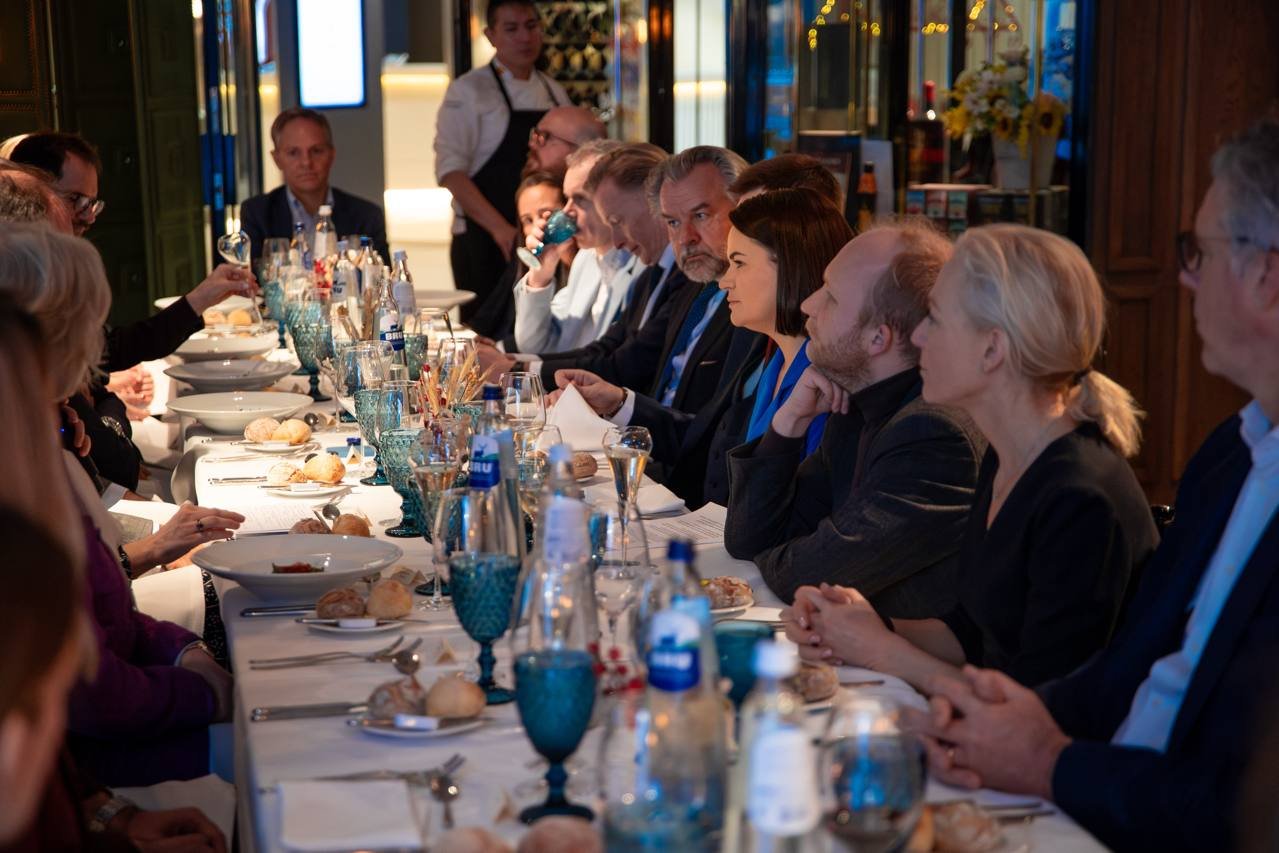




On March 5, Sviatlana Tsikhanouskaya met in Brussels with leaders of major European tech companies and businesses. She was accompanied by her Diplomatic Advisor, Dzianis Kuchynski, and Pavel Liber, who has launched several innovative projects for the Belarusian community. The meeting was organized by MEP Eva Maydell.
Ms. Tsikhanouskaya emphasized that international corporations can play a key role in defending democracy. She noted that Belarus is a country where the past and the future collide: the past represented by a repressive regime clinging to power for thirty years, and the future represented by a modern, innovative, and deeply European nation.
She highlighted that Belarusians have repeatedly demonstrated their talent and capacity for innovation, though they have often had to develop their potential abroad. This trend continues today: many IT specialists and entrepreneurs have left Belarus due to repression. At the same time, companies with Belarusian roots create thousands of jobs, pay taxes, and strengthen the European economy.
Sviatlana Tsikhanouskaya expressed confidence that after democratic change, these people will return home and play a crucial role in rebuilding the economy and bringing Belarus closer to Europe. She added that technology has already been decisive in the democratic movement: it helped document the real victory in the 2020 election, Telegram coordinated protests, Signal ensured secure communication inside and outside Belarus, and YouTube effectively became an alternative to state television.
Ms. Tsikhanouskaya acknowledged the contribution of companies that supported Belarusian journalists and civil society, including Microsoft, which provided free access to its tools, and TikTok, which appointed a dedicated contact for Belarus-related work.
According to Ms. Tsikhanouskaya, the severe degree of repression prevents Belarusians from organizing large-scale street protests. Nevertheless, they persist in their resistance within the information domain. She stated: “Through the use of technology, Belarusians are constructing a parallel state – one that is democratic and free”.
At the same time, she pointed out that the regime uses technology for surveillance of activists, spreading disinformation, and putting pressure on the democratic movement. She urged tech companies to ensure that their tools are not used for repression.
Ms. Tsikhanouskaya also highlighted the problem of Belarusian users being restricted from accessing services and technologies due to sanctions. She warned that such measures primarily harm those Belarusians who oppose the regime.
“Block state institutions, state-owned companies, and propaganda outlets. But leave tools accessible for the Belarusian democratic society. These tools are our weapons in the fight for democracy”, she emphasized.
She also called for supporting content in the Belarusian language on international platforms, noting that the Belarusian language symbolizes the European identity of Belarusians and is an important element of resistance to the “Russian world”.
Ms. Tsikhanouskaya encouraged large private corporations to support humanitarian programs, develop partnerships with civil society and independent media, appoint contact points for Belarusian initiatives, expand grant programs for projects that strengthen democracy, and refuse cooperation with authoritarian regimes.
She expressed hope that Belarusian entrepreneurs and IT specialists currently working in Europe will be able to help transform Belarus into a regional center for innovation and high technology in the future.
“When Belarus becomes free, Europe will also become safer. And I believe we can achieve this only together”, she noted.
Representatives from IKEA, NVIDIA, Vodafone Group, Broadcom, Amazon, IBM, Microsoft, Meta, Airbus, Intel, OpenAI, Nscale, Anthropic, and others attended the meeting.